Analysis of Ultrasonic Waves at a point

Click For Summary

Discussion Overview

The discussion revolves around the theoretical analysis of ultrasonic waves emitted by a system of transducers. Participants explore the mathematical formalism for describing the interference and intensity of these waves at a specific point in space, considering various factors such as wave behavior, intensity patterns, and the effects of distance from the transducers.

Discussion Character

  • Exploratory
  • Technical explanation
  • Mathematical reasoning
  • Debate/contested

Main Points Raised

  • Some participants propose that the displacement generated by each transducer can be described as a function, allowing for the summation of these functions to determine the resultant wave at a point.
  • It is noted that the intensity of the waves decreases with distance from the source and varies with the angle from the axis of the transmitter.
  • One participant suggests using real parts of the wave functions for calculations, while another emphasizes the importance of accounting for directivity patterns of the transducers.
  • A later reply questions the assumption of plane waves, suggesting that the disturbances will be more complex and not necessarily planar.
  • Another participant proposes using spherical waves instead of plane waves, arguing that this approach better accounts for the intensity drop-off with distance and the omnidirectional nature of the waves.

Areas of Agreement / Disagreement

Participants express varying opinions on the assumptions made regarding wave behavior, such as the use of plane versus spherical waves. There is no consensus on the best approach, and multiple competing views remain regarding the mathematical modeling of the ultrasonic waves.

Contextual Notes

Some limitations include the dependence on the assumptions made about wave behavior, the need for accurate modeling of transducer directivity, and the potential impact of reflections from mounting boards on the wave patterns.

Who May Find This Useful

Researchers and students interested in ultrasonic wave analysis, transducer design, and simulation modeling in MATLAB may find this discussion relevant.

CGandC
Messages
326
Reaction score
34
I have a question regarding a theoretical analysis of Ultrasonic waves :

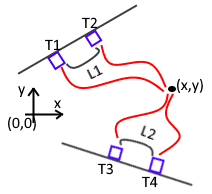
The next picture represents a system of transducers sitting on fixed boards:
upload_2018-5-12_15-58-50.png


Datum:
* there are 4 transducers ( represented by blue color , indexed by letter ' T ' ) , each outputting Ultrasonic wave (represented by red) and sitting on planar surfaces
* 2 transducers are separated with distance L1 from each other
* another 2 transducers are separated with distance L2 from each other

Question:
How can I describe the interference and Intensity of the Ultrasonic waves ( from each transducer ) at a point (x,y) in space? What's the mathematical/theoretical formalism?

Note: I didn't write frequencies/wavelengths/pressure magnitude ,etc. These will be variables ( not necessarily to be found )
 

Attachments

  • upload_2018-5-12_15-58-50.png
    upload_2018-5-12_15-58-50.png
    4.2 KB · Views: 1,198
Physics news on Phys.org
CGandC said:
I have a question regarding a theoretical analysis of Ultrasonic waves :

The next picture represents a system of transducers sitting on fixed boards:
View attachment 225598

Datum:
* there are 4 transducers ( represented by blue color , indexed by letter ' T ' ) , each outputting Ultrasonic wave (represented by red) and sitting on planar surfaces
* 2 transducers are separated with distance L1 from each other
* another 2 transducers are separated with distance L2 from each other

Question:
How can I describe the interference and Intensity of the Ultrasonic waves ( from each transducer ) at a point (x,y) in space? What's the mathematical/theoretical formalism?

Note: I didn't write frequencies/wavelengths/pressure magnitude ,etc. These will be variables ( not necessarily to be found )
Sound waves are linear. If you can describe the displacement generated by each transducer at ##(x,y)## as a function ##f_i(x,y,t)##, then you can just sum up the functions for all of the transducers to get ##\sum_i f_i(x,y,t)##.
 
CGandC said:
How can I describe the interference and Intensity of the Ultrasonic waves ( from each transducer ) at a point (x,y) in space?
As @tnich says, they add linearly, but you need to take several other things into consideration:
  • The intensity of the waves decreases as they move away from the source transmitter
  • The intensity pattern of the transmitters varies with the angle from the axis of the transmitter (the intensity decreases with increasing angle off-axis)
  • Any pickup transducer you use will also have a similar "gain" pattern that falls off with increasing angle off-axis) -- it is difficult to make an isotropic transmitter or receiver for ultrasound.
Can you say more about the application? A typical pattern for Tx and Rx for an ultrasonic transducer is shown below...

http://www.newelectronics.co.uk/article-images/image-library/93/Fig5.jpg

Fig5.jpg
 

Attachments

  • Fig5.jpg
    Fig5.jpg
    42.7 KB · Views: 1,167
  • Like
Likes   Reactions: sophiecentaur
tnich said:
Sound waves are linear. If you can describe the displacement generated by each transducer at ##(x,y)## as a function ##f_i(x,y,t)##, then you can just sum up the functions for all of the transducers to get ##\sum_i f_i(x,y,t)##.
- When you say displacement of the transducer, do you mean the pressure function of each soundwave emitted from a transducer or the velocity potential ϕ of each soundwave?

- If I understood what you said, suppose each soundwave from each transducer has a wavenumber indexed as ## k_i ## in the picture below:
upload_2018-5-12_23-39-50.png


Next, I want to describe the pressure disturbance function ## P(x,y) ## as a result from the superposition of soundwaves emitted from transducers T1 , T2 , T3 and T4 , so i'll suppose the disturbance is a planewave , and in order to describe the planewave easily, i'll create a coordinate axis on each transducer to make the plane equation ( ## \vec{k}*\vec{r} = const ## ) "Nice" to look at :

upload_2018-5-13_0-34-4.png
So, I suppose that the total pressure function that results from the superposition of the pressure function of the transducers T1 , T2 , T3 , T4 is: ## P(x,y) = A_1*e^{(\vec{k_1}*\vec{r'_1}-\omega*t)} + A_2*e^{(\vec{k_2}*\vec{r'_2}-\omega*t)}+A_3*e^{(\vec{k_3}*\vec{r'_3}-\omega*t)}+A_4*e^{(\vec{k_4}*\vec{r'_4}-\omega*t)}
##

Where ## \vec{r'_i} ## is a vector on the planewave relative to i-th coordinate axis. ( there are 4 coordinate axis , 1 for each transducer ).
## A_i ## is a constant
## A_i*e^{(\vec{k_i}*\vec{r'_i}-\omega*t)} ## is the pressure function for the i-th transducer

And I suppose the soundwaves are coherent.

Would you say this analysis is correct?

___

berkeman said:
As @tnich says, they add linearly, but you need to take several other things into consideration:
  • The intensity of the waves decreases as they move away from the source transmitter
  • The intensity pattern of the transmitters varies with the angle from the axis of the transmitter (the intensity decreases with increasing angle off-axis)
  • Any pickup transducer you use will also have a similar "gain" pattern that falls off with increasing angle off-axis) -- it is difficult to make an isotropic transmitter or receiver for ultrasound.
Can you say more about the application? A typical pattern for Tx and Rx for an ultrasonic transducer is shown below...

http://www.newelectronics.co.uk/article-images/image-library/93/Fig5.jpg

View attachment 225624
The theoretical system I've drawn is merely to achive a general idea so there's no specific transducer yet... I aim to create a simulation in MATLAB that will calculate the pressure/intensity at a point from a collection of transducers and will know the direction of the resultant ultrasonic wave.
 

Attachments

  • upload_2018-5-12_23-39-50.png
    upload_2018-5-12_23-39-50.png
    3.5 KB · Views: 653
  • upload_2018-5-13_0-34-4.png
    upload_2018-5-13_0-34-4.png
    4.6 KB · Views: 635
CGandC said:
The theoretical system I've drawn is merely to achive a general idea so there's no specific transducer yet... I aim to create a simulation in MATLAB that will calculate the pressure/intensity at a point from a collection of transducers and will know the direction of the resultant ultrasonic wave.
Fair enough, sounds like a fun project. My main point was to use real-world transducer gain-versus-angle numbers from their datasheets if you want a simulation that will be accurate in real-world testing. It's a lot easier if you assume isotropic Tx and Rx, but that's not how it works in the real world. Have fun! :smile:
 
There are some "i"s missing in those exponential versions of the trig in post #4 but we recognise what you are proposing. If you want to calculate the pattern, it would be easier to stick to the Real part all the way through. (Just the cos's or sin's)

As @berkeman points out, because the transducers are not pointing in the same direction, you would need to modify that vector summation by the directivity patterns unless you are considering the area where all the transducer patterns are within about +/- 30 degrees.
If I were doing this exercise, I would be inclined to start off by assuming omnidirectional patterns to start with - just to get it working convincingly. To include the directivity could be a bit fiddly - more trouble than the initial calculation. To start with, I would perhaps place the transducers in a line. That would produce a very familiar pattern.

If this is to be followed by a real world version, the mounting boards could possibly introduce reflections from the 'other two' transducers. It may be necessary to use some absorbent coating to deal with that.
CGandC said:
so i'll suppose the disturbance is a planewave ,
Why would you assume that? The waves around the (xy) point on the diagram will be a total mishmash and not plane at all. But that doesn't matter if you are calculating the amplitude distribution over a 2D grid.
 
  • Like
Likes   Reactions: berkeman
So if I understood of what was meant by saying that the disturbances should be omnidirectional:
My solutions would be better if I use spherical waves and write the solution in real form:

## P(x,y) = \frac{ A_1*cos(k_1*r_1-\omega*t) }{r_1} +\frac{ A_2*cos(k_2*r_2-\omega*t) }{r_2}+\frac{ A_3*cos(k_3*r_3-\omega*t) }{r_3} + \frac{ A_4*cos(k_4*r_4-\omega*t) }{r_4}
##
where ## r_i ## is the distance from each transducer to the spherical wavefront relative to the i-th transducer .

Is this solution better? ( I think so because the intensity now drops off as the distance from the transducer grows and the distrubances are omnidirectional )
 
CGandC said:
if I use spherical waves
I guess that is implicit in the idea that you are calculating the path lengths from the four sources to the (x,y) selected. You assume point sources here and that approximation gets better as the distance increases - as you'd expect. There's a bit of a paradox here because point sources would be omnidirectional in the near field but there has to be a limit to how far you want to go in polishing it up.

I just spotted that radiation pattern in @berkeman's post, earlier on. That refers to a radio antenna (dipole array), which produces different patterns in different planes because EM waves are transverse. Ultrasound waves are longitudinal so that's one problem you won't have. You can use the 'Horizontal' pattern which is based on point sized elements and is not influenced by the vertical pattern of each dipole. Even so, the half amplitude width is +/- 50° and a factor of a half for some contributions can be really significant to the pattern. So ignore this until you are confident your basic calculation gives convincing results.
 
Last edited:

Similar threads

  • · Replies 10 ·
Replies
10
Views
2K
  • · Replies 5 ·
Replies
5
Views
2K
Replies
20
Views
5K
  • · Replies 8 ·
Replies
8
Views
2K
Replies
3
Views
3K
  • · Replies 0 ·
Replies
0
Views
5K
  • · Replies 3 ·
Replies
3
Views
4K
  • · Replies 10 ·
Replies
10
Views
3K
  • · Replies 1 ·
Replies
1
Views
3K
  • · Replies 30 ·
2
Replies
30
Views
4K