Angular acceleration of pulley with two masses

Join the discussion
Ask a follow-up here, or get your own question answered by working scientists, mathematicians and engineers — people, not an autocomplete.
Real named experts · corrections over time · the nuance an AI answer skips
9 replies · 12K views
KKazaniecki
Messages
12
Reaction score
0
1. Homework Statement The system shown in the diagram contains two blocks, of masses 1.9 kg and 5.7 kg, connected by a light string over a pulley of radius 0.15 m and rotational inertia 2.8 kg m 2 . The block of mass 5.7 kg is free to slide on a horizontal frictionless surface and the pulley is free to rotate on a frictionless fixed horizontal axle passing through its center. Find the magnitude of the angular acceleration α of the pulley once the system is released from rest. The string connecting the blocks does not slip on the pulley. Enter your answer in rad/s 2 and use g = 9.8 m/s 2 .
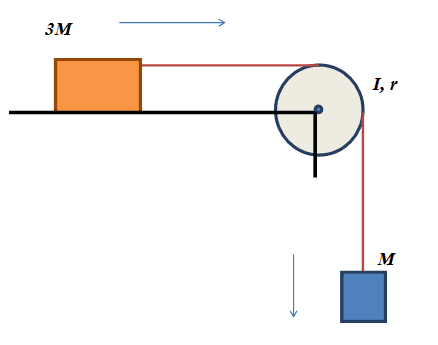
problems_MIT_rayyan_check_points_Pictures_BK84.png


2. Homework Equations
τ=Torque
t=tension
A=linear acceleration
aΘ=Angular acceleration
r=radius

τ=I*aΘ
A=r*aΘ
F=A*m


3. The Attempt at a Solution
box with mass m is box 1
box with mass 3m is box 2

ok so, drawing a FBD of both boxes we get. F1=m*g-t=m*a. t=m*g-m*a.
and F2=3*m*a=t. Since tension and acceleration is the same throughout.
m*g-m*a=3*m*a. So we get a=g/4.

Now since we know acceleration we can use it in a equation.

τ=r*t.where t= (m*g-m*a) or (3*m*a).
rearranging the formula τ=I*aΘ.

we substitute the variables in. we get τ/I=aΘ. = r*(3*m*a)/I = aΘ.
and we know all the variables there substituting them we get. 0.15*(3*1.9*2.45)/2.8 = aΘ.

and the final answer is aΘ= 0.748125.
but when I put it down as the answer it marks me incorrect. Could someone help me out to see where I went wrong ? thank you :)
 
Physics news on Phys.org
mhmm, so how would I go about solving it with two different tensions?
 
would it be, m*g-m*a=t1. t1-T(torque)=3*m*a? rearranging we get T(torque)=m*(g-4a). And I could keep working on it to get a. then just do T(torque )/ I = a(angular) . but is the relation between the tensions and torque correct there ?
 
No, torque does not have the same units as force so you cannot equate them like that. Try drawing a free-body diagram for the pulley to determine the torque acting on it. How do you relate this torque to the angular acceleration? In the end you should have three equations (one for each free-body diagram as they all have one degree of freedom) and three unknowns: the acceleration/angular acceleration, the tension in the thread on one side, and the tension in the thread on the other side. This is a system of equations that can be solved to find the acceleration.

On a different note: If you are familiar with Lagrange mechanics this problem is trivial, but typically this type of problems are also asked in courses before Lagrange mechanics are considered.
 
the , I think I need few more hints. well I have no idea how to relate the two tensions to the torque. So I tried using the equation of : a(linear)=r*a(angular). So since the rope doesn't stretch, meaning that if the m goes down by say 1cm the 3m block will go 1cm to the right. So this means that their accelerations are the same. so I guess I could use that fact and that would mean that : (m*g-T(1))/m=T(2)/(3*m)=a. And well I could go from there, if only I knew the tensions or the linear acceleration. But I don't know any of them. I really have no idea what to do. I tried drawing the FBD for each object. So I got that the T(1)=m*g-m*a. And T(2)=3*m*a. Because of Newton's 2nd law. But I don't know how to draw a FBD for the pulley. Since there is one rope with two tensions. And I don't know how the tensions affect the torque. Like I could do it easily with only the weight m. But how does the 3m weight affect the torque. I'm guessing it would decrease it because some of the force due to gravity is used to pull the 3m block, so not as much goes to the pulley. But I really don't know. please help :) thank you
 
torque is : r*F*sin(theta).where both the tensions are 90 degrees from the Axis. so sin(90)=1. here the torque is only r*F. where r is the radius. And I'm having trouble working out what the force is. I know it's somehow connected to the two tensions. Where the tension due to block 1( with mass m) is the leading one since it's the one making the system move. If I know the force then I can get the torque . and through the equation T(torque)=I*a(angular). I can get a( angular) = T(torque )/I . And the problem would be solved. my question is how do I get the force. is it T1+T2 = F. or well you know what I mean ye?