Angular Momentum of a Uniform Rod

Click For Summary
SUMMARY

The discussion focuses on calculating the mass of a particle that sticks to a uniform rod during a collision and the energy dissipated in the process. The uniform rod has a length of 1.5 m and a mass of 2.8 kg, while the particle is suspended by a string of length 1.1 m. The maximum angle after the collision is θmax = 45°. Participants highlight the importance of correctly applying the order of operations in the equations and understanding the underlying physics concepts rather than merely substituting numbers into formulas.

PREREQUISITES
  • Understanding of rotational dynamics and angular momentum
  • Familiarity with the concepts of energy conservation and energy dissipation
  • Knowledge of trigonometric functions, particularly cosine
  • Proficiency in using equations of motion in a vertical plane
NEXT STEPS
  • Study the principles of angular momentum conservation in collisions
  • Learn how to derive and apply the equations for energy dissipation in inelastic collisions
  • Explore the use of trigonometric identities in physics problems
  • Practice solving similar problems involving rotational motion and collisions
USEFUL FOR

Students studying physics, particularly those focusing on mechanics, as well as educators looking for examples of collision problems involving angular momentum.

Bob4321
Messages
4
Reaction score
0
<< Mentors have notified the OP to show their Attempt at a Solution >>[/color]

1. Homework Statement

A uniform rod of length L1 = 1.5 m and mass M = 2.8 kg is supported by a hinge at one end and is free to rotate in the vertical plane. The rod is released from rest in the position shown. A particle of mass m is supported by a thin string of length L2 = 1.1 m from the hinge. The particle sticks to the rod on contact. After the collision, θmax= 45°.

a)Find m (in kg)

b) How much energy is dissipated during the collision? (in J)
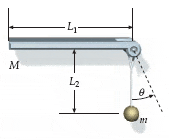
10-55.gif

Homework Equations


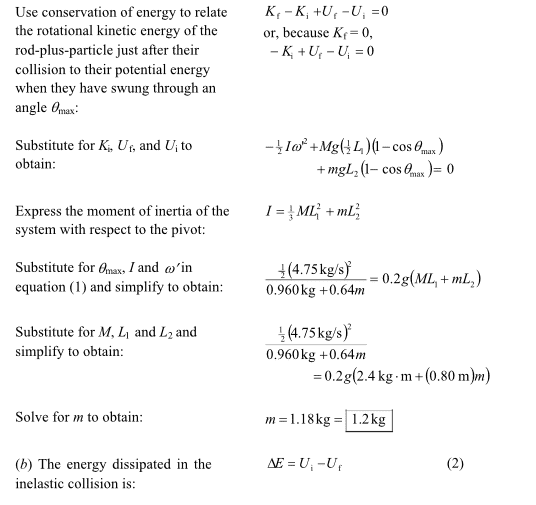
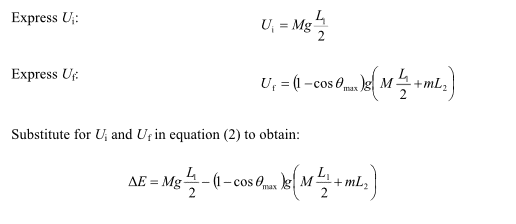
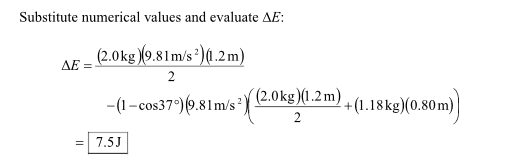
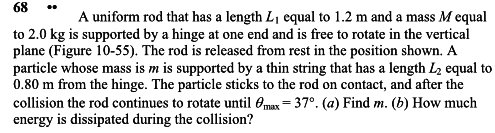
I found the question with different numbers but when I plug in mine. It's still wrong.
Screen Shot 2015-07-03 at 4.46.35 PM.png


Screen Shot 2015-07-03 at 4.38.58 PM.png
Screen Shot 2015-07-03 at 4.41.08 PM.png
Screen Shot 2015-07-03 at 4.41.18 PM.png
Screen Shot 2015-07-03 at 4.41.28 PM.png
Screen Shot 2015-07-03 at 4.41.35 PM.png


The Attempt at a Solution

 
Last edited by a moderator:
Physics news on Phys.org
Bob4321 said:

Homework Statement


A uniform rod of length L1 = 1.5 m and mass M = 2.8 kg is supported by a hinge at one end and is free to rotate in the vertical plane. The rod is released from rest in the position shown. A particle of mass m is supported by a thin string of length L2 = 1.1 m from the hinge. The particle sticks to the rod on contact. After the collision, θmax= 45°.

a)Find m (in kg)

b) How much energy is dissipated during the collision? (in J)

10-55.gif

Homework Equations


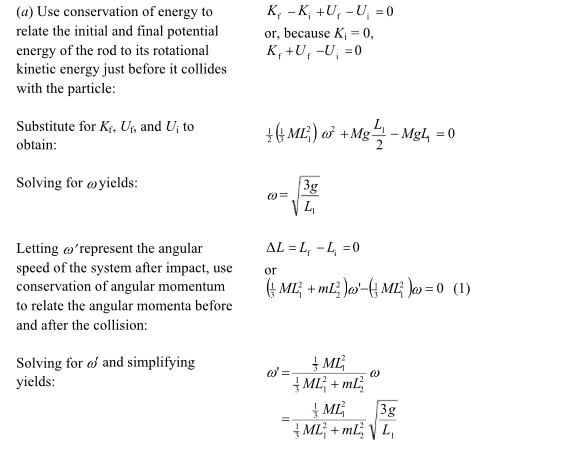
I found the question with different numbers but when I plug in mine. It's still wrong.
View attachment 85506

View attachment 85501 View attachment 85502 View attachment 85503 View attachment 85504 View attachment 85505

The Attempt at a Solution

Hello Bob4321. Welcome to PF.

Please show your attempt. What did you do in attempting to use that solution?
 
Solution Attempt:

Ok so for A:

ω1=((1/3)(2.8)(1.52))/ ((1/3)(2.8)(1.52))+m(1.12)√3(9.81m/s2)/1.5= (4.429kg/s)/(2.1kg)+1.21m

½(4.429kg/s)2/(2.1kg)+1.21m I don't know what to do now. Where did they get the .2 from in their example?
 
Last edited:
Bob4321 said:
Solution Attempt:

Ok so for A:

ω1=((1/3)(2.8)(1.52))/ ((1/3)(2.8)(1.52))+m(1.12)√3(9.81m/s2)/1.5= (4.429kg/s)/(2.1kg)+1.21m

½(4.429kg/s)2/(2.1kg)+1.21m I don't know what to do now. Where did they get the .2 from in their example?
What is (½)(1 - cos(θmax) ) ?

It looks like you have an issue regarding "order of operations". The entire expression, (⅓)(2.8)(1.52)+m(1.12) should be in the denominator. It's clear that in the solution you're attempting to mimic, the mass, m, is in the denominator.In my opinion: This method of obtaining an answer for an exercise is not to be recommended. If you don't know what quantities are being used, and why they're used, simply getting an answer to work out numerically isn't of much use.

Examining a worked out solution can indeed be very helpful, but don't just try to plug in some numbers into something that you don't understand.
 
Ok I have figured out that the .2 is from 1-cos but I still keep getting the wrong answer! Could you solve it so I can see what you did?
 
Last edited by a moderator:
For my problem the (1-cos45) is .48
 
Bob4321 said:
Ok I have figured out that the .2 is from 1-cos but I still keep getting the wrong answer! Could u solve it so I can see what you did?
That's not how we do things here at PF.

0.48 Is incorrect. Were you using 45 radians rather than 45° ?
 

Similar threads

  • · Replies 71 ·
3
Replies
71
Views
3K
  • · Replies 12 ·
Replies
12
Views
2K
  • · Replies 5 ·
Replies
5
Views
2K
  • · Replies 18 ·
Replies
18
Views
3K
Replies
10
Views
2K
  • · Replies 12 ·
Replies
12
Views
2K
Replies
23
Views
2K
  • · Replies 8 ·
Replies
8
Views
4K
  • · Replies 22 ·
Replies
22
Views
4K
  • · Replies 2 ·
Replies
2
Views
2K