Another Newton's Law of Motion Problem.

Click For Summary

Homework Help Overview

The problem involves a patient requiring a strap that exerts a net upward force of 5.00 N on the chin, with discussions centered around the tension in the strap and the forces acting on it. The subject area pertains to Newton's Laws of Motion, particularly focusing on equilibrium and forces.

Discussion Character

  • Exploratory, Assumption checking, Mathematical reasoning

Approaches and Questions Raised

  • Participants discuss the equilibrium of forces, with one noting that the tension in the strap is equal on both sides. There is consideration of whether the weight of the head should be included in the analysis, with some suggesting it can be ignored. Questions arise about how to express the sum of forces and the implications of symmetry in the problem.

Discussion Status

The discussion is active, with participants providing guidance on how to approach the problem. There is acknowledgment of the importance of the upward force and the vertical components of tension. Some participants are exploring different interpretations of the problem setup, while others are attempting to derive equations based on the forces involved.

Contextual Notes

Participants note the assumption that the weight of the head is not known and question whether it should be considered in the calculations. The requirement for the net upward force is emphasized, and there is a focus on ensuring that the forces are in equilibrium.

Elkay
Messages
20
Reaction score
0
Due to a jaw injury, a patient must wear a strap (see the figure) that produces a net upward force of 5.00 N on his chin. The tension is the same throughout the strap. To what tension must the strap be adjusted to provide the necessary upward force? Here's the picture:
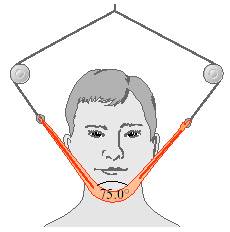
1027442.jpg


I think the tension for both sides of the strap will be equal, and the sum of all forces should equal zero. I'm also thinking that the sum of all forces should be zero if this is at equilibrium.
This is what I've done so far (hopefully my handwriting isn't too bad):
http://home.earthlink.net/~copper017/Random/freebody.jpg
http://home.earthlink.net/~copper017/Random/equations.jpg


I'm under the impression that this problem should be simple, but I've been looking at it and trying to do different things to it yesterday.
 
Last edited by a moderator:
Physics news on Phys.org
That's correct; you can now use the second equation to obtain the tension in the strap (since T1=T2).
 
Your on the right lines; however, there is no need to consider the weight of the head in this case, we don't actually know the weight of the head, you've just assumed it be the same as the required net upwards force. The important point to remember is the required upward force is provided by the sum of the vertical components of both tensions. Neverless, either way you consider the problem you will obtain the same equations, as you have done correctly above. As you correctly said above, due to the symmetry of the problem, both tensions we be equal (i.e. T1=T2=T). Using this, can you simplify your expression for \sum F_y?

Edit: That's twice cristo :wink:...
 
Last edited:
Hmm, if I don't consider the weight, just look at the \sum F_y equation and solve for T1, the answer I got was -5...


http://home.earthlink.net/~copper017/Random/revise.jpg
 
Last edited by a moderator:
It is true that you don't need to consider weight here. However, you should consider the required upward force. RE:
Hootenanny said:
The important point to remember is the required upward force is provided by the sum of the vertical components of both tensions.
Hence, you should obtain;

\sum F_y = T_1\sin52.5 + T_2\sin52.5 = 5

Which, by coincidence is identical to your second equation above.
 
Thank you so much. I think I got the right answer:

http://home.earthlink.net/~copper017/Random/final1.jpg

Since T1=T2=T, then:
http://home.earthlink.net/~copper017/Random/final2.jpg So I guess the key to solving a problem like this is to recognize that the forces are in equilibrium, and to simplify the equations before attempting to solve. Hopefully my text will have a similar problem so I can practice some more.
 
Last edited by a moderator:

Similar threads

Replies
3
Views
2K
  • · Replies 5 ·
Replies
5
Views
3K
  • · Replies 4 ·
Replies
4
Views
24K
Replies
16
Views
3K
  • · Replies 21 ·
Replies
21
Views
11K
  • · Replies 4 ·
Replies
4
Views
2K
  • · Replies 10 ·
Replies
10
Views
5K
  • · Replies 5 ·
Replies
5
Views
7K
  • · Replies 6 ·
Replies
6
Views
2K
  • · Replies 4 ·
Replies
4
Views
2K