Another nice problem from Savchenko

  • Thread starter Thread starter wrobel
  • Start date Start date
wrobel
Science Advisor
Insights Author
Messages
1,276
Reaction score
1,076
A slab rests on two massless rollers of different radii such that the angle of the slab's inclination is ##\alpha##. There is no slipping between the slab and the rollers, nor between the rollers and the ground. Prove that the slab moves with purely translational motion and find its acceleration.
(the value of the acceleration is ##g\sin(\alpha/2)##)
The standard obstacle here is finding the reactions of the rollers, but the use of the energy integral allows one to avoid this difficulty. Accurate proof that the motion is translational also requires some kinematic techniques.

It is also interesting to note that the hypothesis of ideal constraints here does not imply that the reactions of the rollers are perpendicular to the slab. This is not the case, even though the rollers are massless. It is because the net reaction is perpendicular to the virtual displacement, as it must be
 

Attachments
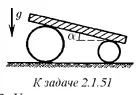
  • Screenshot_20260206_141451.webp
    Screenshot_20260206_141451.webp
    13.4 KB · Views: 1
Last edited:
  • Like
Likes   Reactions: Lnewqban and weirdoguy
Physics news on Phys.org
I would try some math.

1. I observe that angle ##\alpha## does not change during the motion but the slab moves with NOT purely (horizontal, I would add. See my post #6. ) translational motion. Displacement d of the slab, which has horizontal and perpendicular components, is
$$d=r\theta\sqrt{(1+\cos\alpha)^2+\sin^2\alpha}=2 r\theta\cos\frac{\alpha}{2}$$
where r, ##\theta## are radius and rotation angle of either one of the rollers. Thus
$$\vec{d}=d(\cos\frac{\alpha}{2},-\sin\frac{\alpha}{2})$$
and
$$\vec{g} \cdot \frac{\vec{d}}{d} = g \sin\frac{\alpha}{2}$$
Therefore
$$d = \frac{1}{2}g \sin\frac{\alpha}{2} \ t^2+\dot{d}_0t+d_0$$

2. Lagrangian for massless rollers case is
$$L=m[\frac{1}{2} (2 r\dot{\theta}\cos\frac{\alpha}{2})^2 + g r\theta \sin\alpha)]=4mr^2\cos^2\frac{\alpha}{2}(\ \frac{1}{2}\dot\theta^2+\frac{g}{2r}\tan\frac{\alpha}{2}\ \theta\ )$$
where m is mass of the slab. By solving the Lagrange equation
$$ \ddot{\theta}=\frac{g}{2r}\tan\frac{\alpha}{2}$$
Thus
$$\ddot{d}=g \sin\frac{\alpha}{2}$$
1770681553298.webp
 
Last edited:
My version is
$$L=mr^2\dot\theta^2(1+\cos\alpha)+mgr\theta\sin\alpha$$
hopefully that is the same:)
 
  • Like
Likes   Reactions: anuttarasammyak
anuttarasammyak said:
angle α does not change during the motion but the slab moves with NOT purely translational motion
?????
By definition, purely translational motion is when all the points of a rigid body move with the same velocity
 
  • Like
Likes   Reactions: anuttarasammyak
The drop of the slab releases potential energy which enhances kinetic energy. The perpendicular component of the slab displacement should be considered as well as the horizontal component.
1770618270121.webp
 
Last edited:
  • Like
Likes   Reactions: Lnewqban
wrobel said:
By definition, purely translational motion is when all the points of a rigid body move with the same velocity
My bad. I confused translational with horizontal translational.
 
Last edited:

Similar threads

  • · Replies 55 ·
2
Replies
55
Views
10K
  • · Replies 3 ·
Replies
3
Views
6K
  • · Replies 4 ·
Replies
4
Views
2K
Replies
46
Views
6K
Replies
13
Views
2K
  • · Replies 1 ·
Replies
1
Views
1K
  • · Replies 1 ·
Replies
1
Views
1K
  • · Replies 4 ·
Replies
4
Views
2K
  • · Replies 12 ·
Replies
12
Views
3K
  • · Replies 1 ·
Replies
1
Views
3K