Answer: Understanding the Effect of Gravity on Falling Objects

Click For Summary
SUMMARY

The discussion centers on the effects of gravity on two ball bearings released inside a railway coach launched upward. When the coach is moving upward, the distance between the ball bearings decreases due to compressive tidal forces, while in a vertical launch, they move apart due to slight differences in acceleration. Observers inside the coach cannot distinguish between upward and downward motion based solely on the behavior of the ball bearings, as both scenarios exhibit similar phenomena. The conversation references the principles of Newtonian physics and tidal forces, emphasizing the importance of gravitational acceleration in these dynamics.

PREREQUISITES
  • Understanding of Newtonian mechanics
  • Familiarity with gravitational forces and tidal effects
  • Basic knowledge of non-inertial reference frames
  • Concept of acceleration and its impact on objects in free fall
NEXT STEPS
  • Study the effects of tidal forces in gravitational fields
  • Learn about non-inertial frames of reference in physics
  • Explore gravitational acceleration variations in different contexts
  • Investigate the principles of General Relativity related to motion in gravitational fields
USEFUL FOR

Students and educators in physics, particularly those focusing on mechanics and gravitational theory, as well as anyone interested in understanding the dynamics of objects in non-inertial frames.

Whitehole
Messages
128
Reaction score
4
You are launched upward inside a railway coach in a horizontal position with respect to the surface of Earth, as shown in the figure. After the launch, but while the coach is still rising, you release two ball bearings at opposite ends of the train and at rest with respect to the train.
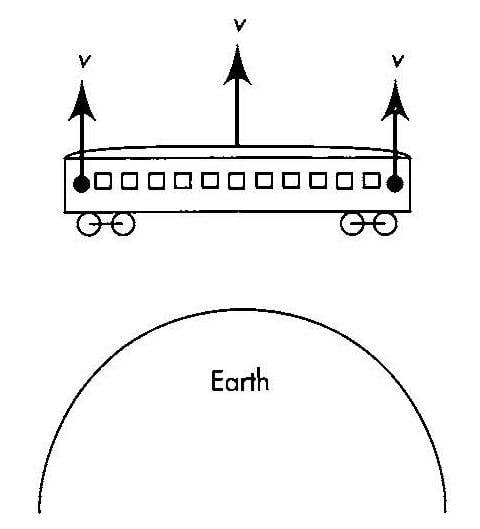
gIxXp.jpg


a) Riding inside the coach, will you observe the distance between the ball bearings to increase or decrease with time?

Answer: At the instant the coach was released, it is already starting to fall and since the objects inside the coach are also falling with the same rate with the coach, gravity is not present inside but just for a while. So, whether the coach is moving upwards or downwards doesn't really matter as long as they are falling at the same rate. Eventually tidal forces come into play so the distance between balls will increase during the upward trip.

b) Now you ride in a second railway coach launched upward in a vertical position with respect to the surface of Earth (not shown). Again you release two ball bearings at opposite ends of the coach and at rest with respect to the coach. Will you observe these ball bearings to move together or apart?

Answer: Again, at the instant the coach was released, it is already starting to fall. The two balls are experiencing approximately the same acceleration initially (lower ball has greater acceleration compared to the upper ball but just a tiny bit), but this tiny difference will cause a detectable change in separation between the balls as they fall. So, the two balls will move apart.

c) In either of the cases described above, can you, the rider in the railway coach, distinguish whether the coach is rising or falling with respect to the surface of Earth solely by observing the ball bearings from inside the coach? What do you observe at the moment the coach stops rising with respect to Earth and begins to fall?

Answer: No, because again as stated above, at the instant the coach was released, it is already starting to fall so whatever phenomena are observed inside when the coach is on the downward trajectory, it is the same phenomena during the upward trajectory. As the coach reaches the top of the trajectory, you still observe the same phenomena (signs of "non-inertial frame" if already exceeded the detection tolerance).

Can anyone please comment on my argument in this problem. Do I have the correct reasoning and intuition on the problem? Did I miss anything?
 

Attachments

  • gIxXp.jpg
    gIxXp.jpg
    15.8 KB · Views: 716
Physics news on Phys.org
You might want to think a bit more about c. What would the motion of the ball bearings be if the carriage had been thrown hard enough to reach interstellar space?
 
Ibix said:
You might want to think a bit more about c. What would the motion of the ball bearings be if the carriage had been thrown hard enough to reach interstellar space?
The answer of Taylor and Wheeler was None. So I based my explanation from that answer. I know that you think I might think that the balls would be pressed on the floor but I think in the case that you are saying, the acceleration would have to be greater than the gravitational acceleration. But either ways, the balls and the coach would be falling at the same rate at the instant it leaves the "thrower".
 
What I meant was, how strong are the tidal forces when the carriage is just launched? How strong are they in interstellar space? What about in between those two extremes?
 
I'm not sure about a. Releasing the balls gives them an initially parallel velocity displaced left and right of center. The right one would tend to a counterclockwise orbit, the left one a clockwise orbit. This suggests they should converge. My assumption is that the walls of the car force an initially parallel velocity.
 
Ibix said:
What I meant was, how strong are the tidal forces when the carriage is just launched? How strong are they in interstellar space? What about in between those two extremes?
Well, I think the authors implicitly assume that the gravitational acceleration is approximately constant throughout. So talking about interstellar space is out of the question.
 
Whitehole said:
Well, I think the authors implicitly assume that the gravitational acceleration is approximately constant throughout. So talking about interstellar space is out of the question.
I hoped it would lead you to a mistake in your thinking. Let's try something else - look at the picture in your first post. From that exterior perspective, why are the balls moving apart? Again in that exterior perspective, what happens to the separation of the balls when the coach reaches its maximum height and starts moving down the page? Could you spot this from inside the carriage?
 
Ibix said:
I hoped it would lead you to a mistake in your thinking. Let's try something else - look at the picture in your first post. From that exterior perspective, why are the balls moving apart? Again in that exterior perspective, what happens to the separation of the balls when the coach reaches its maximum height and starts moving down the page? Could you spot this from inside the carriage?
I'm sorry, I've read my answer to part a) again and it should have been "the distance between balls will decrease during the upward trip". As for part c) I still don't see what you want me to think, based on my understanding there shouldn't be any difference between upwards and downwards as observed inside the coach (the answer of Taylor and Wheeler was also "nothing is different"), the balls just float (aside from the decrease in distance between the balls in part a) and increase in distance between the balls in part b.
 
Ah! I misunderstood the question, and your original answer to (a) is consistent with my misunderstanding.

The balls are released in flight, so their paths curve slightly towards the centre of the carriage, as you say. I now agree with you about (c).

Sorry for the confusion. o:)
 
  • #10
Ibix said:
Ah! I misunderstood the question, and your original answer to (a) is consistent with my misunderstanding.

The balls are released in flight, so their paths curve slightly towards the centre of the carriage, as you say. I now agree with you about (c).

Sorry for the confusion. o:)
I should be the one who should apologize for the typo. Thanks for the clarification!
 
  • #11
Whitehole said:
You are launched upward inside a railway coach in a horizontal position with respect to the surface of Earth, as shown in the figure. After the launch, but while the coach is still rising, you release two ball bearings at opposite ends of the train and at rest with respect to the train.

a) Riding inside the coach, will you observe the distance between the ball bearings to increase or decrease with time?

Answer: At the instant the coach was released, it is already starting to fall and since the objects inside the coach are also falling with the same rate with the coach, gravity is not present inside but just for a while. So, whether the coach is moving upwards or downwards doesn't really matter as long as they are falling at the same rate. Eventually tidal forces come into play so the distance between balls will increase during the upward trip.

b) Now you ride in a second railway coach launched upward in a vertical position with respect to the surface of Earth (not shown). Again you release two ball bearings at opposite ends of the coach and at rest with respect to the coach. Will you observe these ball bearings to move together or apart?

Answer: Again, at the instant the coach was released, it is already starting to fall. The two balls are experiencing approximately the same acceleration initially (lower ball has greater acceleration compared to the upper ball but just a tiny bit), but this tiny difference will cause a detectable change in separation between the balls as they fall. So, the two balls will move apart.

c) In either of the cases described above, can you, the rider in the railway coach, distinguish whether the coach is rising or falling with respect to the surface of Earth solely by observing the ball bearings from inside the coach? What do you observe at the moment the coach stops rising with respect to Earth and begins to fall?

Answer: No, because again as stated above, at the instant the coach was released, it is already starting to fall so whatever phenomena are observed inside when the coach is on the downward trajectory, it is the same phenomena during the upward trajectory. As the coach reaches the top of the trajectory, you still observe the same phenomena (signs of "non-inertial frame" if already exceeded the detection tolerance).

Can anyone please comment on my argument in this problem. Do I have the correct reasoning and intuition on the problem? Did I miss anything?

In case a), the distance between the bearings will decrease, not increase.

This is due to to the fact that the Earth's gravity points towards the center of the Earth. The slight change in separation can in both a) and b) be attributed to tidal forces, in case a) it's a compressive tidal force, in case b) it's a stretching tidal force.
 
  • #12
pervect said:
In case a), the distance between the bearings will decrease, not increase.

This is due to to the fact that the Earth's gravity points towards the center of the Earth. The slight change in separation can in both a) and b) be attributed to tidal forces, in case a) it's a compressive tidal force, in case b) it's a stretching tidal force.
Thanks, but see post 8. It's a typo.
 
  • #13
Whitehole said:
You are launched upward inside a railway coach in a horizontal position with respect to the surface of Earth, as shown in the figure. After the launch, but while the coach is still rising, you release two ball bearings at opposite ends of the train and at rest with respect to the train...
For a Newtonian analysis draw ##\vec g## vectors on each ball pointing towards the center of the Earth. Now project those ##\vec g## vectors on the line of separation of the balls. Which way do the projections point? Does it matter if the car is going up or down?
 
  • #14
Whitehole, I really don't really understand your argument in c). It could be me, it could be the argument is unclear.

My answer to c) would be that if you can measure the tidal force (say with a gravity gradiometer), you can in principle use the magnitude of the force / gravity gradient and a fairly simple calculation for a stationary observer gives you your distance away from the center of the Earth. If you can measure your distance away from the center of the Earth, you can tell whether it's increase, decreasing, or staying the same. It think this was Ibix's point, though I'm not sure.

Now what we need to answer is if the gravity gradient depends on the velocity, which is what I suspect is really being asked. And I have assumed that we can't, but I haven't proved it.

It turns out, though, that for radial motion, the velocity doesn't affect the gradient, even in full GR, at least for a spherically symmetric gravitating body. I could give a GR textbook reference on this point, with enough effort, but I'm not sure it'd be helpful. The limits on the argument though are that this turns out not to be true for non-radial motion. (I can't give a textbook reference for the non-radial case it's something I calculated. The textbook reference is for the radial case, and the terminology is probably not familiar in any event).

That's the GR answer, I don't know for sure what the Newtonian answer is, which is what you appear to be asking about. But if we focus on Newton's laws, is there a velocity depndent term in the gravitaional force, or does it only depend on the current distance?

Is this a homework problem, by the way?
 

Similar threads

  • · Replies 1 ·
Replies
1
Views
1K
  • · Replies 13 ·
Replies
13
Views
5K
  • · Replies 51 ·
2
Replies
51
Views
4K
  • · Replies 10 ·
Replies
10
Views
2K
  • · Replies 2 ·
Replies
2
Views
2K
  • · Replies 8 ·
Replies
8
Views
3K
  • · Replies 11 ·
Replies
11
Views
2K
  • · Replies 14 ·
Replies
14
Views
2K
  • · Replies 10 ·
Replies
10
Views
2K
  • · Replies 144 ·
5
Replies
144
Views
9K