AP Physics Lab Help: Calculating Acceleration and Distance on an Inclined Ramp

Click For Summary
SUMMARY

The discussion focuses on calculating acceleration and distance for a ball rolling down an inclined ramp in an AP Physics lab. Key parameters include a change in X of 0.35 meters, a change in Y of -0.91 meters, and an acceleration of Y at -9.8 m/s². Participants suggest using the equations of motion, specifically the kinematic equation velocity final squared = velocity initial squared + (2)(a)(change in x or y), to determine the necessary initial velocity for the X component. Additionally, they discuss using energy conservation principles to find the ramp's height and the angle required for the ramp.

PREREQUISITES
  • Understanding of kinematic equations in physics
  • Familiarity with energy conservation principles
  • Basic knowledge of inclined plane dynamics
  • Ability to perform vector addition for velocity components
NEXT STEPS
  • Study the application of kinematic equations in inclined plane problems
  • Learn about energy conservation in mechanical systems
  • Explore vector addition techniques for calculating resultant velocities
  • Investigate the effects of different angles on acceleration and distance in inclined ramps
USEFUL FOR

Students in AP Physics, educators teaching mechanics, and anyone interested in understanding the dynamics of motion on inclined planes.

dukiex3
Messages
6
Reaction score
0
I'm new here, so sorry if I post this incorrectly! =/

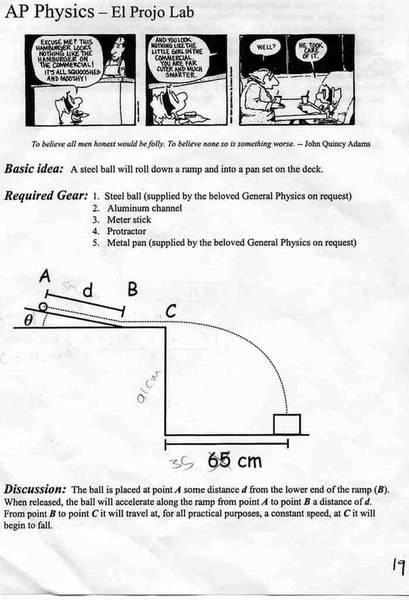
I've scanned the lab, and the pictures are below.

img112.jpg


img114.jpg


Homework Statement


Well, the problem statement is in the picture, I guess...

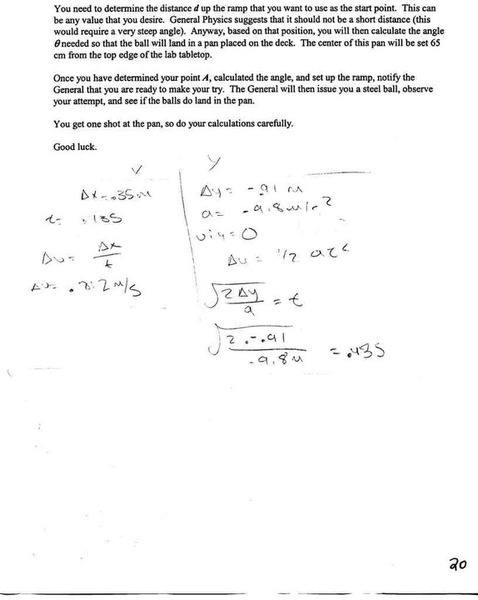
and our givens are that change in X is .35 meters, change in Y is -.91 meters, acceleration of Y = -9.8m/seconds squared, and initial velocity of Y is 0.

Homework Equations


change in y (or x) = (vi)(t) + (1/2)(a)(time squared)
velocity final = velocity inital + (a)(t)
velocity final squared= velocity inital squared + (2)(a)(change in x or y)
change in y (or x) = (1/2)(velocity final-velocity initial) (t)


The Attempt at a Solution


As seen above, we have calculated the time needed for the ball to go from point C into the pan. From this, we then figured out the initial velocity needed for the X component of the ramp. The distance from B-C (though, it has to be greater than zero so that the Y velocity starts at 0) is irrelevant because the velocity for X is always constant. We have figured the acceleration (Sorry I don't have the work for that, my lab partners do.) out by using the equation "velocity final squared= velocity inital squared + (2)(a)(change in x or y)." I am not sure about this acceleration, though. So, we need to figure out the acceleration needed so that at point C, the change in velocity for X = .812 m/s. After we calculate this, we need to find the angle needed for the ramp, and the distance from A-B.


thank you!
 
Physics news on Phys.org
So, what are you asking about again? I think you more or less have it down, though I got lost in your explanation.

Basically you figure out what initial x velocity you would need for the ball to go the distance from the cliff to the bucket, where the amount of travel time, and thus the initial velocity, is based on how high the cliff is. So if you use energy conservation you can figure out how high your ramp needs to be to give you that initial velocity.
 
energy conservation? I guess I'll google that.
 
We haven't really talked about that stuff in class, so I don't think I can use it.. any other way?

and thanks, mindscrape, for replying.
 
Yeah, you can always do the classic ramp with an angle way. You will have to sum the x and y velocities at the bottom of the ramp to get the magnitude of velocity though.

By potential energy, which you may or may not be allowed to use, but I don't see why not if you can demonstrate an understanding of it, you can see that the velocity at the end of the ramp will be v = sqrt(2gh) where h is the vertical distance (y distance). At least use it to check your answer.
 
lol.. (I don't know if this forum is all anti-lol, so sorry in advance for using it =].) I've honestly never had a physics class before this one, so all I know is what I've been taught, and evidently, I don't know that all too well, either. So, can anyone explain this classic ramp with an angle way? What would my change in Y velocity be?
 
Grrr, lol is not allowed here, physicists are serious and down to business. You haven't done any inclined planes yet? Huh, why do you have this problem then?

http://www.ac.wwu.edu/~vawter/PhysicsNet/Topics/Dynamics/gifs/InclinePlane02.gif

You can either find the velocity at the bottom of the ramp with a fancy inclined plane transformation like in the diagram above, and since all the velocity is in the direction of the transformed x, and there is no velocity in the transformed y direction, then you know the magnitude must be sqrt(v_xtrans^2) = v_xtrans.

Alternatively, you can stick with regular coordinates and not confuse yourself with a transformed coordinate system, and find the velocity in x and the velocity in y based on their respective acceleration components, then find the total magnitude.
 
Last edited by a moderator:
I can't access the pictures. What do I need to do in order to see them?
 

Similar threads

  • · Replies 10 ·
Replies
10
Views
1K
  • · Replies 5 ·
Replies
5
Views
3K
  • · Replies 4 ·
Replies
4
Views
2K
  • · Replies 56 ·
2
Replies
56
Views
4K
Replies
12
Views
1K
  • · Replies 11 ·
Replies
11
Views
2K
  • · Replies 38 ·
2
Replies
38
Views
4K
  • · Replies 3 ·
Replies
3
Views
915
  • · Replies 1 ·
Replies
1
Views
1K
  • · Replies 8 ·
Replies
8
Views
2K