AP Physics problem help - centripetal motion

Click For Summary
SUMMARY

The discussion revolves around solving a centripetal motion problem involving a suitcase on a baggage carousel with a radius of 10.8 m, a static friction coefficient of 0.760, and an angle of 35.6°. The user attempts to calculate the time required for the suitcase to complete one rotation but struggles with the equations of motion. Key equations include the net force equations and the relationship between angular velocity (w) and time (T). The final calculation attempts yield incorrect results, prompting further clarification on the forces acting on the suitcase.

PREREQUISITES
  • Understanding of centripetal motion principles
  • Familiarity with static friction and its coefficient
  • Knowledge of force diagrams and net force calculations
  • Basic proficiency in algebra and solving equations
NEXT STEPS
  • Study the derivation of the centripetal force equation in circular motion
  • Learn how to construct and analyze free body diagrams for objects in motion
  • Explore the relationship between angular velocity and period in circular motion
  • Review the concepts of gravitational force and its components in inclined scenarios
USEFUL FOR

Students in introductory physics courses, particularly those struggling with centripetal motion problems, and educators looking for examples of practical applications of physics concepts.

stuplato
Messages
34
Reaction score
0
This problem is KILLING ME!
The drawing shows a baggage carousel at an airport. Your suitcase has not slid all the way down the slope and is going around at a constant speed on a circle (r = 10.8 m) as the carousel turns. The coefficient of static friction between the suitcase and the carousel is 0.760, and the angle in the drawing is 35.6°. How much time is required for your suitcase to go around once?
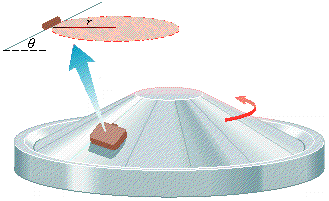
05_26.gif

Please help!
It involves centripetal motion
 

Attachments

  • 05_26.gif
    05_26.gif
    13.2 KB · Views: 940
Physics news on Phys.org
So far here is what I got:

Fc = m*g*tan(theta)
Fn = m*g*cos(theta)
Ffrx (this is x-component of friction) = m*g*cos(theta)*cos(theta)

Ffrx + Fc = (m*w^2) / r

But the answer I get is wrong!
 
What is the net force acting on the bag? Redo your force diagram.
 
whozum said:
What is the net force acting on the bag? Redo your force diagram.
Net force is opposite of the perpendicular component of gravity which will be mass times g times cos(theta)
So... Fn = m times 7.968
And Friction will be u times Fn...
Ffr = m times 6.056
And Fc is m times .7159
The x component of Friction will be cos(theta) times Ffr
Ffrx = m times 4.924
And using Ffrx + Fc = (m*w^2) / r
m*4.924+m*.7159 = m*w^2) / r
the mass cancels out and i get
5.64 = w^2 / 10.8
Simplify...
w = .725
Now w = C/T and C= 2*pi*r
.725 / T = 2*pi*10.8
T = .0107
 
This is still wrong :cry:
 
Haha we have that exact same drawing/diagram in our book...you got the book with the skier on it?
 
I know T must be atleast twenty, but I just cannot get it, please give me a hint!
 
celticsthree4 said:
Haha we have that exact same drawing/diagram in our book...you got the book with the skier on it?

Ya, Cutnell 5th edition
 
Let me try this:
w = .725 & C = 21.6*pi
21.6*pi = .725*t
And I get 93.598 for t... somehow that sounds high, but I like someone 2 double check me please
 
  • #10
stuplato said:
Let me try this:
w = .725 & C = 21.6*pi
21.6*pi = .725*t
And I get 93.598 for t... somehow that sounds high, but I like someone 2 double check me please

It's wrong AGAIN :cry:
 
  • #11
Answer this question: What forces act on the suitcase? (I see three forces.)

Then answer this: What is the net centripetal force?

Answer these questions with symbols, not numbers.
 
  • #12
i'm struggling with this same problem except my numbers are a little different my r=11.4, friction is .76 and theta as 36.8.
To be completely honest I am in Physics 1 and have no idea how to do physics at all. I understand the concepts, but have a really hard time finding the right equations and right times to use those equations.
I know there are three forces that are acting on it you got the force from the friction pointing up, you have mg acting on the suitcase downwards and you have the N force pulling from the center towards the suitcase.
 
  • #13
My teacher in class gave us this equation to solve for the problem:
T= 2 pi sqrt. (R/g)(usin theta +cos theta / ucos theta - sin theta)

I'm not really sure what u= if i knew i think i could solve the problem.
Just to confirm
g=9.8 m/s^2
R=11.4

right?
 

Similar threads

  • · Replies 5 ·
Replies
5
Views
3K
  • · Replies 1 ·
Replies
1
Views
3K
  • · Replies 1 ·
Replies
1
Views
4K
Replies
1
Views
3K
  • · Replies 9 ·
Replies
9
Views
5K
  • · Replies 28 ·
Replies
28
Views
3K
Replies
10
Views
2K
  • · Replies 1 ·
Replies
1
Views
3K
  • · Replies 10 ·
Replies
10
Views
7K
  • · Replies 20 ·
Replies
20
Views
5K