Apparent depth when two or more refracting surfaces are present

Click For Summary
SUMMARY

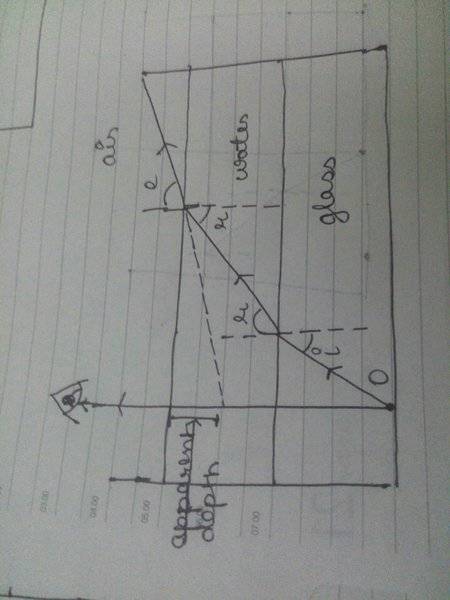
The discussion focuses on the concept of apparent depth when multiple refracting surfaces are involved. It highlights that the apparent depth changes due to the convergence or divergence of emergent rays, which is influenced by the angles at which light exits the medium. The participants emphasize the need for a clear understanding of the layout and calculations required for multiple refracting surfaces, akin to those used in multiple lens systems. The discussion concludes that while single surface calculations are straightforward, complexity increases significantly with additional surfaces.

PREREQUISITES
  • Understanding of Snell's Law and refraction principles
  • Familiarity with the concept of apparent depth in optics
  • Basic knowledge of lens systems and their calculations
  • Ability to interpret diagrams related to light paths and angles
NEXT STEPS
  • Study the calculations for multiple lens systems in optics
  • Learn about the effects of refractive index on light behavior
  • Explore advanced topics in geometric optics, including ray tracing
  • Investigate practical applications of apparent depth in optical devices
USEFUL FOR

Students of physics, optical engineers, and anyone interested in advanced optics and the behavior of light through multiple refracting surfaces.
esha
Messages
74
Reaction score
3
I know the concept of apparent depth as such: It is the depth at which an object is seen when viewed from a different medium. But i want to know what happens when two refracting surfaces are kept one after the other. In the given diagram let the object be placed at the bottom of the vessel. Of course the apparent depth this time wud be different if it would have been only one refracting surface. It is because the emergent ray will converge or diverge (in this case) more. But i don't know how to calculate it.
1504205987750.jpeg
 
Science news on Phys.org
All that counts is the angle at which the light emerges from the water and enters the eye. We can have absolutely no idea of the path that the light took before that.
In real situations, the eye only sees a narrow range of angles (of course) and the diagrams that people draw are always much exaggerated, which doesn't help.
 
Last edited:
but we are able to calculate it when only one surface is present
 
We can calculate the path for as many surfaces as we want to. But we need to know the layout (multiple lenses calculations etc) first.
 

Similar threads

  • · Replies 5 ·
Replies
5
Views
3K
  • · Replies 20 ·
Replies
20
Views
4K
  • · Replies 7 ·
Replies
7
Views
7K
  • · Replies 8 ·
Replies
8
Views
2K
  • · Replies 9 ·
Replies
9
Views
4K
Replies
1
Views
3K
  • · Replies 4 ·
Replies
4
Views
675
  • · Replies 2 ·
Replies
2
Views
4K
  • · Replies 17 ·
Replies
17
Views
2K
  • · Replies 1 ·
Replies
1
Views
3K