Undergrad How to Calculate Surface Integral Using Stokes' Theorem?

Click For Summary
SUMMARY

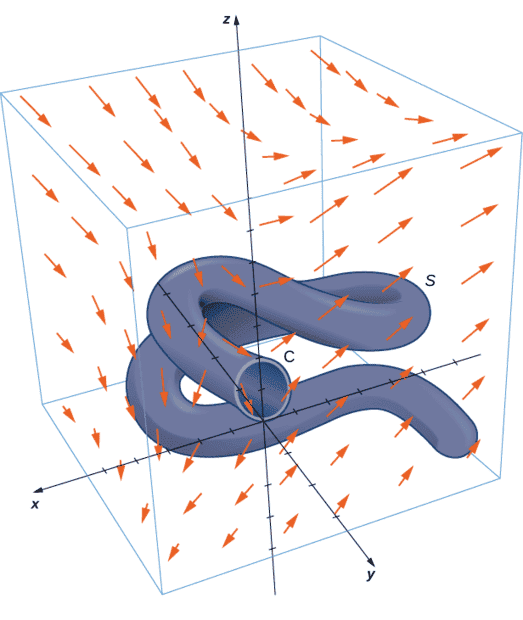
The discussion focuses on calculating the surface integral of the curl of the vector field F = [z, 2xy, x+y] over a surface S using Stokes' Theorem. The integral is expressed as \(\iint\limits_S \text{curl } F \cdot dS\), which can be transformed into a line integral over the boundary curve C of the surface S. Participants emphasize the necessity of knowing the specific curve C to complete the calculation accurately.

PREREQUISITES
  • Understanding of Stokes' Theorem
  • Familiarity with vector calculus
  • Knowledge of curl and surface integrals
  • Ability to interpret vector fields
NEXT STEPS
  • Study the application of Stokes' Theorem in various contexts
  • Learn how to compute curl for different vector fields
  • Explore examples of surface integrals in vector calculus
  • Investigate the relationship between line integrals and surface integrals
USEFUL FOR

Students and professionals in mathematics, physics, and engineering who are working with vector calculus and need to understand the application of Stokes' Theorem in calculating surface integrals.

WMDhamnekar
MHB
Messages
378
Reaction score
30
TL;DR
Stokes’ theorem translates between the flux integral of surface S ##\displaystyle\iint\limits_{\Sigma} f \cdot d\sigma ## to ## \displaystyle\int\limits_C f\cdot dr## a line integral around the boundary of S. Therefore, the theorem allows us to compute surface integrals or line integrals that would ordinarily be quite difficult by translating the line integral into a surface integral or vice versa.
Calculating a surface integral
Calculate surface integral ## \displaystyle\iint\limits_S curl F \cdot dS ## where S is the surface, oriented outward in below given figure and F = [ z,2xy,x+y].
1669809506421.png


How can we answer this question?
 
Physics news on Phys.org
You would do that as a line integral over C; I assume the question tells you what C is?
 
  • Like
Likes minimikanix
Relativistic Momentum, Mass, and Energy Momentum and mass (...), the classic equations for conserving momentum and energy are not adequate for the analysis of high-speed collisions. (...) The momentum of a particle moving with velocity ##v## is given by $$p=\cfrac{mv}{\sqrt{1-(v^2/c^2)}}\qquad{R-10}$$ ENERGY In relativistic mechanics, as in classic mechanics, the net force on a particle is equal to the time rate of change of the momentum of the particle. Considering one-dimensional...

Similar threads

  • · Replies 6 ·
Replies
6
Views
2K
  • · Replies 1 ·
Replies
1
Views
3K
  • · Replies 3 ·
Replies
3
Views
2K
  • · Replies 2 ·
Replies
2
Views
3K
  • · Replies 2 ·
Replies
2
Views
2K
  • · Replies 3 ·
Replies
3
Views
2K
  • · Replies 7 ·
Replies
7
Views
2K
  • · Replies 8 ·
Replies
8
Views
2K
  • · Replies 5 ·
Replies
5
Views
3K
  • · Replies 1 ·
Replies
1
Views
2K