Are holograms able to reconstruct wavefronts in all directions?

  • Context: Graduate 
  • Thread starter Thread starter rumborak
  • Start date Start date
  • Tags Tags
    Holography
Click For Summary

Discussion Overview

The discussion centers around the capabilities of holography in reconstructing wavefronts, specifically whether these wavefronts can be accurately reconstructed in all directions, including behind the hologram. The inquiry involves theoretical aspects of holography and its implications for image formation.

Discussion Character

  • Exploratory
  • Technical explanation
  • Debate/contested

Main Points Raised

  • One participant questions whether holography can reconstruct wavefronts towards the back of the hologram, specifically asking if points corresponding to the surface of an object (a cube) would experience constructive interference.
  • Another participant suggests that while the initial setup may not produce the desired effect, a real image can be created by altering the reference beam direction.
  • A different participant expresses a hypothesis that the wavefronts would recreate point sources at the positions of the object's surface, seeking confirmation of this idea.
  • A reference to Goodman's book is made, indicating that illuminating the hologram with a conjugate reference wave can produce a real image that is a complex conjugate of the original object, suggesting a nuanced understanding of holographic image formation.
  • One participant expresses gratitude for the clarification provided, indicating that the information aligns with their expectations.

Areas of Agreement / Disagreement

Participants express differing views on the reconstruction of wavefronts in holography, with some uncertainty about the conditions under which accurate reconstruction occurs. No consensus is reached regarding the specific behavior of wavefronts behind the hologram.

Contextual Notes

The discussion touches on various recording techniques in holography, such as Gabor holograms and the Leith-Upatnieks geometry, which may influence the outcomes discussed but are not fully explored in detail.

rumborak
Messages
706
Reaction score
154
Hi everybody,

first time post/question, hope you're kind with me :)

I got a somewhat detailed question about holography:
Obviously the very point of holography is to recreate the wavefronts correctly towards the viewer, as in this picture
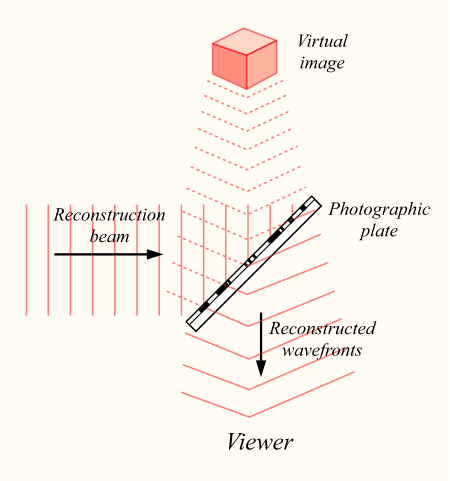
450px-Holography-reconstruct.svg.png

(thanks to Wikipedia)

My question is, are the wavefronts also correctly reconstructed on the other side, i.e. towards the cube? That is, in the above example, would the points in space that correspond to the surface of the cube, be points in space where the wavefronts constructively interfere, thus resulting in large amplitude?

Thanks in advance,
rumborak
 
Science news on Phys.org
Not the way you have it pictured. But you can make a real image of a hologram - where the image appears in front of the hologram.

Using your diagram, and assuming that the reconstruction beam is planar, then a similar planar beam coming from the right would allow the real image to be seen as viewed from the top of the diagram.
 
Last edited:
Hi Scott,

Thanks for responding so quickly. What I'm interested in is not the virtual image though (and I agree that flipping the reference beam would produce the virtual image on the other side), but rather, in the same setup as above where the reference beam is coming from that left, what the wavefronts look like in the area where the cube used to be.
My wild guess is that the wavefronts recreate the point sources that the cube surface used to be, in the positions of that surface. But, can anybody confirm that hunch?
 
Goodman's book "Introduction to Fourier Optics" has an excellent discussion of this- if you illuminate the hologram with a conjugate reference wave (loosely, the 'opposite direction'), the hologram will produce a real image that is the complex conjugate of the original object:

http://imagebank.osa.org/getImage.xqy?img=cCF6ekAubGFyZ2Usb2wtMjEtMTYtMTI5NS1nMDAx

In general, a hologram will produce both a real and virtual image:

http://cnx.org/resources/b5e5db18ff14bb75a9315309fe8ddc41/Figure_31_05_15.jpg

Certain recording techniques (Gabor holograms) produce both real and virtual images that are in line with each other. the Leith-Upatnieks recording geometry spatially separates the real and virtual image.
 
Ooooh, thank you very much, Andy! That's exactly what I wondering/hoping for.
 

Similar threads

  • · Replies 21 ·
Replies
21
Views
6K
  • · Replies 1 ·
Replies
1
Views
10K
  • · Replies 2 ·
Replies
2
Views
14K
  • · Replies 4 ·
Replies
4
Views
5K
  • · Replies 27 ·
Replies
27
Views
18K
  • · Replies 1 ·
Replies
1
Views
3K
  • · Replies 9 ·
Replies
9
Views
2K
Replies
8
Views
3K
  • · Replies 1 ·
Replies
1
Views
3K
  • · Replies 11 ·
Replies
11
Views
5K