Are the positive charges from a hole and a proton ?

Click For Summary
SUMMARY

The discussion clarifies the concept of holes in n-type semiconductors, specifically addressing the role of phosphorus as a dopant in silicon. When phosphorus donates an extra electron, it does not create a hole; instead, the positive charge remains locked in the ionic core of the phosphorus atom. This is because the positive charge associated with the phosphorus nucleus does not move, distinguishing it from the mobile holes created by trivalent dopants like gallium. The conversation emphasizes the importance of understanding band structure and energy levels in semiconductor physics.

PREREQUISITES
  • Understanding of semiconductor physics
  • Knowledge of n-type and p-type doping
  • Familiarity with band structure and energy levels in solids
  • Basic concepts of covalent bonding in silicon
NEXT STEPS
  • Research the role of trivalent elements like gallium in creating holes in semiconductors
  • Study the band structure of silicon and its implications for electron mobility
  • Explore the concept of donor and acceptor energy levels in semiconductor materials
  • Learn about intrinsic and extrinsic carrier concentrations in semiconductors
USEFUL FOR

Students and professionals in physics and electrical engineering, semiconductor researchers, and anyone interested in the principles of doping in semiconductor materials.

Kerrigoth
Messages
14
Reaction score
1
The book I'm reading is discussing the physics of semiconductors. I'm having a hard time understanding a passage in section introducing n-type semiconductors.

(Phosphorus is used as the impurity)
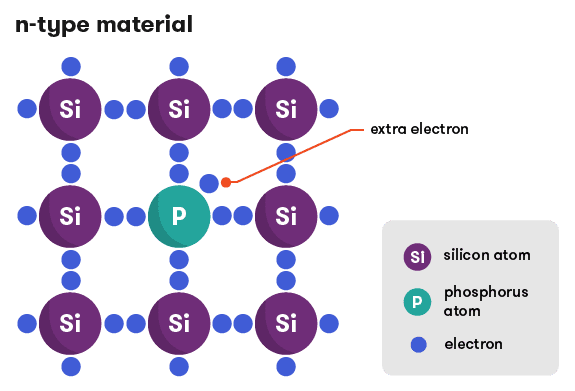
n-type-v2.png


The book says:
"At normal operating temperatures, this extra electron breaks its bond with the impurity atom and becomes a free electron. However, a hole is not created by the impurity atom--the positive charge that balances the free electron is locked in the ionic core"​

I've been under the impression holes are regarded as positive charge because when an electron is absent the atom becomes ionized. This ionization is why the hole is considered positive. How could the atom be ionized without a hole present?

So why would the author say a hole is not created after an electron becomes free? This missing electron's vacancy could be filled by other extra electrons contributed by other phosphorus atoms in the doped material.

Thanks for your time.
 
Physics news on Phys.org
Kerrigoth said:
How could the atom be ionized without a hole present?

So why would the author say a hole is not created after an electron becomes free? This missing electron's vacancy could be filled by other extra electrons contributed by other phosphorus atoms in the doped material.
Band structure.
In your material the silicon determines the band structure. One phosphorus atom can lose its electron to become delocalized. but the effect of its extra proton (which is confined to the nucleus) is minimal because the matrix is silicon.
 
Let's go step by step. Take a look at the crystal structure of silicon, for instance at http://hyperphysics.phy-astr.gsu.edu/hbase/solids/sili2.html. You can see that each silicon atom has 4 neighbours. The reason is that the bonding of silicon atoms is covalent. Silicon has 4 valence electrons and forms 4 covalent bonds with its neighbours.
Covalent bond comes from sharing electronic states between neighbouring atoms (not sharing electrons as it sometimes described). Basically, you have two atoms with electronic states of similar energy in the same space and you form two new states: one state with energy lower than that of an isolated atom (bonding state) and one with the energy higher than that of isolated atom (antibonding state). Each of those states can accept two electrons (with opposite spins). Since each silicon atom has four valence electrons, these electrons will occupy the bonding covalent state and the antibonding state would remain empty.
If you assemble atoms into a large crystal, these states form bands, that is electrons can move freely across the crystal and you have kinetic energy in addition to the electrostatic energy of the state (attraction to the positive charges of the nuclei). The occupied bonding covalent states of all the atoms in the crystal form the valence bands and the empty antibonding states will form conduction bands. There is an energy gap between the highest valence band and the lowest conduction band.

Now, if you put a phosphorus atom in a place of silicon, it will form same electronic states as silicon but it has one more electron. This electron will be put into the valence band and it is free to move around in the crystal. The positive charge is actually residing in the nucleus and can't move, hence it is not a hole.
To get a hole, dope the crystal with a trivalent element, like gallium. Gallium replacing a silicon atom anywhere in the crystal will, again, form exactly same states as silicon but has only 3 valence electrons. Therefore, there will be a room for another electron in the valence band. That empty space is mobile and it is called a hole.

I hope I managed to clarify things a bit rather than confuse you more.

H.
 
  • Like
Likes   Reactions: Vedward and nasu
I don't know whether you still have got the question or not but, here a small explanation.
The one extra electron has the energy level Ed or the donor energy level. At T=0, i.e. the total freeze out effect such electrons remain at Ed level, as T increases few electron shifts to Ec, leaving behind +ve empty state in Ed energy level, if I am not wrong the energy state you are referring to is a valence band energy state, but the electron that is in contrast is from donor energy state, so it will leave behind an empty state at Ed level and not Ev level, now the transition you are looking for is Ev to Ed transition(i.e. "why not valance band electrons moves to the empty region", as you have asked), but when you increase T, Ed to Ec transition takes place(since this gap is many many times smaller than Ev to Ed gap), and when T is well above 300K Ed becomes almost empty and all electrons shifts from Ed to Ec. Beyond this temperature, electron hole pairs are generated from the valance band and ni(intrinsic carrier concentration) takes over as majority carrier concentration. Now you may say, "so at such high temperature, Ev to Ed transition is possible?", well theoretically even if it does still the electron in no time will then shift from Ed to Ec(since the gap between Ed and Ec is very small and T is very high).
So, that's the whole thing.
 
Last edited:
You've got it right

H
 

Similar threads

  • · Replies 2 ·
Replies
2
Views
3K
  • · Replies 1 ·
Replies
1
Views
3K
  • · Replies 2 ·
Replies
2
Views
3K
  • · Replies 24 ·
Replies
24
Views
3K
  • · Replies 0 ·
Replies
0
Views
3K
  • · Replies 2 ·
Replies
2
Views
4K
  • · Replies 9 ·
Replies
9
Views
3K
  • · Replies 1 ·
Replies
1
Views
1K
  • · Replies 2 ·
Replies
2
Views
2K
  • · Replies 3 ·
Replies
3
Views
552