Are Uncontacted Tribes Influenced by External Cultures?

  • Thread starter Thread starter rootX
  • Start date Start date
Click For Summary

Discussion Overview

The discussion revolves around the influence of external cultures on uncontacted tribes, particularly focusing on the Piraha tribe and their unique cultural characteristics. Participants explore various aspects of these tribes, including their perceptions of outsiders, the implications of contact, and the cognitive effects of language and culture.

Discussion Character

  • Exploratory
  • Debate/contested
  • Conceptual clarification
  • Technical explanation

Main Points Raised

  • Some participants express surprise at the existence of uncontacted tribes and speculate on their perceptions of outsiders, suggesting that they may view outsiders as gods or predators.
  • There are references to the Piraha tribe, with discussions on their lack of abstract concepts and unique cultural traits, such as the absence of numbers and creation myths.
  • Participants question the implications of contact with uncontacted tribes, with some arguing for the need to protect them from outside influences while others suggest studying their habits from a distance.
  • Concerns are raised about the potential impact of diseases on uncontacted tribes, with discussions on the vulnerability of these populations to illnesses like smallpox and influenza.
  • Some participants discuss the relationship between language and thought, with references to how cultural constraints may influence cognitive processes, particularly in the context of the Piraha tribe.
  • There are humorous and light-hearted comments about throwing objects at the tribes, reflecting a mix of serious and playful tones in the discussion.

Areas of Agreement / Disagreement

Participants do not reach a consensus on the influence of external cultures on uncontacted tribes. Multiple competing views are presented regarding the necessity of contact, the implications of cultural differences, and the cognitive effects of language.

Contextual Notes

Some statements reflect uncertainty about the nature of contact and its consequences, as well as the complexities of cultural influence on cognition. The discussion includes references to various sources and articles, which may not be universally accepted or verified.

Who May Find This Useful

Readers interested in anthropology, linguistics, cultural studies, and the dynamics of human interaction with isolated communities may find this discussion relevant.

rootX
Messages
480
Reaction score
4
I never of them before :eek:

_44701396_pixone.jpg


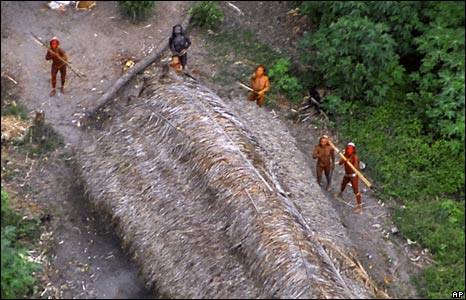
Its really surprising that few of them are of black color (or maybe they painted themselves black?) I think black ones are females .

http://news.bbc.co.uk/2/hi/in_pictures/7426869.stm
 
Biology news on Phys.org
Nice picture, it captures a moment of our past.

We must appear as gods to them.
 
Now that's an interesting discovery. I especially like the picture of the warriors prepping to shoot arrows at the plane or helicopter.

_44701421_pixw.jpg


It's nice to think that there's still tribes out there that still haven't been influenced by outside culture.
 
Last edited:
what said:
Nice picture, it captures a moment of our past.

We must appear as gods to them.

no no .. we are not gods, majority we are predators :biggrin:
 
What the freak is that black noise maker flying above us?...Lets shoot arrows at it!

That's crazy. :bugeye:
 
'We do not need to make contact with them. We need to protect them. We need to completely leave them alone, but it sure would be nice to fly over once and a while and study their habits.'

UFOs:rolleyes:
 
what said:
We must appear as gods to them.

I'm sure we appear to be quite the opposite.
 
B. Elliott said:
'We do not need to make contact with them. We need to protect them. We need to completely leave them alone, but it sure would be nice to fly over once and a while and study their habits.'

UFOs:rolleyes:

Are aliens thinking the same way?
Because of our own good, they just staying away from us.


My Algebra professor compared us to some tribe named Peruhara (I forgot the exact name) who lack abstraction - they are really interesting and dumb people. I don't remember exactly what he said but something like if you are walking in straight line and then take a turn, you would become invisible to them llol
 
  • #10
Wow! That is pretty interesting, thanks for posting :smile:
 
  • #12
Throw empty glass coke bottles at them. Bahahahahaha.
 
  • #13
Cyrus said:
Throw empty glass coke bottles at them. Bahahahahaha.

Magic demon crystals!

*edit* That just reminded me of the tribe that was in Joe vs. the Volcano. lol
 
  • #14
Those two movies have got to be some of my favorites, ever!
 
  • #15
Cyrus said:
Throw empty glass coke bottles at them. Bahahahahaha.

There is a movie like that :smile:

Edit: note to self, read rest of postings. Nevermind
 
  • #16
rootX said:
My Algebra professor compared us to some tribe named Peruhara (I forgot the exact name) who lack abstraction - they are really interesting and dumb people. I don't remember exactly what he said but something like if you are walking in straight line and then take a turn, you would become invisible to them llol
That would be the Piraha. I wrote this back in 2004.

Cultural constraints on cognition?

--------------------------------------------------------------------------------

Marcus, you mentioned an interest in linguistics. I wonder what your neighbor would think about this. I have been interested for some time in tribal cultures in South America and New Guinea. This tribe, the Piraha, is the most unusual I have come across.

I'd like to know what you and others think about this. Does their culture prevent them from learning?

The first is an article giving a brief overview of the tribe. The second (PDF) covers their language and culture.

Rueters

"Members of a tiny, isolated Brazilian tribe have no words for numbers other than "one or a few" or "many" and seem to have trouble counting, the researchers reported.

The Piraha tribespeople are clearly intelligent, so the finding opens questions into how language may affect thinking, the researchers say in this week's issue of the journal Science."

http://www.reuters.co.uk/newsArticle...199 §ion=news <broken>

The Piraha language challenges simplistic application of Hockett’s (1960) nearly universally-accepted “design features of human language”, by showing that some of these design features (interchangeability, displacement and productivity) may be culturally constrained. In particular Piraha culture constrains communication to non-abstract subjects which fall within the immediate experience of interlocutors. This constraint explains several very surprising features of Piraha grammar and culture:

1) The absence of creation myths and fiction
2) The simplest kinship system yet documented
3) The absence of numbers of any kind or a concept of counting
4) The absence of color systems
5) The absence of embedding in the grammar
6) The absence of “relative tenses”
7) The borrowing of its entire pronoun inventory from Tupi
8) The fact that the Piraha are monolingual after more than 200 years of regular contact with Brazilians and the Tupi-Guarani-speaking Kawahiv
9) The absence of any individual or collective memory of more than two generations past
10) The absence of drawing or other art and one of the simplest material cultures yet documented
11) The absence of any terms for quantification, e.g. “all”, “each”, “every”, “most”, “some”, etc…
Since my links are broken, I will just throw this article in for now.

http://www.newyorker.com/reporting/2007/04/16/070416fa_fact_colapinto
 
Last edited by a moderator:
  • #19
Evo said:
That would be the Piraha. I wrote this back in 2004.
Wow, that's crazy. That has some profound implications in it about the nature of human development.
 
  • #20
I don't know much about linguistics, but I had a prof in college who was fascinated by mathematical notation. He believed that the influence of notation on mathematical thought was huge.

After learning Dirac notation, I found it certainly changed the way I thought about quantum mechanics. The notation became a scaffold for my thinking.

So if notation can influence how one thinks of mathematical concepts, I can see how language could influence thought.

But it seems that it would be hard to distinguish the influence of language from the influence of culture.
 
  • #21
lisab said:
I don't know much about linguistics, but I had a prof in college who was fascinated by mathematical notation. He believed that the influence of notation on mathematical thought was huge.

After learning Dirac notation, I found it certainly changed the way I thought about quantum mechanics. The notation became a scaffold for my thinking.

So if notation can influence how one thinks of mathematical concepts, I can see how language could influence thought.

But it seems that it would be hard to distinguish the influence of language from the influence of culture.
I also disagree with the person that stated "language influences thought", in this case, They've been exposed to language from another tribe for over 200 years and it has not changed them. They are satisfied with their simplicity. It seems to work for them.
 
  • #22
The Piraha and Dirac is fascinating. How could George Orwell have known, when he invented http://www.netcharles.com/orwell/articles/col-newspeak.htm :

...Newspeak is closely based on English but has a greatly reduced and simplified vocabulary and grammar. This suited the totalitarian regime of the Party, whose aim was to make subversive thought ("thoughtcrime") and speech impossible...
 
Last edited by a moderator:
  • #23
I've read about isolated tribes (I think in Australia and parts of Polynesia) that as recently as a few decades ago, when they were studied pretty extensively, hadn't yet figured out the connection between sex and conception. That too may be related to design aspects of their languages.
 
  • #24
Has any research gone into the idea that it isn't the language that limits their thinking, but their thinking that limits their language? Why can't a tribe uncontacted by the rest of the world for thousands of years, not have an actually physically different brain by now?
 
  • #25
How can language affect "basic" thinking? If I see a picture of a part of the body that I don't know the name for, but I see where it belongs in the body, what difference does it make if I know the name?

Someone might know that if you eat a certain plant you will get sick or die. You don't need the words for plant, sick or die to put them together in your mind and understand the link between them.

You don't need to have words for fire, hot or burn to understand. language just makes communicating what you know with someone else easier. Of course, you could just demonstrate and neither would need words.
 
Last edited:
  • #26
Evo said:
How can language affect "basic" thinking? If I see a picture of a part of the body that I don't know the name for, but I see where it belongs in the body, what difference does it make if I know the name?

Someone might know that if you eat a certain plant you will get sick or die. You don't need the words for plant, sick or die to put them together in your mind and understand the link between them.

You don't need to have words for fire, hot or burn to understand. language just makes communicating what you know with someone else easier. Of course, you could just demonstrate and neither would need words.

It is argued that the language one learns as a child directly affects the development of the brain... or perhaps I should say cognitive processes.
 
  • #27
On a related note: I recall my German Professor saying that at some age, something around four or five years, maybe a little older... the language known will always be one's native tongue. Any other language learned after that time will always be secondary in one's thinking processes.
 
  • #28
Gokul43201 said:
I've read about isolated tribes (I think in Australia and parts of Polynesia) that as recently as a few decades ago, when they were studied pretty extensively, hadn't yet figured out the connection between sex and conception. That too may be related to design aspects of their languages.

That sounds like rural Wisconsin a few decades ago (like when my parents were young). Well, at least young married couples. Sex was a pretty uncomfortable topic for parents to talk about to their kids. Sometimes the doctor had to be the one to explain where these kids kept coming from.

For the most part, I'd be surprised at a culture where no one knew that. Even your primitive cultures had drugs that lessened the chance of pregnancy or had a good chance of ending a pregnancy. Having more than one child nursing at a time usually wasn't a good thing.
 
Last edited:
  • #29
BobG said:
That sounds like rural Wisconsin a few decades ago (like when my parents were young). Well, at least young married couples. Sex was a pretty uncomfortable topic for parents to talk about to their kids. Sometimes the doctor had to be the one to explain where these kids kept coming from.

For the most part, I'd be surprised at a culture where no one knew that. Even your primitive cultures had drugs that lessened the chance of pregnancy or had a good chance of ending a pregnancy. Having more than one child nursing at a time usually wasn't a good thing.

Nursing usually - though not always - suppresses ovulation.
 
  • #30
Ivan Seeking said:
It is argued that the language one learns as a child directly affects the development of the brain... or perhaps I should say cognitive processes.
I've heard that argument, of course learning a language is a part of learning overall, which would I assume would affect development of the brain, but additional learning can come without language. Nereid had brought this up in one of our discussions that for these tribes an ethnobotanist would be better at determining the level of knowledge that these tribes possesses than an anthropologist.

Trapped in a jungle, would you rather have an illiterate tribesman that knows the thousand important ways to survive or a PHD in English Literature? :-p

Nereid said:
Presumably the Piraha are (or were) quite successful in their environment - do any of the materials mention how long they've been there as a group? It obviously can't be more than ~13,000 years.

Everett is an anthropologist, not an ethnobotanist, so presumably couldn't assess the depth and sophistication of the Piraha's knowledge and understanding of the local flora. IIRC, all (most?) hunter-gatherer groups who've been studied by ethnobotanists have shown - to us - astonishingly rich understanding of their local flora. The extent of the Piraha's capabilities might be an easy way to test hitssquad's idea (unless, of course, such rich botanical understanding can be easily acquired by people with low IQ).

Evo, have you come across the Fayu of New Guinea in your reading?
 
Last edited:

Similar threads

Replies
8
Views
6K
Replies
1
Views
3K
  • · Replies 25 ·
Replies
25
Views
2K
  • · Replies 29 ·
Replies
29
Views
5K
  • · Replies 4 ·
Replies
4
Views
2K
Replies
5
Views
2K
  • · Replies 12 ·
Replies
12
Views
3K
  • · Replies 28 ·
Replies
28
Views
4K
  • · Replies 10 ·
Replies
10
Views
2K
  • · Replies 15 ·
Replies
15
Views
3K