Are we predisposed to run along the line of a falling tree?

  • Thread starter Thread starter Melbourne Guy
  • Start date Start date
  • Tags Tags
    Falling Line Tree
Click For Summary

Discussion Overview

The discussion revolves around the behavior of animals and humans in response to falling objects, particularly whether there is a predisposition to run along the line of a falling tree or similar structures. Participants explore the implications of this behavior in both real-life scenarios and fictional portrayals in movies, considering aspects of instinctual reactions, safety, and decision-making under pressure.

Discussion Character

  • Exploratory
  • Debate/contested
  • Conceptual clarification
  • Experimental/applied

Main Points Raised

  • Some participants note that in movies, characters often run along the line of a falling object, questioning whether this reflects a real instinctual behavior in animals.
  • One participant suggests that running straight away from a threat may be a faster reaction than trying to change direction, especially when being chased.
  • Another participant argues that the portrayal in movies is unrealistic and suggests that people would not actually behave that way in real life.
  • Some participants share personal anecdotes about experiences with falling trees, indicating that they instinctively ran along the line of the fall.
  • There is a suggestion that under extreme pressure, instinct may override logical thinking, leading individuals to run in the direction of the threat.
  • A proposal for a study is made to test how people react to falling trees and whether they would run in the same direction as the fall.
  • Participants discuss the potential for learning and adaptation in response to threats, such as dodging baseballs, and how this might relate to instinctual responses to falling objects.

Areas of Agreement / Disagreement

Participants express a range of views, with no clear consensus on whether running along the line of a falling object is a hard-coded behavior or a product of situational instinct. The discussion remains unresolved regarding the validity of this behavior in real-life scenarios versus its depiction in media.

Contextual Notes

Participants acknowledge the complexity of instinctual responses, the influence of adrenaline, and the potential for learned behavior in reaction to threats. There are also considerations regarding the timing and decision-making involved in fleeing from danger.

Melbourne Guy
Messages
462
Reaction score
315
TL;DR
In movies, when something tall falls toward the protagonist, they run along the line of the fall. Why?
We have trams in Melbourne, and this weekend I watched a pigeon on the tracks fly up and along the route as the tram came along, being hit by the windscreen (it survived, no worries). Yet it could of flown up and across and escaped because the tram was higher than it was wide.

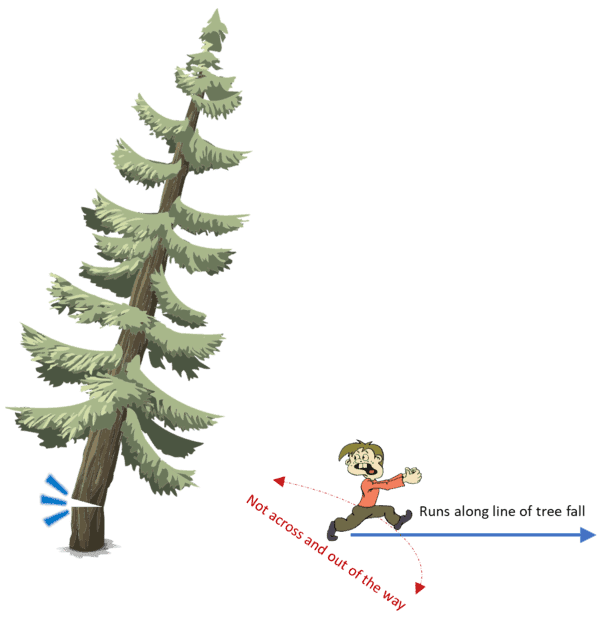
It prompted the thought that in movies, especially, when something tall like a tree or building falls on them, they run along the line of the falling object, just like the pigeon did, rather than to the side.

Does anyone know whether this is a hard-coded behaviour typical in most animals? Or is this a good behaviour in most circumstances?
1659949017712.png
 
Biology news on Phys.org
A crow would nonchalantly jump out of the way!
 
PeroK said:
A crow would nonchalantly jump out of the way!
Crows are certainly smarter than pigeons, @PeroK, well spotted. And possibly smarter than us, on that basis 🤔
 
  • Haha
  • Like
Likes   Reactions: hutchphd and PeroK
Melbourne Guy said:
Summary: In movies, when something tall falls toward the protagonist, they run along the line of the fall. Why?

We have trams in Melbourne, and this weekend I watched a pigeon on the tracks fly up and along the route as the tram came along, being hit by the windscreen (it survived, no worries). Yet it could of flown up and across and escaped because the tram was higher than it was wide.

It prompted the thought that in movies, especially, when something tall like a tree or building falls on them, they run along the line of the falling object, just like the pigeon did, rather than to the side.

Does anyone know whether this is a hard-coded behaviour typical in most animals? Or is this a good behaviour in most circumstances?

View attachment 305561

I guess if an animal is being chased by another animal, then changing direction too soon would be a mistake because the chasing animal, from a distance, needs to change direction at a smaller angle than the chased animal, to correct course and intercept it, and thus loses less speed and closes in faster. So cutting to the side has to be timed just right and done at the last second. Before that, it is better to maintain a strait line path which allows for maximum speed.
 
Last edited:
  • Like
  • Informative
Likes   Reactions: pinball1970, hutchphd and Melbourne Guy
Jarvis323 said:
So cutting to the side has to be timed just right and done at the last second. Before that, it is better to maintain a strait line path which allows for maximum speed.
That's a great point, @Jarvis323, thanks, I had not considered this.
 
Melbourne Guy said:
In movies, when something tall falls toward the protagonist, they run along the line of the fall. Why?
Because they would be out of danger almost immediately. Where's the suspense in that? Yes, it's utterly moronic and I don't believe people would actually DO that but you're talking about the movies.
 
  • Haha
Likes   Reactions: Melbourne Guy
phinds said:
Yes, it's utterly moronic and I don't believe people would actually DO that but you're talking about the movies.
Now you've got me thinking about a study to test the theory, @phinds! Though I do recall, once, chopping trees with my father, when one came down toward us, we both ran along the line of the fall, rather than sideways, which would have gotten us out of the way more quickly. Fortunately, the tree missed us...and the car, yikes...but I'd forgotten about that little incident. My father and his chainsaw, my God, he was a danger to man and beast alike.
 
  • Like
Likes   Reactions: PeroK
“[...]"Come on. Let's run away."

"Where to?"

Rincewind sighed. He'd tried to make his basic philosophy clear time and again, and
people never got the message.

"Don't you worry about to," he said. "In my experience that always takes care of itself.
The important word is away.”
By Terry Pratchett, in Eric

Dodging requires time to clarify the situation first. To start running comes faster :smile:

Ps.: by the way, it's one very bad idea to remain in the proximity of the trunk when a tree falls.
 
  • Like
Likes   Reactions: Melbourne Guy
Rive said:
To start running comes faster :smile:
That is likely the underlying mechanism, @Rive. Threat...reaction, with not much conscious thought, but also an instinctual understanding that usually, the straight line is the best reaction, as per @Jarvis323's observation.
 
  • #10
Melbourne Guy said:
Now you've got me thinking about a study to test the theory, @phinds! Though I do recall, once, chopping trees with my father, when one came down toward us, we both ran along the line of the fall, rather than sideways, which would have gotten us out of the way more quickly. Fortunately, the tree missed us...and the car, yikes...but I'd forgotten about that little incident. My father and his chainsaw, my God, he was a danger to man and beast alike.
Just a thought, it could be simpler than that. If you have a large falling tree you have a split second to start running, so you run.
Your brain could work that fast, under pressure, with adrenaline pumping to think of run out of the fall path maybe too much to ask.
Instinct would be tree approaching from North you run south.
Thinking about it the safest place to run would be to run NNW or NNE. Towards the tree but just missing it then you are out of the kill zone.
Not an instinctive thing to do.
You would not do that with a lion, run towards it then change direction last split second.
I forgot the noise part, you would run in the opposite direction.
Flight taking over from being logical.
Hopefully I will never be in a position to test this hypothesis.
 
Last edited:
  • Like
Likes   Reactions: Melbourne Guy
  • #11
Melbourne Guy said:
Now you've got me thinking about a study to test the theory
Excellent idea.
participants should be placed in various close positions around the tree.

A the tree is falling, would one not expect all participants to run in the same direction as the tree is falling.
ie if the tree is falling North, they all run North?
I would premise that all participants would move radially away from the tree in an attempt to increase their distance from the threat. An instinctive flight or fight response.

For the second trial and subsequent trials, increase the initial radial distance of the participants to the base of the tree. Here I premise that above and beyond a particular radial distance, which would be different for each participant, the initial movement would be to get out of the way with some tangential motion rather than complete radial motion in order to decrease the threat. Some participants off to the side might even decide to stay put as they would see no threat at all. Key word being 'decide'.

For the final trails, have the participants line up and throw baseballs at them.
Some participants might freeze and be hit. Some participants might dodge their bodies to avoid the collision. It would be interesting to find out if anyone would attempt to outrun the baseball.
After several of these trails, I premise that the majority of people would learn to attempt to dodge the baseball. ( or even catch it )
Keyword being 'learn'.
 
  • #12
256bits said:
For the final trails, have the participants line up and throw baseballs at them.
🤔 Don't they do that on a regular basis in that country just south of you, @256bits? Actually, I played a bit of little league when young, you're right, some kids flinched, some kids were hit, and some kids dodged because we had to learn to deal with the baseballs in flight. (Coach made me a pitcher, so I most got to do the throwing!)

Though I don't recall anyone trying to outrun one, perhaps even though instinct is involved, we do gauge the speed of the approaching / falling object and realize outrunning a fast-moving ball is not possible?
 
  • Like
Likes   Reactions: 256bits

Similar threads

  • · Replies 1 ·
Replies
1
Views
2K
Replies
12
Views
4K
  • · Replies 84 ·
3
Replies
84
Views
8K
  • · Replies 7 ·
Replies
7
Views
4K
  • · Replies 15 ·
Replies
15
Views
6K
  • · Replies 21 ·
Replies
21
Views
5K
  • · Replies 94 ·
4
Replies
94
Views
12K
  • · Replies 1 ·
Replies
1
Views
3K
  • · Replies 4 ·
Replies
4
Views
9K
  • · Replies 3 ·
Replies
3
Views
4K