Area of a general n-sided polygon

  • Context: Undergrad 
  • Thread starter Thread starter I_am_learning
  • Start date Start date
  • Tags Tags
    Area General Polygon
Join the discussion
Ask a follow-up here, or get your own question answered by working scientists, mathematicians and engineers — people, not an autocomplete.
Real named experts · corrections over time · the nuance an AI answer skips
3 replies · 3K views
I_am_learning
Messages
681
Reaction score
16
Finding the area of an irregular polygon with n side is quite easy when we are given the length of all of the n sides and the length of (n-3) specific diagonals. This way, we get (n-2) triangles whose areas can be calculated using Heron's formula and then added up.
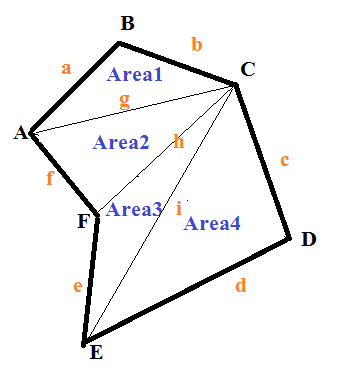
attachment.php?attachmentid=65765&stc=1&d=1390046811.png

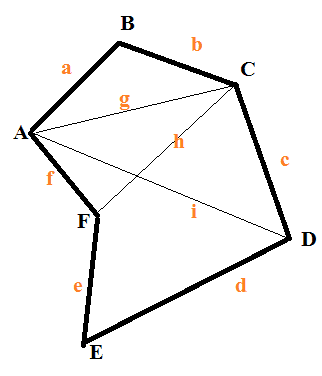
But what if the length of the (n-3) diagonals provided doesn't make (n-2) triangles, such as this case:
attachment.php?attachmentid=65766&stc=1&d=1390046811.png

The polygon is still fully determined by the given measurements, but calculating the area is difficult.
Is there some sort of generic formula for such cases? Like maybe using matrices. :D

I thought of making a mobile application to help real-estates peoples calculate the area of lands, and came-up with this question.
Thank you.
 

Attachments

  • easy.png
    easy.png
    3.4 KB · Views: 1,159
  • hard.png
    hard.png
    2.9 KB · Views: 917
Mathematics news on Phys.org
SteamKing said:
There are several different methods of finding areas of general polygons:

http://en.wikipedia.org/wiki/Polygon

When you say 'real estate peoples', are you referring to land surveyors or someone else?


There is no formula for finding area when n sides and n-3 diagonals are known.
The surveyors formula seems to be the best way to go. So from the given information, I should somehow find the coordinates of all the vertices and also sort them counter clockwise or clockwise.

By real state peoples I just meant anyone who is involved in buying or selling of lands.
 
Well, in the US, the land surveyor is the professional who confirms and measures the boundaries of a particular plot of land. There is usually a legal description of the land produced for a deed of title to the land, which would contain the area enclosed by these boundaries.

The proper orientation for your vertex coordinates is counterclockwise to calculate the positive area of the figure. If you use a clockwise orientation, the result will be a negative area. This comes in handy if you want to evaluate the area of complex, non-convex polygons, say a polygon with a hole in it.