Calculating the Area of an Apollonian Gasket: A Formula for n Layers

  • Context: Undergrad 
  • Thread starter Thread starter caters
  • Start date Start date
  • Tags Tags
    area circle geometry
Click For Summary

Discussion Overview

The discussion revolves around calculating the area of an Apollonian gasket with a focus on defining layers and the corresponding radii of circles within those layers. Participants explore the mathematical formulation of the area as well as the conceptual understanding of what constitutes a layer in the context of the gasket's structure.

Discussion Character

  • Exploratory
  • Technical explanation
  • Conceptual clarification
  • Debate/contested

Main Points Raised

  • One participant presents a formula for the area of n layers of an Apollonian gasket, involving the outer circle's radius and the radii of inner circles, and seeks clarification on how to represent this formula effectively.
  • Another participant questions the definition of "layers," suggesting that the nth layer should be defined by the largest possible disk fitting into the gaps left by the previous layers.
  • A participant clarifies that for their definition, n represents the number of different radii that are not the radius of the outer circle, with the radii defined geometrically and trigonometrically.
  • Further clarification is sought on how the "next layer" is defined, with one participant suggesting that layers alternate between inward and outward changes in radius.
  • In discussing n = 3, a participant describes the radii involved, indicating that as n increases, the radii decrease and approach zero, while the area approaches that of the outer circle.
  • Another participant expresses confusion regarding the definition of layers, proposing a different naming convention for the disks and seeking further explanation on how these disks are categorized into layers.

Areas of Agreement / Disagreement

Participants express differing views on the definition of layers within the Apollonian gasket, with some proposing a geometric approach while others suggest a more functional definition based on the arrangement of disks. The discussion remains unresolved regarding a consensus on how to define layers and the corresponding radii.

Contextual Notes

The discussion highlights limitations in the definitions of layers and radii, as well as the dependence on geometric arrangements. There are unresolved questions regarding the mathematical representation of the area formula and the conditions under which it holds true.

caters
Messages
229
Reaction score
10
Here is my formula for the area of n layers of appolonian gasket(assuming no circles past the nth layer):

$$πR^2 - (πR^2 - (\sum_{0}^{n} x_n*πr_{n}^2))$$

Here R is the radius of the outer circle, r is the radius of an inner circle, x is a function that represents the number of circles in a given layer and n is the number of layers.

I know this is right as far as calculating area is concerned but how would I actually represent this if I wanted to show someone else this formula?

The reason I only have ##πr_{n}^2## once is because here is what the sum would be like for a successive number of layers. If I assume I have this kind of Apollonian gasket:
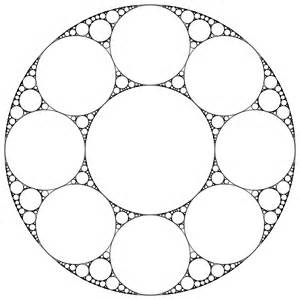
th?&id=OIP.Me9c0c5c93c2ef6467e1d285d31f776b0o0&w=300&h=300&c=0&pid=1.9&rs=0&p=0&r=0.jpg


then the area formula is like this as n increases:

n=0

$$πR^2 - (πR^2 - (πR^2)) = πR^2$$

n=1

$$πR^2 - (πR^2 - (πr_{1}^{2}))$$

n=2

$$πR^2 - (πR^2 - (πr_{1}^2 + 8*πr_{2}^2))$$

n=3

$$πR^2 - (πR^2 - (πr_{1}^2 + 8*πr_{2}^2 + 8*πr_{3}^2))$$

etc.

But I could easily replace each of those multipliers with ##x_1##, ##x_2##, ##x_3## etc.

So basically every time n increases by 1 is a time when the radius changes in an Apollonian gasket as you get more and more circles inside that 1 outer circle.

Would the general formula for any Apollonian gasket I have at the top of this post be the best way to represent this area formula?
 
Last edited by a moderator:
Physics news on Phys.org
I'm not sure how "layers" is being defined. I would have guessed that a disk of the n+1st layer is one that is as large as possible inside one of the gaps left by the nth layer.

But if so, then beginning with n = 3 (i.e., in the 3rd layer), the radii of its disks are not just a function of n. So I am not sure if I understand the definition of what the nth layer is.
 
The way I am defining it here is that when n = 0, the resulting formula is just the area of the outer circle. x I am defining here as a function that represents how many circles there are of a given radius at n.

In the n =/ 0 case, n represents the number of radii that aren't the radius of the outer circle. so when n = 3, there are 3 radii that aren't the radius of the outer circle. As n increases, the number of different radii increases in a 1:1 ratio. So it is the number of radii, not the radii themselves that n represents. The radii are defined in a geometric and trigonometric way.
 
I'm not asking how many, but how is the "next layer" defined?
 
And the next layer is defined by a change in radius as you go either outwards or inwards. I myself would do it so that inward and outward layers alternate. So I would have at n = 4, the center circle radius, tangent circle radius, first outward layer(touches the largest tangent circles but itself isn't tangent to the outer circle), and first inward layer(same touching tangent circles but this time not being tangent to the center circle instead) for at least this kind of Apollonian gasket and in general for any Apollonian gasket, the next layer would be defined by the next smallest radius.
 
How about n=3 ?
 
For n = 3, in the kind of Apollonian gasket shown here the radii in that sum would be the center circle radius, tangent circle radius, and then the next smallest radius after that which is outwards from the tangent circles but itself isn't tangent to the outer circle. So in general, as n increases, the nth radius gets smaller and smaller and as n approaches infinity, the nth radius approaches 0 and the area of the Apollonian gasket approaches the area of the outer circle.
 
I am still very confused. Let's call the biggest disk — the "whole thing" — D(0).

Consider the "first" layer — the single largest disk D(1) (not counting the whole thing), centered at the center of the whole thing.

I will call the "second" layer the 8 disks that are tangent to D(1) and (internally) to D(0). We can call these the 8 D(2)'s

Now look at the disks having the largest remaining radius. These are each tangent to 2 of the D(2)'s, but lie between them and D(0), without being tangent to D(0).

I have no idea how these disks, which you would apparently call the third layer, are defined. Can you please explain?
 

Similar threads

  • · Replies 7 ·
Replies
7
Views
2K
  • · Replies 4 ·
Replies
4
Views
2K
  • · Replies 12 ·
Replies
12
Views
2K
Replies
6
Views
3K
  • · Replies 4 ·
Replies
4
Views
4K
  • · Replies 6 ·
Replies
6
Views
2K
  • · Replies 21 ·
Replies
21
Views
4K
Replies
28
Views
4K
  • · Replies 4 ·
Replies
4
Views
2K
  • · Replies 26 ·
Replies
26
Views
1K