Area of cylinder sliced by sphere

Click For Summary
SUMMARY

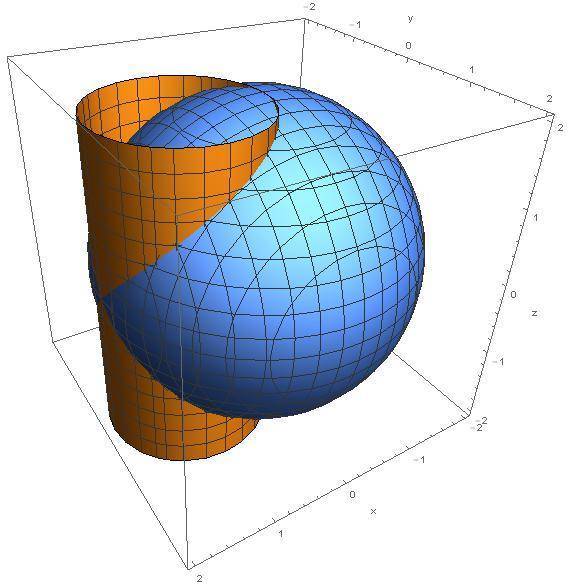
The discussion focuses on calculating the area of a cylinder defined by the equation $$x^{2}+y^{2}=ax$$ sliced by a sphere represented by $$x^{2}+y^{2}+z^{2}=a^{2}$$. A participant suggests correcting the exponent of y in the cylinder's equation to 2 and proposes using cylindrical coordinates for the calculation. The method involves translating the cylinder's axis to the origin and determining the limits for z based on the intersection of the two surfaces. This approach is deemed straightforward, although not executed in detail.

PREREQUISITES
  • Understanding of cylindrical coordinates
  • Familiarity with double integrals
  • Knowledge of surface area calculations
  • Ability to manipulate equations of geometric shapes
NEXT STEPS
  • Study the application of cylindrical coordinates in surface area calculations
  • Learn about the intersection of geometric shapes in three dimensions
  • Explore advanced techniques in double integrals for surface area
  • Investigate the implications of translating geometric figures in coordinate systems
USEFUL FOR

Mathematicians, physics students, and anyone involved in geometric analysis or surface area calculations in three-dimensional space.

etf
Messages
179
Reaction score
2
Hi!
Here is my task:
Calculate area of cylinder $$x^{2}+y^{x}=ax$$ sliced by sphere $$x^{2}+y^{2}+z^{2}=a^{2}$$.
Here is graph:
111.jpg


How to do it? If problem was "Calculate area of sphere $$x^{2}+y^{2}+z^{2}=a^{2}$$ sliced by cylinder $$x^{2}+y^{x}=ax$$" I would solve it using double integrals ($$P=\iint\sqrt{1+(\frac{\partial z}{\partial x})^{2}+(\frac{\partial z}{\partial y})^{2}}dxdy$$ over region $$x^{2}+y^{x}=ax$$). That area would be this (I think):
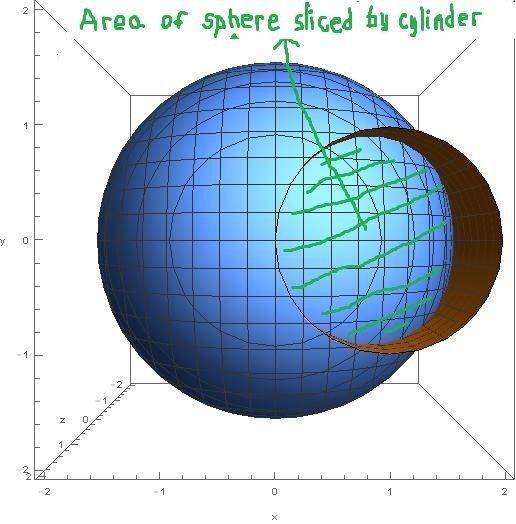
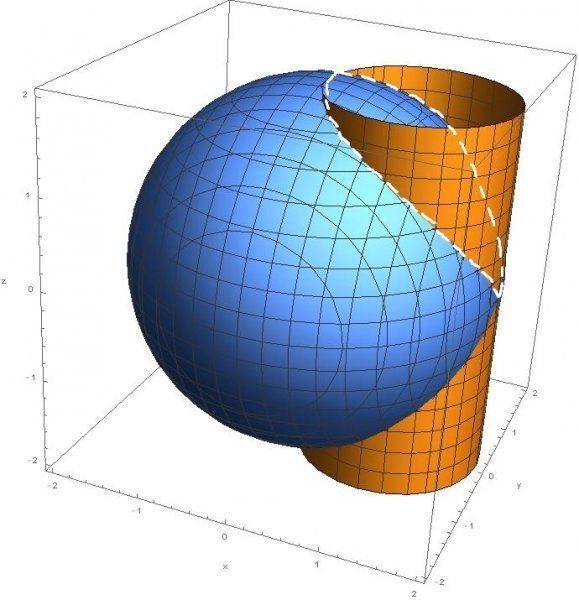
222.jpg


123.jpg


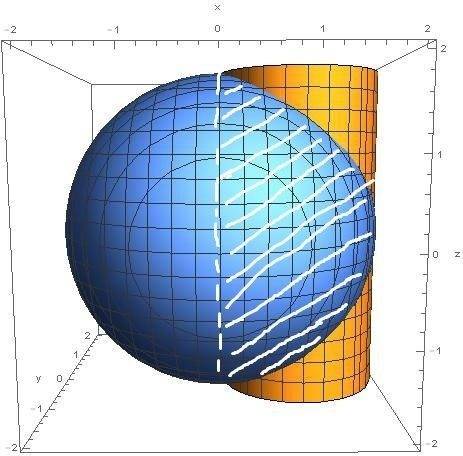
But what would be area of cylinder sliced by sphere? Maybe this:
444.jpg
 
Last edited:
Physics news on Phys.org
First correct the exponent of y in your equation of the cylinder, it is 2. Yes, it is the surface area of the cylinder contained within the sphere. Then, at first glance, I would translate the whole thing left by a/2 so that the axis of the cylinder passes through the origin and use cylindrical coordinates. r is constant, the limits on your polar angle are a full circle, and the limits on z (as a function of angle) are found from the intersection of the two equations. Should be straightforward (I didn't actually do it).
 

Similar threads

  • · Replies 2 ·
Replies
2
Views
2K
  • · Replies 3 ·
Replies
3
Views
2K
  • · Replies 9 ·
Replies
9
Views
3K
  • · Replies 8 ·
Replies
8
Views
2K
  • · Replies 1 ·
Replies
1
Views
1K
  • · Replies 7 ·
Replies
7
Views
2K
  • · Replies 2 ·
Replies
2
Views
2K
  • · Replies 4 ·
Replies
4
Views
2K
  • · Replies 4 ·
Replies
4
Views
2K