Area Under a Load Vs Deflection Curve

Click For Summary
SUMMARY

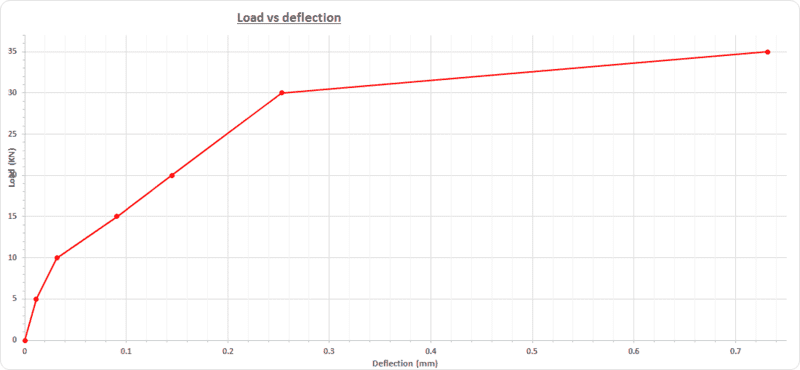
The area under a load versus deflection curve represents the work done on a material, specifically in terms of energy absorption during deformation. In the context of a concrete sample loaded until failure, integrating the curve from 0 to 0.75 mm (the deflection at failure) quantifies this work. Both energy and work share the same units, reinforcing that the area under the curve indeed reflects energy absorption as well as the work performed on the material during loading.

PREREQUISITES
  • Understanding of load versus deflection curves in material science
  • Basic knowledge of integration and regression analysis
  • Familiarity with the concepts of work and energy in physics
  • Experience with concrete material properties and failure analysis
NEXT STEPS
  • Study the principles of energy absorption in materials under load
  • Learn about regression techniques for curve fitting in experimental data
  • Explore the relationship between work and energy in mechanical systems
  • Investigate the behavior of concrete under various loading conditions and failure modes
USEFUL FOR

Engineers, material scientists, and researchers involved in structural analysis, concrete testing, and mechanical engineering will benefit from this discussion.

tomtomtom1
Messages
160
Reaction score
8
Hi all

I was wondering if someone could help explain what the area under a load vs deflection curve tells you.

I have a concrete sample which I loaded until it failed.

I plotted the load (kN) and deflection (mm) as shown below.

My question is; if the curve in red can be represented as a function f(x) (which I can do via regression) and I integrated this function from 0 to 0.75 (0.75 was the deflection at failure) then what does this tell me?

What does the area under the curve tell you?
upload_2019-1-1_2-56-3.png


From my research the area under a load vs deflection curve is meant to represent energy absorption but others have said it actually represents Work done?

I was wondering if someone could explain?

Thank you.
 

Attachments

  • upload_2019-1-1_2-56-3.png
    upload_2019-1-1_2-56-3.png
    6.6 KB · Views: 3,410
Engineering news on Phys.org
Isn't is just a case of units? Work = force * distance. Work is energy. Load is a force. Displacement is a distance. So the area under that curve has units of energy.
 
anorlunda said:
Isn't is just a case of units? Work = force * distance. Work is energy. Load is a force. Displacement is a distance. So the area under that curve has units of energy.

Hi Anorlunda

I know I am being thick but I don't understand.

Are you saying the energy absorption and work are the same thing and if they are then the area under the curve tells you the Work?

Work is defined as "a force is said to do work if, when acting, there is a displacement of the point of application in the direction of the force. For example, when a ball is held above the ground and then dropped, the work done on the ball as it falls is equal to the weight of the ball (a force) multiplied by the distance to the ground (a displacement). Work transfers energy from one place to another, or one form to another. "

Thanks
 
Yes, the units of work and the units of energy are the same. When you lift or lower a ball to a different lev then stop, the work you did equals the change in potential energy.
 
If you are bending the beam the area is the work done by you on the beam. If the deformation is elastic then its also the same as the energy stored in the beam when bent. When you allow the beam to bend back straight it does work on you (or you do negative work on the beam).
 

Similar threads

  • · Replies 11 ·
Replies
11
Views
2K
  • · Replies 2 ·
Replies
2
Views
3K
  • · Replies 4 ·
Replies
4
Views
3K
  • · Replies 8 ·
Replies
8
Views
2K
  • · Replies 5 ·
Replies
5
Views
2K
  • · Replies 1 ·
Replies
1
Views
2K
  • · Replies 3 ·
Replies
3
Views
2K
  • · Replies 13 ·
Replies
13
Views
2K
  • · Replies 11 ·
Replies
11
Views
2K
  • · Replies 3 ·
Replies
3
Views
2K