Assistance with a rock identification 2 (southwest part of the U.S.)

Click For Summary
SUMMARY

The discussion centers on identifying a rock found in the southeastern region of Arizona, near a location known as "Cinder Hill." Participants suggest that the rock may be basalt due to the area's volcanic activity, although it is not magnetic and appears lighter than expected. The conversation highlights the importance of geographical context in rock identification, particularly in regions with significant volcanic history. The contributors emphasize that while basalt can exhibit magnetic properties, further testing is necessary to confirm any meteorite claims.

PREREQUISITES
  • Understanding of volcanic rock types, specifically basalt.
  • Familiarity with geological terminology and concepts, such as cinder hills.
  • Knowledge of the geological landscape of southeastern Arizona.
  • Basic principles of rock identification and testing methods.
NEXT STEPS
  • Research the geological features of southeastern Arizona, focusing on volcanic formations.
  • Learn about the characteristics and identification methods for basalt rock.
  • Explore the significance of cinder hills in volcanic geology.
  • Investigate methods for testing rocks for magnetic properties and potential meteorite classification.
USEFUL FOR

Geologists, rock enthusiasts, historical researchers, and anyone interested in the volcanic geology of the southwestern United States will benefit from this discussion.

C Mac
Messages
6
Reaction score
2
Hello,
Could I please get assistance with a rock identification. I came across this one in the southwest part of the U.S. While I see a lot of slag from old mines, this rock appears to be something different than slag. Besides, it was the only dark colored rock I came across that day. It also appears to have grooves of some kind.

This is my second post asking for assistance with a rock identification, so just a reminder, I do historical research and at times, come across (what I consider) odd rocks that don't match anything else in the area.

Please see the attached photos and let me know your thoughts or if you have additional questions.
Thank you in advance.
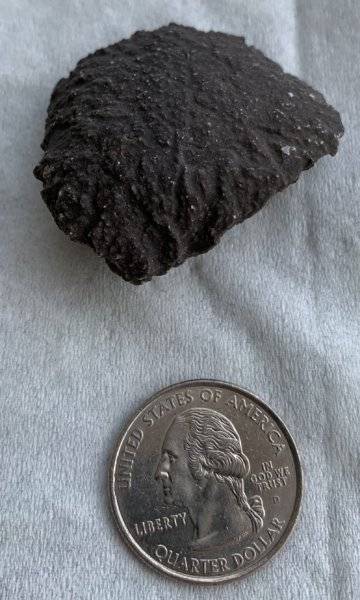
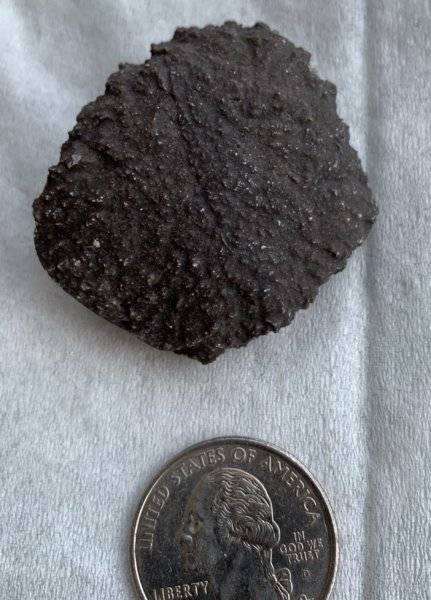
IMG_8517.jpg
IMG_8518.jpg


IMG_8518.jpg
 

Attachments

  • IMG_8518.jpg
    IMG_8518.jpg
    46.2 KB · Views: 925
  • IMG_8517.jpg
    IMG_8517.jpg
    39.6 KB · Views: 794
Last edited by a moderator:
Earth sciences news on Phys.org
Just a first-pass guess, details left for the more knowledgeable ones here. Is it magnetic, heavier than expected? Could me a meteorite.
 
  • Like
Likes   Reactions: C Mac
C Mac said:
I came across this one in the southwest part of the U.S.
Specifically ? ... state and area in state ?My initial thoughts would be Basalt
There's a lot of volcanics in Arizona and a reasonable amount in New Mexico
I would have to dig through my travel pix, but did take some good photos of lava flows in NM

Dave
 
  • Like
Likes   Reactions: C Mac
Thanks for the feedback Tom and Dave,
No, not magnetic. Also, doesn't seem heavier than expected. Actually, it might seem a pinch lighter than expected, but it doesn't have any identifiable voids to air pocket - that I can see.

I believe this was also SE Arizona. Please understand that unless I take a photo at the time I come across a rock, I probably won't have specific information since I'm not out actually hunting rocks.

Now that you say, basalt, I remember seeing a topo map identifying a "cinder hill" about 40 miles SE of where I picked this up, so maybe I came across this rock after it had been previously moved? There were just no other rocks like this in the area, but it would make sense it might be basalt.
 
Last edited:
C Mac said:
No, not magnetic. Also, doesn't seem heavier than expected. Actually, it might seem a pinch lighter than expected, but it doesn't have any identifiable voids to air pocket - that I can see.

OK :)
Being magnetic doesn't confirm a meteorite. Other tests would have to be done for that. Even basalt can show magnetic tendencies
as it often has a reasonable around 20 - 40% iron content.

C Mac said:
I believe this was also SE Arizona. Please understand that unless I take a photo at the time I come across a rock, I probably won't have specific information since I'm not out actually hunting rocks.

that's OK, no problems :smile: ... state and area in state is a great start. As you could imagine, geology can change rapidly across a given region.
So the more accurate you are, the easier it makes to identify :smile:
C Mac said:
Now that you say, basalt, I remember seeing a topo map identifying a "cinder hill" about 40 miles SE of where I picked this up, so maybe I came across this rock after it had been previously moved? There were just no other rocks like this in the area, but it would make it might be basalt.

that really helps narrow it down
Cinder Hills is just NE of Flagstaff. Been there a couple of times. that whole region from the Flagstaff area and right
up to the Grand Canyon is full of volcanics

awesome stuff ... I look forward to seeing your next queryDave
 
  • Like
Likes   Reactions: C Mac
Sorry, let me provide a little clarity. I was SE of Tucson in SE Arizona when I came across this rock. SE of my location where I found this rock, close to the Arizona, New Mexico, Mexico border, is a small hill identified as "cinder hill." My bad if I made this confusing, but there is a hill in the area of Arizona, New Mexico, and the Mexican border identified as "cinder hill.." Anyway, same name as the one up in Flagstaff, but geographically in a different part of the state.
 
C Mac said:
I was SE of Tucson in SE Arizona when I came across this rock. SE of my location where I found this rock, close to the Arizona, New Mexico, Mexico border, is a small hill identified as "cinder hill." My bad if I made this confusing, but there is a hill in the area of Arizona, New Mexico, and the Mexican border identified as "cinder hill.."
No Problems :smile:
I haven't been as far south as Tucson. Always wanted to get to Tombstone, AZ., just for the historical value, maybe one day. :biggrin:

Anyway, still plenty of volcanic outcrops around that SE area of the state, so I would expect that you would find plenty of evidence
scattered around the areaD
 
  • Like
Likes   Reactions: C Mac

Similar threads

Replies
25
Views
5K
Replies
9
Views
5K
Replies
5
Views
2K
  • · Replies 2 ·
Replies
2
Views
4K
Replies
8
Views
5K
  • · Replies 21 ·
Replies
21
Views
5K
  • · Replies 8 ·
Replies
8
Views
3K
  • · Replies 10 ·
Replies
10
Views
3K
  • · Replies 1 ·
Replies
1
Views
2K
  • · Replies 62 ·
3
Replies
62
Views
11K