Atmosphere Layer: Gases Buoyancy & Wind Effects

Click For Summary
The discussion explores the behavior of gases in the atmosphere, focusing on buoyancy and wind effects. It highlights that while gases are generally mixed due to wind, they can separate in still conditions, similar to liquids, but this is rare in the atmosphere. Specific scenarios, such as in deep mines, show that heavier gases can accumulate without ventilation. The conversation also touches on the dynamics of gas exchange in composting, emphasizing that gas pressure and temperature play significant roles in how gases move in and out of a composter. Overall, the atmosphere is characterized by a uniform mixture of gases rather than distinct layers.
Stephanus
Messages
1,316
Reaction score
104
Dear PF Forum,
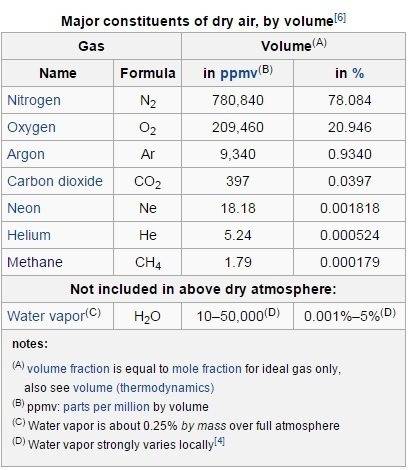
Our atmosphere consist of 78% N2, 21% O2, 0.9% Argon, and other...
https://en.wikipedia.org/wiki/Atmosphere_of_Earth
Atmosphere Gas.jpg

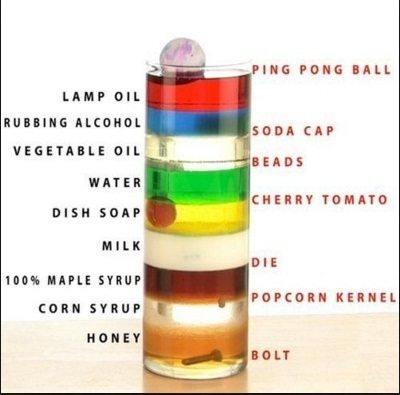
What about theses gases? Will they form a layer like this liquid because of their buoyancy difference?
Buoyancy.jpg

Or they will be scattered evenly because of the wind.
I think they will be scattered evenly. But I'm just curious.
 
Earth sciences news on Phys.org
If there is no wind then very gradually the component gases should separate similarly to the liquids shown in the picture.
However there IS wind and this mixes them up at much faster rate than they could separate, so we don't see any separation usually.
Some exceptions to consider though.
1. In deep mines, heavier gases such as CO2 and Radon do become more concentrated unless artificial ventilation is applied.
2.Hydrogen, being the lightest of gases by a very big margin does tend to rise to the top of the atmosphere despite wind.
Being of low mass compared to other gases it then is vulnerable to solar wind particles, which can remove it from Earth altogether.
3. There is at least one situation where a gas in the middle atmosphere does have significantly higher concentration, the Ozone layer, I'm not sure offhand what causes this though.
 
Last edited:
  • Like
Likes Stephanus and davenn
  • Like
Likes votingmachine
rootone said:
If there is no wind then very gradually the component gases should separate...
1. In deep mines...
Thanks for the answer rootone. I might have forgotten that in a deep well, there are poisonous gas. That people who climb down in a deep well might get injured. Yes, so the gas is scattered, but if there's no wind as in a deep well/mine, it will be layered just as the liquid in a glass.
Actually, I'm studying and doing composting. I just want to know how do we introduce oxygen. Will the oxygen (since it's lighter than CO2) enter the bin from the upper hole and carbon dioxyde expelled from the lower hole. But that's for other thread.
Thanks for the answer.
 
256bits said:
Good thread, but already closed. For 1 speculation post I think.
So it's wind and surface tensor. Right, the more I think, it doesn't make sense that the atmosphere is layered like the glass. If it were, than that would be... O3 at the bottom, right. Since it's the heaviest atmosphere gas I think.
Very hot and good link 256bits. Thanks.
 
Stephanus said:
Will the oxygen (since it's lighter than CO2) enter the bin from the upper hole and carbon dioxyde expelled from the lower hole

as a quick response ... not likely, for a significant reason, can you think what that may be ?Dave
 
davenn said:
as a quick response ... not likely, for a significant reason, can you think what that may be ?Dave
Okay...
Because it seems that the atmosphere is mixed, CO2 (very small amount of it), N2 and O2 (and Ar) they are all mixed and scattered not layered.
Second, I think the gas pressure inside the composter (because there are some chemical reaction in it, bacteria digesting) is higher than the atmosphere, so gas will be expelled from both lower and upper hole.
I think only after the reaction diminished and the pressure inside the composter is lower than the atmosphere , then the Oxygen (along with nitrogren, CO2) will enter the composter from the upper hole (depends on the buoyancy of the gas inside the composter).
 
Stephanus said:
Second, I think the gas pressure inside the composter (because there are some chemical reaction in it, bacteria digesting) is higher than the atmosphere, so gas will be expelled from both lower and upper hole.

That may have an effect, but I was thinking of something more significant ... have another think about processes occurring in the compost pile
 
  • #10
Thanks Davenn for your responses.
They say (I don't know, I've never actually researched it. I just read it in the net) that the composting process is the reverse of photosynthesis. That is
C6H12O6 + 6O2 -> 6CO2 + 6H2O + heat.
Someone said in PF forum, that the reverse of photosynthesis is true, but the process is not that simple, it involved nitrogen and some other element.
Okay...
So the composting expelled CO2 and water,
But my composter bin, I think, is for anaerobic composting.
Composter Bin - Small.jpg

So, it does not expleled CO2 and water. Instead it expelled CH4 and H2S.
But before I go further, let me give you the atmosphere facts first.
By volume the atmosphere contains:
N2 78.08%
O2 20.94%
Ar 0.93%
CO2 0.0397%
the other Ne, Helium, Methane are too small fraction.
List of molecular weight compared to H -> 1.008. I divide those number by Hydrogen weight, so it will be an easier conversion.
Nitrogen: 27.8
Oxygen: 31.75
Argon: 39.63
CO2: 43.66
Multiply those numbers by volume divided by total volume divided by Hydrogen weight, I have the weight of the Earth atmosphere is 28.74 times of the weight of Hydrogen.
The weight of CH4 compared with H is 15.91
The weight of Hydrogen Sulfida compared with H is 33.82
Okay, now back to your question:
davenn said:
Stephanus said:
Second, I think the gas pressure inside the composter (because there are some chemical reaction in it, bacteria digesting) is higher than the atmosphere, so gas will be expelled from both lower and upper hole.
That may have an effect, but I was thinking of something more significant ... have another think about processes occurring in the compost pile
I think I stick to my earlier answer. The gas in the composting will be expelled IF the pressure in the composter bin is higher than the atmospheric pressure, not matter what gas inside. I've already calculated the density of the gas and atmosphere. But on second thought I think that doesn't matter. Only the pressure in the composter bin matters.
If I were a detective, I would have lost this case. I'm sorry, I'm lost here. What do you think why the oxygen is not likely enters the composter bin from above? Is it gas pressure?

Thanks

Steven
 
  • Like
Likes Merlin3189
  • #11
Stephanus said:
...
List of molecular weight compared to H -> 1.008. I divide those number by Hydrogen weight, so it will be an easier conversion...
Multiply those numbers by volume divided by total volume divided by Hydrogen weight
On second thought, I think I don't have to divide the weight by hydrogen weight.
 
  • #12
I know, I know! (raising hand)
Heat. The composting process is exothermic. A lot of heat is produced; a hot pile can exceed 150F. This is generally desired, to kill weed seeds and pathogens.
All gases will tend to enter the bottom (or sides, if the pile sits on a surface of low porosity) and exit the top.
 
  • Like
Likes davenn
  • #13
Andrew Juggler said:
I know, I know! (raising hand)
Heat. The composting process is exothermic. A lot of heat is produced; a hot pile can exceed 150F. This is generally desired, to kill weed seeds and pathogens.
All gases will tend to enter the bottom (or sides, if the pile sits on a surface of low porosity) and exit the top.
Yeah, that's what I guess, too. The pile produces heat, and the air pressure in the chamber/composter is higher than the atmosphere.
But, no matter how. The gas will exit from top and bottom, I think.
 

Similar threads

  • · Replies 36 ·
2
Replies
36
Views
12K
  • · Replies 6 ·
Replies
6
Views
2K
  • · Replies 21 ·
Replies
21
Views
5K
  • · Replies 9 ·
Replies
9
Views
6K
  • · Replies 1 ·
Replies
1
Views
3K
  • · Replies 1 ·
Replies
1
Views
6K
Replies
5
Views
3K
  • · Replies 0 ·
Replies
0
Views
2K
  • · Replies 15 ·
Replies
15
Views
6K
  • · Replies 8 ·
Replies
8
Views
6K