Average velocity in a turbulent flow tube

Click For Summary
SUMMARY

The discussion focuses on deriving the expression for average velocity in a turbulent flow tube, specifically referencing Bird's "Transport Phenomena." The user initially struggled with the integration process and noted issues with the logarithmic term becoming undefined at the boundary. After further analysis, they determined that integrating up to 0.9999999999R resolved the issue, allowing them to match the book's equation. Key insights include the importance of including an additional 'r' in the denominator during integration.

PREREQUISITES
  • Understanding of turbulent flow dynamics
  • Familiarity with integration techniques in fluid mechanics
  • Knowledge of logarithmic functions and their properties
  • Access to Bird's "Transport Phenomena" for reference
NEXT STEPS
  • Study the integration methods for turbulent flow calculations
  • Review the properties of logarithmic functions in fluid dynamics
  • Explore numerical methods for approximating integrals in fluid mechanics
  • Examine case studies using Bird's "Transport Phenomena" for practical applications
USEFUL FOR

Fluid mechanics students, engineers working with turbulent flow systems, and researchers seeking to understand average velocity calculations in turbulent environments.

Est120
Messages
54
Reaction score
3
TL;DR
obtaining the average speed using the logarithmic profile
hi guys
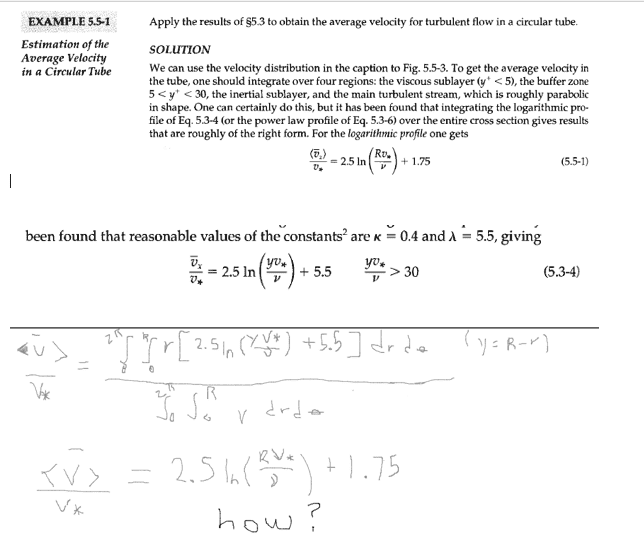
I'm really struggling to get the expression for average speed in turbulent flow

The book explains absolutely nothing about how the integration is carried out, in addition to the fact that the logarithmic term becomes undefined when r = R what I did was carry out the integration up to 0.9999999R in order to obtain a numerical result equal to the one that I could have obtained integrating up to R even so, the expression I got is not the one shown in the book
Turbulent flow- average speed in a flow across a pipe.PNG
 
Engineering news on Phys.org
It would help if you cited the book you are using.

But for starters, are you not missing an ##r## in your denominator to go along with the ##d\theta##?
 
boneh3ad said:
It would help if you cited the book you are using.

But for starters, are you not missing an ##r## in your denominator to go along with the ##d\theta##?
i already solved the problem i was supposed to integrate up to 0.9999999999...99999 R (integral in numerator) so i get the equation of the book, the book is Bird's Transport Phenomena
 

Similar threads

  • · Replies 9 ·
Replies
9
Views
2K
  • · Replies 4 ·
Replies
4
Views
3K
Replies
0
Views
2K
  • · Replies 5 ·
Replies
5
Views
2K
  • · Replies 3 ·
Replies
3
Views
5K
  • · Replies 9 ·
Replies
9
Views
3K
  • · Replies 28 ·
Replies
28
Views
2K
  • · Replies 11 ·
Replies
11
Views
4K
  • · Replies 8 ·
Replies
8
Views
2K
  • · Replies 2 ·
Replies
2
Views
8K