Balancing forces on a bicycle wheel

  • Context: Undergrad 
  • Thread starter Thread starter peanutaxis
  • Start date Start date
  • Tags Tags
    Bicycle Forces Wheel
Click For Summary
SUMMARY

The discussion focuses on the forces acting on a stationary bicycle wheel on an incline, specifically analyzing the effects of weight, friction, and braking forces. The weight of the bicycle acts through the center of the wheel, while friction opposes the weight's component along the incline. Newton's Third Law is crucial in understanding the interaction between the brake and the wheel, as the brake applies a force that the wheel reciprocates. The balance of tangential forces and torques is essential for maintaining the stationary position of the bicycle.

PREREQUISITES
  • Understanding of Newton's Laws of Motion
  • Basic principles of static equilibrium
  • Knowledge of forces acting on inclined planes
  • Familiarity with torque and its calculation
NEXT STEPS
  • Study the application of Newton's Third Law in static systems
  • Learn about calculating forces on inclined planes in physics
  • Explore torque calculations in rigid body mechanics
  • Investigate the role of friction in static equilibrium scenarios
USEFUL FOR

Physics students, mechanical engineers, and anyone interested in understanding the dynamics of forces on stationary objects, particularly in the context of bicycles and inclined surfaces.

peanutaxis
Messages
26
Reaction score
3
Hi, (this is not a homework question)

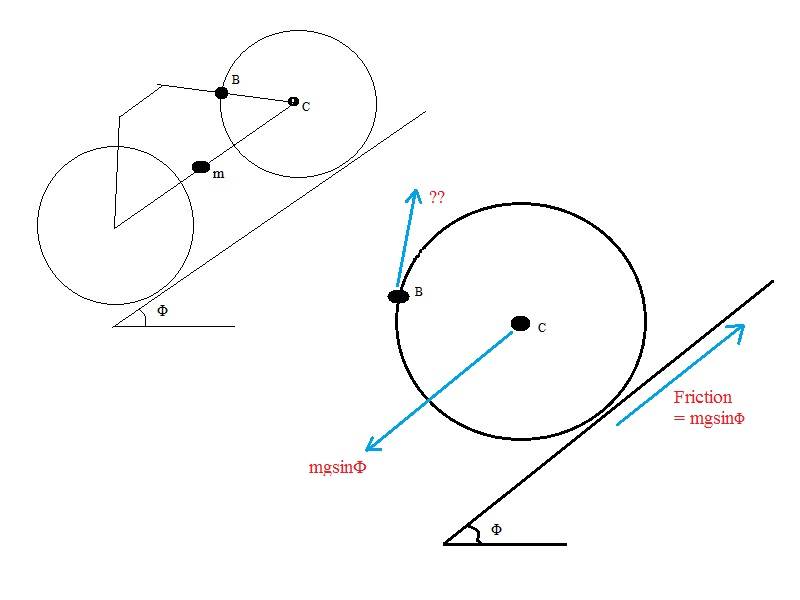
If I have a bicycle with COM, M (in line with the center of the wheels, C) on an incline, angle Φ, and the bicycle is NOT moving at all because the brake is on at B.

I am trying to put in the forces acting on the wheel. I figure that the weight of the bicycle is probably acting through the center of the wheel because the COM is at the same height (would this change if the COM was in a different place?). And because the wheel is not moving laterally I figure the friction force is opposing the weight, but acting at ground level.

The brake is preventing the wheel from turning CCW, and so I think the ?? force from the brake needs to also be mgsinΦ in a CW direction. But the problem is that if I put the brake/?? force in, the static/overall forces on the wheel won't balance and the wheel should move off in the direction of the ?? force.

Help!?
thanks
jfz0bp.jpg
 
Physics news on Phys.org
peanutaxis said:
I figure that the weight of the bicycle is probably acting through the center of the wheel because the COM is at the same height (would this change if the COM was in a different place?). And because the wheel is not moving laterally I figure the friction force is opposing the weight, but acting at ground level.
First of all, force from the frame is acting on center, right. That's property of the axis, so it will not change even if CoM is higher/lower.

You are also correct that the friction will be equal to weight's projection along the incline. No problem there.

What you are forgetting about is Newton's 3rd Law for the brake. If brake is applying force on wheel, wheel is applying force back on the brake. That force would accelerate the bike backwards if it weren't attached to the wheel. So rather than just bike's weight, front wheel experiences bike's weight plus the reaction force of the brake through it's center.

Now you can balance the tangential forces. Keep in mind that you also have normal forces on the wheel, and that normal force on the two wheels together adds up to component of weight perpendicular to the incline.
 
K^2 said:
What you are forgetting about is Newton's 3rd Law for the brake. If brake is applying force on wheel, wheel is applying force back on the brake.

But the whole thing is stationary, so Newton's 3rd applies to everything! So that doesn't help me: The wheel is pushing on the ground equally and opposite to the Friction force pushing on the wheel, and the wheel is pulling on the bicycle mass equally and opposite to the bicycle mass pulling on the wheel.

What I am trying to do is find the forces acting on the wheel.
The wheel is not moving laterally, so the friction force must be opposed equally by the bicycle weight.
The wheel is not rotating, so the torque due to the friction and the weight force must be opposed equally by the torque from the brake? How do you work these out?


thanks,
p
 
The component of the bike's weight perpendicular to the ground is balanced by force of the Earth on the wheels. Since the bike is on slanted ground there is also a component of weight parallel to the ground. That will be balanced by the friction force on the wheels which is transmitted to the brakes that prevent the wheels from turning.
 

Similar threads

  • · Replies 11 ·
Replies
11
Views
2K
  • · Replies 4 ·
Replies
4
Views
1K
  • · Replies 15 ·
Replies
15
Views
3K
Replies
2
Views
2K
  • · Replies 1 ·
Replies
1
Views
2K
  • · Replies 22 ·
Replies
22
Views
5K
  • · Replies 29 ·
Replies
29
Views
8K
  • · Replies 4 ·
Replies
4
Views
4K
  • · Replies 1 ·
Replies
1
Views
1K
  • · Replies 59 ·
2
Replies
59
Views
4K