Eigenvector
- 1
- 0
The problem is modeling a solid ball or radius R rolling down an incline of angle Theta. Note that I am an Electrical Engineer who is somewhat flaky with rotational concepts (but not completely useless :p). If the ball was rolling down a road (or any solid, flat surface), I get the following equations (which I believe neglect friction EXCEPT for causing the ball to roll):
F_x = mg sin (Theta)
T = I * (d^2x/dt^2)/R
Which, after subbing in for I (2/5*mR^2) and converting to linear displacement by multiplying by R, I get a rotational displacement force of F_rx = 2/5m (d^2x/dt^2).
Combining these two equations, we get:
m(d^2x/dt^2) = mg sin (Theta) - 2/5m(d^2x/dt^2). which can be rearranged as
(d^2x/dt^2) = 5/7gsin(Theta).
We then linearize about small Theta, and get a transfer function between position and Theta of (5/7g)/s^2.
Now, I have two questions:
#1 If instead of a solid surface, we instead (and this is the actual experimental setup) we have a ball placed between 2 rails a distance d apart. Do I need to find the "effective radius of the ball", i.e., h from the following diagram and use that to calculate both the displacement of the ball (so converting the Torque equation to position), and through use of the // axis Theorem for finding I?
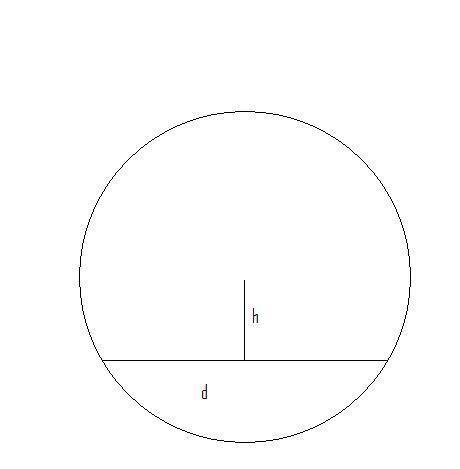
#2 When comparing experimental to simulated data with the above model, no "gain value" for the transfer function fits the data (i.e, the curve has a fundamentally different shape than what our model predicts). I thought that this was due to un-modeled friction effects. Is that correct or is this the result of something else?
F_x = mg sin (Theta)
T = I * (d^2x/dt^2)/R
Which, after subbing in for I (2/5*mR^2) and converting to linear displacement by multiplying by R, I get a rotational displacement force of F_rx = 2/5m (d^2x/dt^2).
Combining these two equations, we get:
m(d^2x/dt^2) = mg sin (Theta) - 2/5m(d^2x/dt^2). which can be rearranged as
(d^2x/dt^2) = 5/7gsin(Theta).
We then linearize about small Theta, and get a transfer function between position and Theta of (5/7g)/s^2.
Now, I have two questions:
#1 If instead of a solid surface, we instead (and this is the actual experimental setup) we have a ball placed between 2 rails a distance d apart. Do I need to find the "effective radius of the ball", i.e., h from the following diagram and use that to calculate both the displacement of the ball (so converting the Torque equation to position), and through use of the // axis Theorem for finding I?
#2 When comparing experimental to simulated data with the above model, no "gain value" for the transfer function fits the data (i.e, the curve has a fundamentally different shape than what our model predicts). I thought that this was due to un-modeled friction effects. Is that correct or is this the result of something else?
