Basic commutator of angular momentum

Click For Summary
The discussion focuses on the transition from the second to the third step in calculating the commutator of angular momentum. It highlights the need to split the commutator into manageable parts, specifically addressing terms that equal zero. The key to simplifying the expression lies in applying the Leibniz product rule effectively. Proficiency with this rule allows for the extraction of commuting variables, streamlining the process. Mastery of the Leibniz rule is emphasized as crucial for handling complex commutators in quantum mechanics.
catsarebad
Messages
69
Reaction score
0
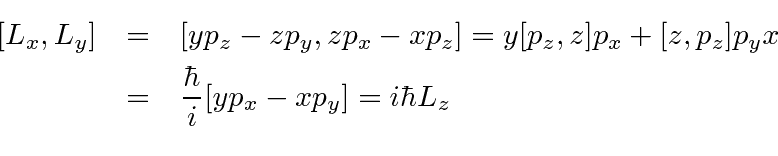
Could someone explain to me how the author goes from 2nd to 3rd step
img1750.png

I think the intermediate step between 2 and 3 is basically to split up the commutator as

[y p_z, z p_x] - [y p_z,x p_z] - [z p_y,z p_x] + [z p_y, x p_z]

2nd term = 0
3rd term = 0

so leftover is
[L_x, L_y] = [y p_z, z p_x] + [z p_y, x p_z]

but how does this turn into what he has on 3rd step?
 
Physics news on Phys.org
catsarebad said:
[...]
so leftover is
[L_x, L_y] = [y p_z, z p_x] + [z p_y, x p_z]

but how does this turn into what he has on 3rd step?
Multiple applications of the Leibniz product rule: ##[AB,C] = A[B,C] + [A,C]B##
 
really? I thought it would be much simpler than that. I thought i was missing a trivial trick.
 
catsarebad said:
really? I thought it would be much simpler than that. I thought i was missing a trivial trick.
Once you become proficient with the Leibniz rule, you'll be able to skip steps. E.g., the ##y## in the 1st commutator commutes with ##zp_x##, so it can just be taken out the front, and so on. You could call that a "trivial" trick, but it's wise to carefully practice the Leibniz rule a few times initially, since it's essential when simplifying more difficult commutators.
 
Time reversal invariant Hamiltonians must satisfy ##[H,\Theta]=0## where ##\Theta## is time reversal operator. However, in some texts (for example see Many-body Quantum Theory in Condensed Matter Physics an introduction, HENRIK BRUUS and KARSTEN FLENSBERG, Corrected version: 14 January 2016, section 7.1.4) the time reversal invariant condition is introduced as ##H=H^*##. How these two conditions are identical?

Similar threads

  • · Replies 1 ·
Replies
1
Views
645
  • · Replies 14 ·
Replies
14
Views
2K
  • · Replies 39 ·
2
Replies
39
Views
5K
Replies
2
Views
2K
Replies
3
Views
3K
  • · Replies 10 ·
Replies
10
Views
2K
  • · Replies 5 ·
Replies
5
Views
2K
  • · Replies 1 ·
Replies
1
Views
6K
  • · Replies 7 ·
Replies
7
Views
2K
  • · Replies 6 ·
Replies
6
Views
6K