Basic conceptual question about angle between two vectors

Click For Summary
SUMMARY

The angle between two vectors is determined using the arccosine of the dot product of the vectors divided by the product of their magnitudes. This angle is always less than or equal to 180 degrees. It is essential for both vectors to either start from the same origin or end at the same point to accurately calculate the angle. Attempting to find the angle when one vector points outward and the other terminates at the former's origin results in an incorrect angle, as it represents the supplement of the actual angle.

PREREQUISITES
  • Understanding of vector mathematics
  • Familiarity with the dot product of vectors
  • Knowledge of vector magnitude calculations
  • Basic trigonometry, specifically the arccosine function
NEXT STEPS
  • Study vector operations in linear algebra
  • Learn about the geometric interpretation of vectors
  • Explore the significance of vector origins and endpoints in angle calculations
  • Investigate the properties of supplementary angles in trigonometry
USEFUL FOR

Students and professionals in mathematics, physics, and engineering who need to understand vector relationships and angle calculations in their work.

anniecvc
Messages
28
Reaction score
0
I know to find the angle between two vectors you would take the arccosine of the dot product of the two vectors divided by the magnitude of both vectors multiplied.

I know the angle between two vectors is always less than or equal to 180 degrees.

The angle can only be found when both vectors begin at the same origin and point outward, or when both vectors begin a different origins but end at the same point:
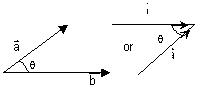
v2.JPG


Why can't we find the angle between two vectors where one points out and the other terminates at the former's origin? What is the significance of both beginning at the same origin or both terminating at the same endpoint?
 
Physics news on Phys.org
anniecvc said:
I know to find the angle between two vectors you would take the arccosine of the dot product of the two vectors divided by the magnitude of both vectors multiplied.

I know the angle between two vectors is always less than or equal to 180 degrees.

The angle can only be found when both vectors begin at the same origin and point outward, or when both vectors begin a different origins but end at the same point:

v2.JPG


Why can't we find the angle between two vectors where one points out and the other terminates at the former's origin? What is the significance of both beginning at the same origin or both terminating at the same endpoint?

In your first picture, imagine pushing the ##\vec a## vector backwards along its length until the tip has been pushed back to the tail of the other vector. Then the angle you see will be the supplement of the correct angle ##\theta## in your picture. That's why you don't do it that way.
 

Similar threads

Replies
3
Views
4K
  • · Replies 5 ·
Replies
5
Views
1K
  • · Replies 2 ·
Replies
2
Views
4K
  • · Replies 5 ·
Replies
5
Views
2K
  • · Replies 2 ·
Replies
2
Views
2K
  • · Replies 3 ·
Replies
3
Views
5K
Replies
2
Views
2K
  • · Replies 7 ·
Replies
7
Views
3K
  • · Replies 1 ·
Replies
1
Views
3K
Replies
12
Views
4K