TheFallen018
- 52
- 0
Hey, I've got this problem I've been doing, but I'm not sure if my approach is right. My textbook has pretty much less than a paragraph on this sort of stuff.
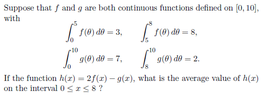
View attachment 8444
My thinking was that since an integral is a sum, in order to get the range from 0 to 8, we should just be able to add or subtract the definite integrals as required. eg. $\int_{0}^{5}f(\Theta )d\Theta + \int_{5}^{8}f(\Theta)d\Theta = \int_{0}^{8}f(\Theta)d\Theta = 3+8=11$
So, following this line of thinking, I found $\int_{0}^{8}h(x)dx$ to be $2*11-5=17$. Then, by dividing by 8, we should get the average value of $h(x)$ to be ($\frac{17}{8}$).
It feels like I'm missing something though. Does this look right? Thanks
View attachment 8444
My thinking was that since an integral is a sum, in order to get the range from 0 to 8, we should just be able to add or subtract the definite integrals as required. eg. $\int_{0}^{5}f(\Theta )d\Theta + \int_{5}^{8}f(\Theta)d\Theta = \int_{0}^{8}f(\Theta)d\Theta = 3+8=11$
So, following this line of thinking, I found $\int_{0}^{8}h(x)dx$ to be $2*11-5=17$. Then, by dividing by 8, we should get the average value of $h(x)$ to be ($\frac{17}{8}$).
It feels like I'm missing something though. Does this look right? Thanks