Basic Engineering design of a small lift

Click For Summary

Discussion Overview

The discussion centers on the engineering design of a small lift intended to support the body of a car, focusing on the appropriate size and thickness of square or rectangular tubing needed to safely lift a maximum load of 1000 pounds. Participants explore structural considerations, including moments of inertia and material properties.

Discussion Character

  • Technical explanation
  • Debate/contested

Main Points Raised

  • One participant requests assistance in determining the size and thickness of square or rectangular tubing required to support a vertical load of 1000 pounds, emphasizing the need for vertical support with no side loading.
  • Another participant calculates that for a midspan load of 4450 N, a 63 x 63 x 4.763 mm square steel tube or a 76 x 51 x 4.763 mm rectangular steel tube would be adequate, questioning whether the load is static and how it is applied.
  • A participant clarifies that there will be no force or acceleration acting on the load during lifting.
  • Further calculations suggest that a 51 x 51 x 4.763 mm square steel tube would be suitable for the vertical columns, using an ultimate factor of safety of 2.0.
  • Another participant notes the differences in flexural properties between square and round bars, recommending square tubing for horizontal members and round tubing for vertical members.

Areas of Agreement / Disagreement

Participants present multiple viewpoints regarding the appropriate materials and dimensions for the lift's structure, with no consensus reached on the best approach or specific design parameters.

Contextual Notes

Participants express varying assumptions about load application and safety factors, indicating that further clarification on these points may be necessary for a complete analysis.

Who May Find This Useful

Individuals interested in basic engineering design, particularly in the context of lifting mechanisms and structural integrity, may find this discussion relevant.

badharley99
Messages
2
Reaction score
0
Hi,

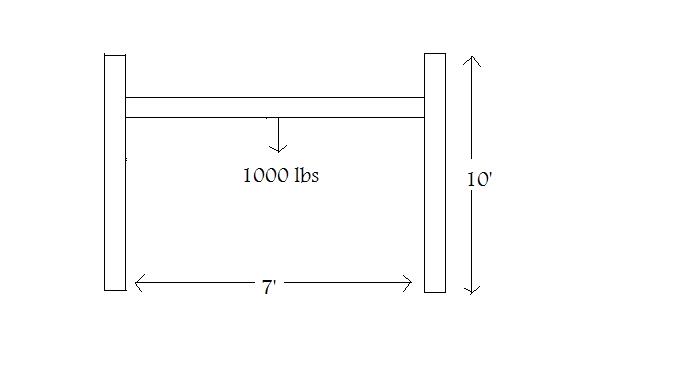
I need a little help on figuring out what size square tubing and thickness I need to make a basic lift for taking the body of a car on and off of a frame. I have included a small drawing of what I am trying to build.

I am going to need to support a maximum of 1000 pounds. All off the force will be vertical with no side loading.

The two vertical post will be bolted to the floor and attached to the ceiling. The distance between posts will be 7 feet. The load will be lifted directly in the middle of the horizontal tube.

Can you please help with what size square (or rectangle) tubing and thickness I need for the verticals and the horizontal to support this weight? Would it be better to use rectangular tubing for the horizontal?

I understand moments of inertia, Youngs modulus have to be figured in just having a little trouble.

Thank you

Nick

badharley99@yahoo.com
Untitled.jpg
 
Engineering news on Phys.org
So you have an applied midspan load of P = 4450 N. For the horizontal member, using a yield factor of safety of FSy = 1.70, it currently appears a 63 x 63 x 4.763 mm square steel tube, or a 76 x 51 x 4.763 mm rectangular steel tube, would work. Comparing these two options, there is no significant advantage of one versus the other. I haven't looked into the columns, so far.

Is your value for P the actual, static weight of the object to be lifted, meaning it can have a maximum mass of 454 kg? If so, can this mass be suddenly applied, or dropped, or stuck and then pop free?
 
Thank you for the reply on size for the horizontal.

There where be no force or acceleration, deacceleration of the load.

I appreciate all the help

thanks

nick
 
Using an ultimate factor of safety of FSu = 2.0, it currently appears a 51 x 51 x 4.763 mm square steel tube would work for the upright members (columns).
 
There are differences between square and round bars. The round ones flex more while square flexes only in some planes.

Use square for horizontal ( with the sides vertical or horizontal to ground) and round for vertical.
 

Similar threads

  • · Replies 8 ·
Replies
8
Views
2K
  • · Replies 18 ·
Replies
18
Views
3K
Replies
0
Views
2K
  • · Replies 6 ·
Replies
6
Views
3K
Replies
3
Views
3K
  • · Replies 14 ·
Replies
14
Views
2K
  • · Replies 12 ·
Replies
12
Views
2K
Replies
6
Views
5K
  • · Replies 4 ·
Replies
4
Views
4K
  • · Replies 14 ·
Replies
14
Views
2K