Basics of forces/torques and fulcrum

  • Thread starter Thread starter JohnnyLaws
  • Start date Start date
  • Tags Tags
    Forces Torque
Click For Summary

Homework Help Overview

The discussion revolves around a problem involving forces and torques related to a cube supported at a fulcrum, with an upward force applied by a balloon. The cube weighs 98N and the balloon exerts a force of 78.4N. Participants are exploring how to determine the distance at which the balloon should be placed for the cube to remain static.

Discussion Character

  • Exploratory, Conceptual clarification, Mathematical reasoning, Problem interpretation

Approaches and Questions Raised

  • Participants discuss the need to sum torques and set the equation to zero. There are questions about measuring distances and drawing free body diagrams. Some express uncertainty about the cross product and the components of position in torque calculations.

Discussion Status

There is an ongoing exploration of different interpretations of the problem setup and the forces involved. Some participants have offered guidance on drawing free body diagrams and choosing reference axes for torque calculations, suggesting that aligning axes could simplify the problem.

Contextual Notes

Participants are considering the implications of the cube's geometry and the forces acting on it, including the location of the fulcrum and the alignment of forces. There is mention of the symmetry of the situation, which may influence the approach to solving the problem.

JohnnyLaws
Messages
10
Reaction score
0
TL;DR Summary: When a cube is supported at the fulcrum and remains stationary due to a balloon exerting a force in the opposite direction of its weight.

So the exercise is as follows: We have a homogeneous cube with an edge length of 2 meters, weighing 98N. On the other hand, we have a balloon that is applying an upward force with a magnitude of 78.4N. What is the distance at which I need to place the balloon for the cube to remain static?
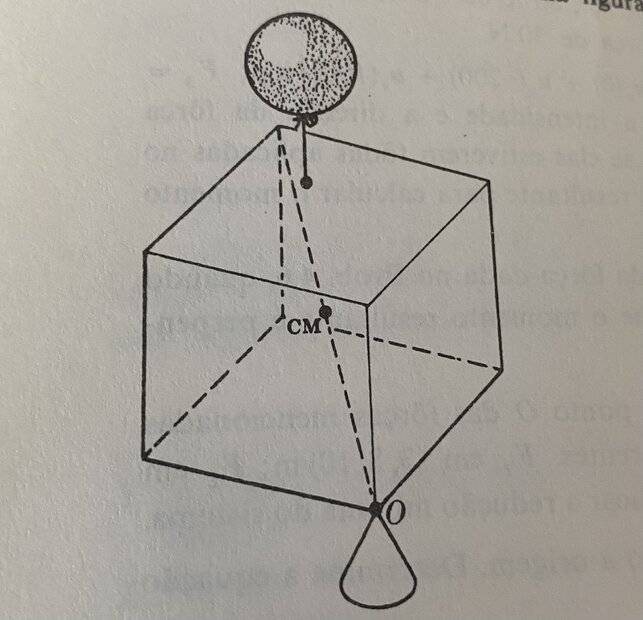
image_50411265.JPG

I think to solve this exercise, I need to add up all the torques and set the equation to 0, but I can't get anywhere with this. The solution to that exercise states that the balloon needs to be placed at a distance of 1.77 meters from the fulcrum and, at the same time, aligned with the cube's diagonals.
 
Physics news on Phys.org
JohnnyLaws said:
I think to solve this exercise, I need to add up all the torques and set the equation to 0, but I can't get anywhere with this.
Sounds good to me. What have you done so far? (Hint: Measure distances from the corner of the cube.)
 
  • Like
Likes   Reactions: JohnnyLaws
JohnnyLaws said:
The solution to that exercise states that the balloon needs to be placed at a distance of 1.77 meters from the fulcrum and, at the same time, aligned with the cube's diagonals.
I wouldn't call that answer the "distance from the fulcrum" since the fulcrum is at the bottom of the cube. But if you measure distances along the top of the cube from the corner directly above the fulcrum, you'll get the given answer.
 
  • Like
Likes   Reactions: JohnnyLaws
JohnnyLaws said:
...I think to solve this exercise, I need to add up all the torques and set the equation to 0, but I can't get anywhere with this.
Welcome, @JohnnyLaws !

Could you show us how far did you get?
Do you know how to draw a free body diagram?
 
  • Like
Likes   Reactions: JohnnyLaws
Lnewqban said:
Welcome, @JohnnyLaws !

Could you show us how far did you get?
Do you know how to draw a free body diagram?
I think I do. Basically I drew a cube after that I put the force of weight in center of mass, the force of the ballon above cube and a force in fulcrum pointing up.
I think what I'm doing wrong is the cross product because in the equation of torques the unic variable is the position and position have 3 different components and I don't know any of them
 
Last edited:
JohnnyLaws said:
I think I do. Basically I drew a cube after that I put the force of weight in center of mass, the force of the ballon above cube and a force in fulcrum pointing up.
Yes. Those are the three forces.

Have you decided on a reference axis yet for computing the torques from those forces? If you choose a reference axis at the right place, you can eliminate one of those forces from the torque balance.

JohnnyLaws said:
I think what I'm doing wrong is the cross product because in the equation of torques the unic variable is the position and position have 3 different components and I don't know any of them
Have you picked your coordinate axes yet? Since all three forces are vertical, you can align one of your axes that way and ignore that coordinate.

Since there is symmetry, you can align one of your axes that way and eliminate a second coordinate.

Now you have a one dimensional problem involving two forces.
 
  • Like
Likes   Reactions: JohnnyLaws
JohnnyLaws said:
I think I do. Basically I drew a cube after that I put the force of weight in center of mass, the force of the ballon above cube and a force in fulcrum pointing up.
I think what I'm doing wrong is the cross product because in the equation of torques the unic variable is the position and position have 3 different components and I don't know any of them
Please, see:
https://www.physicsclassroom.com/class/newtlaws/Lesson-2/Drawing-Free-Body-Diagrams

Having a cube tells you the spatial location of its center of mass (and its vertical weight force) respect to the pivot point (and its vertical reaction force) and the vertical force exerted by the balloon.
 

Similar threads

Replies
6
Views
3K
  • · Replies 1 ·
Replies
1
Views
2K
  • · Replies 25 ·
Replies
25
Views
2K
Replies
17
Views
3K
  • · Replies 7 ·
Replies
7
Views
18K
  • · Replies 5 ·
Replies
5
Views
6K
Replies
4
Views
2K
  • · Replies 1 ·
Replies
1
Views
2K
  • · Replies 2 ·
Replies
2
Views
3K
  • · Replies 6 ·
Replies
6
Views
2K