Beam calculations - Simply supported vs pinned both sides

  • Thread starter Thread starter Turbine
  • Start date Start date
  • Tags Tags
    Beam Calculations
Click For Summary

Discussion Overview

The discussion revolves around the classification and analysis of beam supports, specifically focusing on a beam that is pinned at both ends without rollers. Participants explore the implications of this configuration in the context of a hydraulic press application, comparing it to traditional simply supported and fixed beam scenarios.

Discussion Character

  • Technical explanation
  • Conceptual clarification
  • Debate/contested

Main Points Raised

  • One participant questions how a beam with pinned connections at both ends, without rollers, fits into the standard classifications of simply supported and fixed beams.
  • Another participant explains that pinned connections can accommodate loads in any direction, while simple supports typically allow vertical loads only, and that rollers permit thermal expansion without axial loading.
  • A participant describes their specific setup, indicating that the pins are steel rods and the beam is used in a hydraulic press, suggesting that a roller could be added to fit the simply supported model.
  • Concerns are raised about the adequacy of using a single pin connection for the beam, with a warning about the limitations of handbook formulas without a full understanding of their application.
  • A participant reflects on their background and current studies in mechanical engineering, expressing confusion over the differences in stress and deflection calculations between pinned and fixed supports, particularly when horizontal translation is restricted.
  • Mathematical expressions for maximum deflection are provided, highlighting the differences between simply supported and fixed-end cases, and raising questions about how to account for the unique pinned configuration.

Areas of Agreement / Disagreement

Participants express varying interpretations of the beam's support conditions and their implications, indicating that multiple competing views remain regarding the classification and analysis of the beam connections. The discussion does not reach a consensus on how to categorize the pinned connections or their effects on deflection and stress.

Contextual Notes

Participants acknowledge the complexity of real-world applications compared to textbook scenarios, and there are indications of limitations in the assumptions made regarding support conditions and their effects on beam behavior.

Who May Find This Useful

This discussion may be of interest to students and professionals in mechanical engineering, particularly those involved in structural analysis, beam design, and applications in machinery or hydraulic systems.

Turbine
Messages
9
Reaction score
0
Hi guys,

Hopefully a fairly simple question. All beam formulas I've come across, whether in my own textbooks or Machinery's Handbook, have two sets of formulas for beams. One will be for "simply supported", where one end is pinned and the other end is a pin-roller. The other connection type is simply "fixed". Where would a beam connection fall among those which has ends that are both pinned without "rollers". Basically I'm analyzing a horizontal steel beam pinned between two vertical beams.

Example:
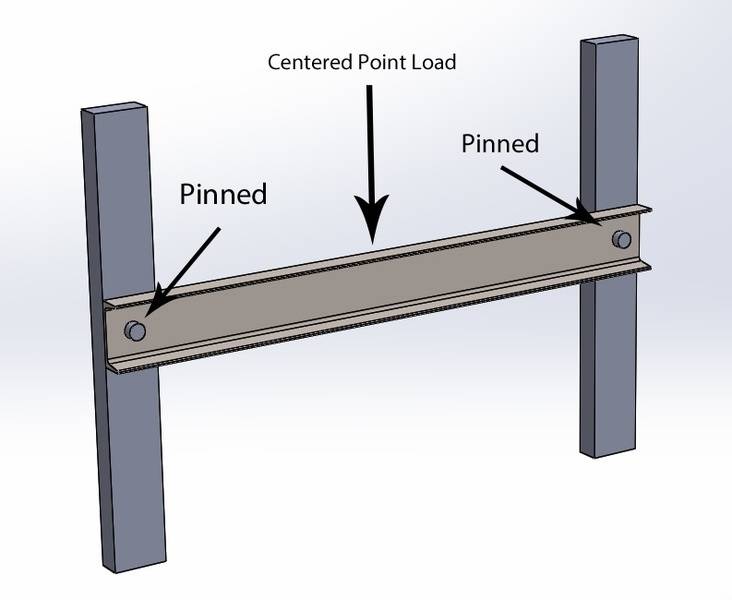
example.jpg


This very well is just a "simply supported" example, my only hesitation is knowing that there will be no horizontal translation in my design, whereas in traditionally "simply supported" situation, there is horiz. translation due to the the roller. Hopefully someone can set me straight. Thank you!
 
Last edited:
Engineering news on Phys.org
A pinned connection can take a load applied in any direction; a simple support can take a load only in one direction (usually vertical). The rollers on a simple support allow a beam to grow or shrink (usually due to temperature differences) without loading up in the axial direction (think of expansion joints in roads and bridges).

You diagram is not clear enough to determine if the horizontal beam is restrained against rotation at the ends or not. If the pins were actually bolts or rivets, you could make the case that this beam is fixed at each end.

Supports are generally idealized to allow for an analysis of some sort. Analyzing beams using actual support conditions and configurations is a little messier.
 
SteamKing said:
You diagram is not clear enough to determine if the horizontal beam is restrained against rotation at the ends or not. If the pins were actually bolts or rivets, you could make the case that this beam is fixed at each end.

Thank you for the quick response. In the diagram, those "pins" are literally just that, about 1-1/4" diameter steel rods. The beam is about 48" long. Application is a hydraulic press. I could just as well design it with a pin support underneath one end of the beam to act as a roller, which would precisely fit the "simply supported" equations.
 
Turbine said:
Thank you for the quick response. In the diagram, those "pins" are literally just that, about 1-1/4" diameter steel rods. The beam is about 48" long. Application is a hydraulic press. I could just as well design it with a pin support underneath one end of the beam to act as a roller, which would precisely fit the "simply supported" equations.
It's not clear how big a hydraulic press we are talking about here, nor how this structure goes with it. Using a single pin at each end of the horizontal beam may also not be advisable.

I will warn you that if you are not a mechanical engineer or a machine designer, you shouldn't be using formulas picked up out of a handbook unless you fully understand the limitations of their application.
 
The size isn't a factor in this question, simply trying to understand the differences in the called-out supports. As for press designs, a single pin connection is standard on many smaller H-frame presses (I'm looking at 40-tons or less). This allows for an adjustable lower platform. I am a returning student (former aviation professional), now a senior undergraduate mechanical engineering major. I'm doing this a an exercise in engineering to refresh on some of these topics. I've done plenty of shear/moment diagrams in years past, bending calculations, bearing stress, etc. But trying to apply textbook problems to real-world situations isn't as cut-and-dry. I'm still learning, by no means have I mastered the material (obviously), and I certainly appreciate your advice.

From my understanding, a fixed support resists any rotation at the support, in contrast to pinned connections that do allow rotation. The confusing difference is between pinned supports with rollers and without. A rollers allow translation along the x-axis, whereas a simply pinned connection does not, yet still allows rotation. Therefore the stress, I'd imagine, will be different, and this is precisely where I'm lacking clarity.

For example, looking at max deflection using my above drawn example. Given a single point load, deflections for two support instances are:

Supported at both ends: WL^3/48EI

Fixed at both ends: WL^3/192EI
(Source: Machinery's Handbook)

Clearly the fixed-support case will have the least deflection. But if the ends are pinned and can NOT translate along the x-axis (as I believe the "supported at both ends" case assumes can occur), yet the ends can rotate unlike fixed-ends, then the deflection would really be in between the two formulas. How does one account for that? Of course I could assume worst case (and perhaps that's what you do), but I'd imagine this has got to be a fairly standard case.
 
Last edited:

Similar threads

  • · Replies 1 ·
Replies
1
Views
2K
Replies
4
Views
4K
Replies
6
Views
4K
Replies
3
Views
10K
  • · Replies 6 ·
Replies
6
Views
6K
  • · Replies 5 ·
Replies
5
Views
2K
  • · Replies 2 ·
Replies
2
Views
2K
  • · Replies 2 ·
Replies
2
Views
3K
Replies
5
Views
3K
  • · Replies 2 ·
Replies
2
Views
2K