Beam Deflection with single support

Click For Summary

Discussion Overview

The discussion revolves around modeling a pipeline crossing over another pipeline on the seabed as a beam problem. Participants are examining the appropriate boundary conditions and supports for the beam model, particularly focusing on the unknowns related to the system's behavior under load.

Discussion Character

  • Exploratory
  • Technical explanation
  • Debate/contested

Main Points Raised

  • One participant is attempting to validate boundary conditions for a beam model representing a pipeline crossing, expressing uncertainty about the correctness of their selected conditions.
  • Another participant suggests that the model may not be adequate, questioning the ability to determine the length L without knowing where the pipe makes full contact with the seabed.
  • A different viewpoint proposes to neglect the floor stiffness and treat it as rigid, while also referencing a document that outlines conditions for solving the unknowns L, M_0, and P_0.
  • One participant requests the complete solution from the referenced document to better understand the context of the claims made.
  • Another participant raises a concern about the discontinuity of the second derivative of the deflection equation at the touchdown point, suggesting that setting the bending moment to zero at that point contradicts intuitive expectations for a fixed end.

Areas of Agreement / Disagreement

Participants express differing views on the appropriateness of the boundary conditions and the model's assumptions, indicating that multiple competing perspectives remain without a consensus on the correct approach.

Contextual Notes

There are unresolved assumptions regarding the model's boundary conditions and the treatment of the seabed's stiffness, which may affect the validity of the proposed solutions.

awiest82
Messages
9
Reaction score
0
Hello

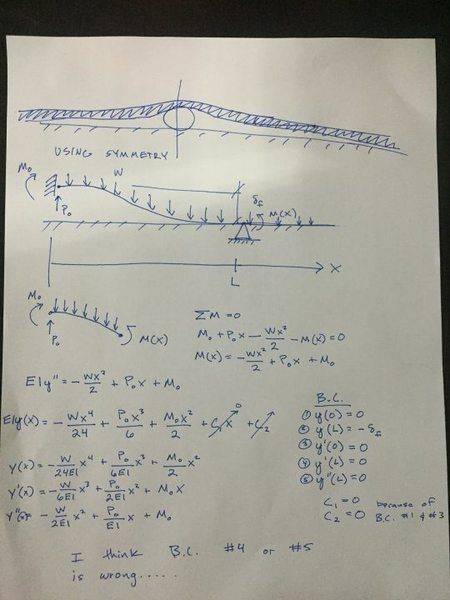
I am trying to setup a problem to represent a pipeline crossing over another perpendicular pipeline on the seabed. I am trying to represent the problem as a simple beam and having some issues with the supports i am selecting and the boundary conditions.

Attached is a picture representing the problem, but using the boundary conditions i select and trying to solve for the 5 unknowns i get two possible answers for one of the unknowns, P_0. I think one of my boundary conditions are wrong.

I using symmetry and the crossing pipe is fixed at the location of the crossed pipe. At the point where the pipe touches down i am using a hinged support.

I am trying to solve for P_0, M_0 and L

Not looking for a solution just a correction or validation of the boundary conditions i have selected.

Thanks.
IMG_0018.JPG
 
Engineering news on Phys.org
You have no way to know L. How far out does the pipe come into full contact with the floor? This means the point at which the pipe is fully supported by the floor, with no support coming from the elevated section. The pipe on the floor is what is called a "beam on an elastic foundation," a fairly tough problem. I don't think you will get an acceptable model with the approach you are using.

Here is a reference: http://www.engineeringmechanics.cz/pdf/19_6_381.pdf
 
Lets neglect the floor stiffness for right now and assume its rigid and inelastic.

L is an unknown that we are trying to solve. I actually already have an answer that someone else did and was asked to validate, but am having an issue replicating. This is an excerpt from the document i am trying to validate:"Five conditions allow us to find the integration constants and the following unknowns: L, Mo, and Po. Note, for convenience the origin (x = 0 and y = 0) has been taken at the peak of the lift. The boundary conditions are: y(0) = 0

y’(0) = 0

y(L) = - δf (5.1-3)

y’(L) = 0

y”(L) = 0where, the primes (‘) denoted derivatives with respect to the independent variable “x.” Algebraic simplification, after applying four of the conditions, results in a final set of equations that may be solved for the distance to the touchdown point, L. They are:

equations.png
This completes the solution and allows calculation of the bending moment at any point in the span using Equation 5.1-2, once Mo and Po are known. This allows the maximum bending stresses in the pipe to be computed and the concentrated force on the crossing pipe and its support (which may include the crossed pipe) to be determined for further analyses."I get two different equations fro Po, the one shown above or a similar but not quite one depending on the equations i combine.
 
Can you show us the complete solution as given in your source document, please?
 
Therein lies the problem. I am being to ask to validate something where no work was shown and only the final result.
 
Looks to me like one difficulty lies in the fact that y''(x) is discontinuous at x = L. To set y''(L) = 0 implies that there is no bending moment at that point as you approach a fixed end from the left (this is not a simple support). That is certainly contrary to all intuition. Why would you expect that to be true? On the other hand, as you approach x = L from the right, y'' is clearly zero all along. I think this is a flaw in the model. (When you have a beam built into a wall, a cantilever, you certainly don't expect zero moment at the wall.)
 
Awiest82 - please look in your inbox .
 

Similar threads

Replies
6
Views
4K
  • · Replies 4 ·
Replies
4
Views
2K
  • · Replies 8 ·
Replies
8
Views
3K
Replies
33
Views
6K
  • · Replies 8 ·
Replies
8
Views
3K
Replies
4
Views
3K
  • · Replies 4 ·
Replies
4
Views
2K
  • · Replies 2 ·
Replies
2
Views
2K
Replies
6
Views
2K
  • · Replies 10 ·
Replies
10
Views
3K