Bell's inequality for non-physicists

  • Context: Undergrad 
  • Thread starter Thread starter Demystifier
  • Start date Start date
  • Tags Tags
    Inequality
Click For Summary

Discussion Overview

The discussion revolves around Bell's inequalities, particularly their derivation and implications in quantum mechanics. Participants explore the conceptual challenges and interpretations of the inequalities, using analogies such as twins and discussing the nature of quantum states versus classical objects. The conversation touches on theoretical implications, experimental observations, and the understanding of non-locality in quantum mechanics.

Discussion Character

  • Exploratory
  • Debate/contested
  • Conceptual clarification
  • Technical explanation

Main Points Raised

  • One participant presents a simple derivation of Bell's inequalities from a popular science book, suggesting it may clarify the topic for others.
  • Another argues that while Bell's inequalities can be derived simply, the implications regarding locality and non-locality cannot be generalized due to the nature of quantum states, which are not always pure.
  • Some participants appreciate the use of analogies, such as twins, to explain the inequalities but express confusion about how these analogies hold when the inequalities are violated.
  • There are discussions about various explanations for the violation of Bell's inequalities, including non-locality, super-determinism, and detection loopholes, with some participants expressing difficulty in conceptualizing these ideas.
  • A later reply emphasizes that the common assumptions in classical physics do not hold in quantum mechanics, suggesting that the violation of Bell's inequalities is a reflection of this fundamental difference.
  • Another participant questions the clarity of the analogy when discussing violations of the inequalities, seeking further explanation on how it applies in those scenarios.

Areas of Agreement / Disagreement

Participants express a range of views on the implications of Bell's inequalities, with no consensus on the interpretations of non-locality or the effectiveness of analogies used. Some agree on the challenges of understanding the implications of violations, while others highlight differing perspectives on the nature of quantum states and classical assumptions.

Contextual Notes

Participants note limitations in the analogies used, particularly regarding their applicability when discussing violations of Bell's inequalities. There is also mention of unresolved assumptions about the nature of quantum measurements and the implications of locality versus non-locality.

Demystifier
Science Advisor
Insights Author
Messages
14,717
Reaction score
7,310
I am reading the popular-science book
A. Zeilinger, Dance of the Photons
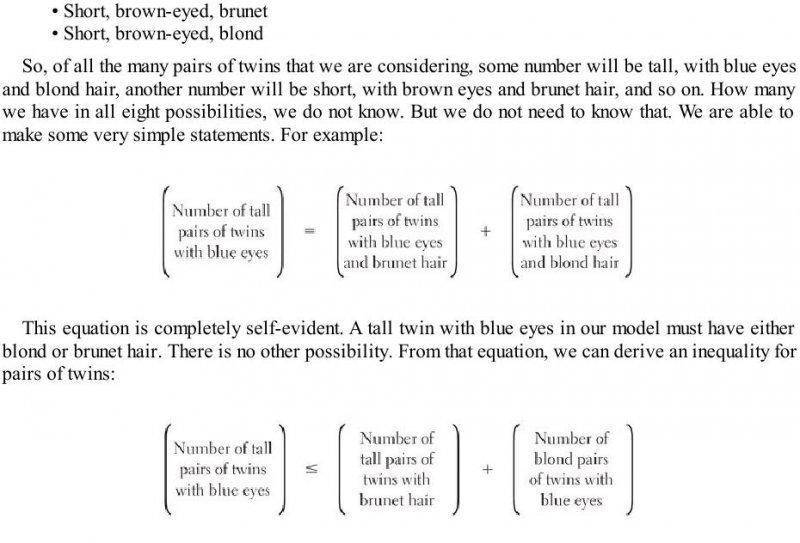
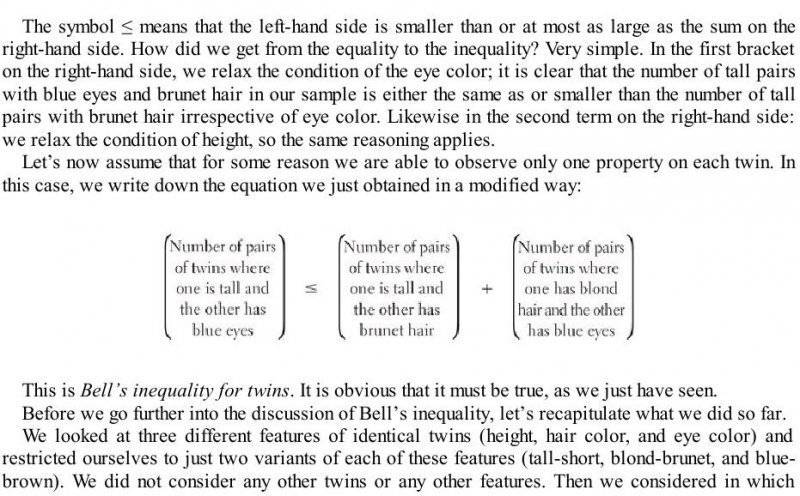
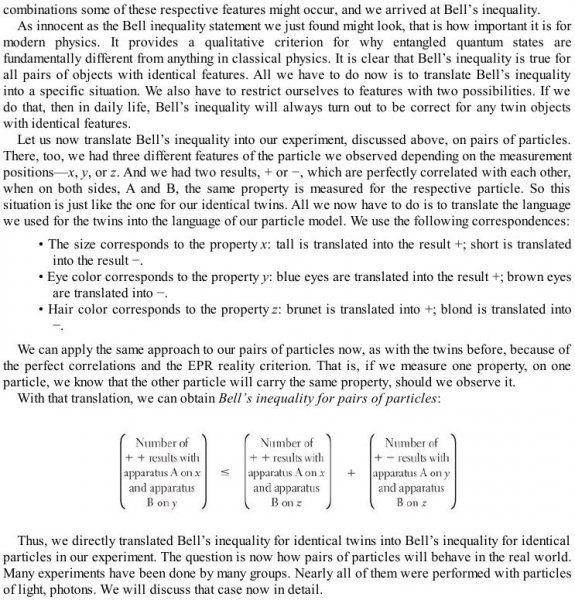
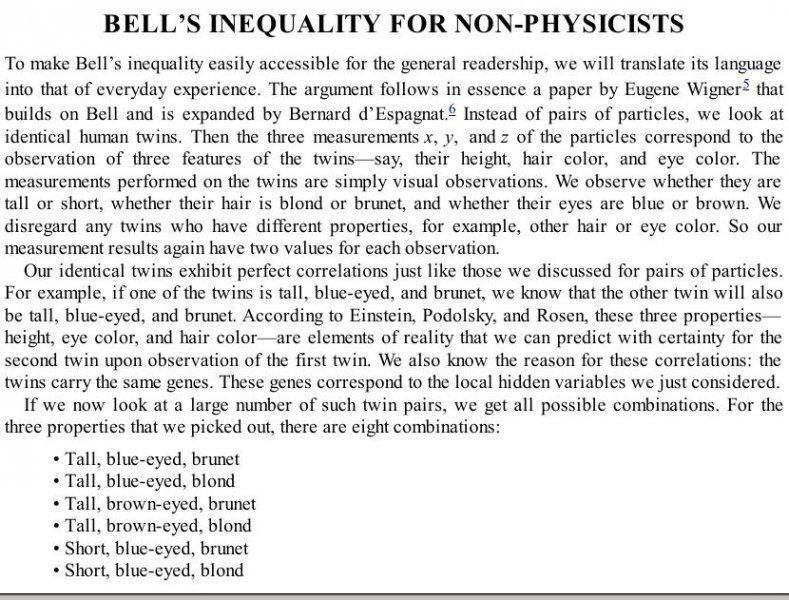
In the Appendix I have found a surprisingly simple derivation of Bell's inequalities, which, I believe, many people here would like to see. Here it is
1.jpeg
2.jpeg
3.jpeg
4.jpeg
 
  • Like
Likes   Reactions: vanhees71, Nugatory and DrChinese
Physics news on Phys.org
That is a clear account of the inequalities, but then again a human twin as a classical object is well defined classically as well as its observable properties, but a one particle quantum system, described completely by a wave function or quantum state is not well defined in general in QM, meaning it is not an invariant as in the classical case. It is in the particular spin case(or any other two-state quantum system) because it is a pure state, and the fact that we experimentally find Bell's inequalities violations simply reflects the Heisenberg indeterminacy of results(incompatibility of conjugate pairs) that is the trademark of quantum mechanics and that is not found classically. But states in QM are not pure in general(specifically they are not for systems with more than two states) so basically conclusions about locality or nonlocality cannot be generalized.
 
I like that explanation a lot, have used variants of it myself. It has the nice property that you can build it from the traditional intuitive realistic examples (Bertlmann's socks, or a pair of gloves separated and sent to two different locations) by adding two more observable properties.
 
TrickyDicky said:
but then again a human twin as a classical object is well defined classically as well as its observable properties, but a one particle quantum system, described completely by a wave function or quantum state is not well defined in general in QM, meaning it is not an invariant as in the classical case.

I don't understand that objection. Bell's theorem is not a statement about quantum mechanics, it is a statement about a class of (hypothetical) theories that aren't quantum mechanics but do make a particularly appealing (to the classically-minded) assumption about the probability distribution of the measurement results.
 
Nugatory said:
I don't understand that objection. Bell's theorem is not a statement about quantum mechanics, it is a statement about a class of (hypothetical) theories that aren't quantum mechanics but do make a particularly appealing (to the classically-minded) assumption about the probability distribution of the measurement results.
My post was a reply to Demystifier's example, where they explicitly "translate" the human twins into Quantum particles and I was presenting a caveat in that translation.
 
Interesting analogy, even if a bit confusing when you start calculating coincidence rates when measuring eye color on one twin and height of another :p To be honest, there are other and more popular analogies that have this covered better, at least in my personal oppinion. Ultimately though, it doesn't matter much which analogy you use, the question is how far do you take it and what do you manage to explain with it.

I doubt most people have a problem with deriving the inequalities themselves. What they do have a problem with is understanding what violating them means and what various mechanisms could lead to it.

The obvious example of non-locality explanation is the twins talking to each other about which property they each have measured, and remaining identical if it is the same property or shuffling it up if it is a different property on each of them.

The super-determinism or conspiracy explanation that the twins know beforehand how they will get measured up is also clear.

And for the case of just three possible properties, I can also see a "detection loophole" explanation where the twins can refuse to give out one of their properties, leading to 33% average non-detection rate, but I am having trouble extending that to a completely random angle measurement and still matching Malus.

And as for local non-realism, or multiple universes or any other "explanation", I can not for the life of me imagine a working analogy, be it with twins, be it with alien devices mailed to Mulder and Scully, or message decoders that change the output based on their angle or anything.
 
Demystifier said:
I am reading the popular-science book
A. Zeilinger, Dance of the Photons
In the Appendix I have found a surprisingly simple derivation of Bell's inequalities, which, I believe, many people here would like to see.
Maybe it's just me but when the theorem is seen derived in this simple form it is hard to fathom all the fuss and the mistery usually attributed to Bell's theorem. In a few words all it is saying is reality is not classical when probed with a quantum experiment, which we already know since we check in a daily basis that the predictions of QM are correct. This can be easily realized just by acknowledging that the common sense inequalities derived using the twins properties, assume as it is common sense from a classical point of view, that all the observables properties commute, but precisely that common sense premise is the one QM proves wrong and therefore switches the Poisson bracket for the quantum commutator. In this particular case (2 dimensional Hilbert space) the commuting relations completely determine the quantum state in an invariant way.

And when instead of twins and hair, eye color and height vs their 2 possible states that are obviously commuting properties we have angle vs intrinsic angular momentum that are not, the violation of the inequalities is unavoidable. And I think this is totally orthogonal to the debate local vs nonlocal that people usually get hung about unless one makes two additional assumptions that are by no means mandatory in QM (the second is in fact not tenable within QM by the HUP): first to consider collapse necessary and physical, second to keep the classical (locally causal) concept of particle.

In this sense rather than the usual interpretation as "no local realistic theory can predict the results of QM experiments", it should be summarized with the easier to understand but apparently tautological "no classical theory can make QM predictions", from which the only conclusion one can draw is that no classical hidden variables theory is viable to predict the outcomes of QM experiments. But again, we already knew that. .
 
Last edited:
The setup using twins as the analogy is easy enough to understand... But how does the analogy continue when the Bell inequality is violated? That's the part I'd really like to read, as I haven't fully gotten to grips with that part yet.
 
  • #10
accelerandom said:
The setup using twins as the analogy is easy enough to understand... But how does the analogy continue when the Bell inequality is violated? That's the part I'd really like to read, as I haven't fully gotten to grips with that part yet.
georgir said:
The obvious example of non-locality explanation is the twins talking to each other about which property they each have measured, and remaining identical if it is the same property or shuffling it up if it is a different property on each of them.
 

Similar threads

  • · Replies 3 ·
Replies
3
Views
2K
  • · Replies 59 ·
2
Replies
59
Views
8K
  • · Replies 5 ·
Replies
5
Views
2K
  • · Replies 17 ·
Replies
17
Views
2K
  • · Replies 73 ·
3
Replies
73
Views
4K
  • · Replies 4 ·
Replies
4
Views
2K
  • · Replies 2 ·
Replies
2
Views
2K
  • · Replies 16 ·
Replies
16
Views
3K
  • · Replies 1 ·
Replies
1
Views
2K
  • · Replies 93 ·
4
Replies
93
Views
8K