Bernoullis & Pressure Gradient force

Click For Summary

Discussion Overview

The discussion revolves around the understanding of Bernoulli's principle in relation to pressure gradients within a fluid-filled balloon subjected to external forces. Participants explore the implications of these forces on internal pressure and the behavior of fluids in motion, touching on concepts of pressure distribution and energy redistribution.

Discussion Character

  • Exploratory
  • Technical explanation
  • Conceptual clarification
  • Debate/contested

Main Points Raised

  • One participant questions the assumption that pressure remains constant throughout the fluid-filled balloon when external forces are applied, suggesting that internal pressure may vary.
  • Another participant reflects on the dynamics of internal forces acting on the fluid as the balloon accelerates, proposing that the internal pressure gradient is a result of these external forces.
  • A further contribution indicates skepticism about the relevance of Bernoulli's equation to the internal pressures, asserting that it primarily applies to external forces acting on the surface of the sphere.

Areas of Agreement / Disagreement

Participants express differing views on the constancy of pressure within the balloon and the applicability of Bernoulli's principle to internal pressure dynamics. The discussion remains unresolved, with no consensus reached on these points.

Contextual Notes

Participants' arguments depend on assumptions about fluid behavior under acceleration and the definitions of pressure in different contexts. The relationship between internal pressure gradients and external forces is not fully clarified.

Timtam
Messages
40
Reaction score
0
The more I learn about Bernoulli's the less I feel I understand it

The problem statement

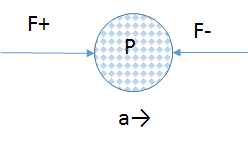
If I had a ball (balloon) filled with fluid at pressure P being acted on by two opposing forces F+ and F-
upload_2016-10-21_10-44-56.png

F+ being larger than F- there would be a net force accelerating the ball to the right but the pressure P would remain the same.

Now if I was to examine the ball as a parcel of fluid in a continuum and have a higher pressure (HP+) ~ F+ acting on one side and a lower pressure (HP-)~ F- on the other side.

upload_2016-10-21_10-41-33.png
Then I would also see the whole ball of fluid being accelerated to the right but the pressure inside the ball would also decrease from HP on the left side to LP on the right side
My question.
What action caused by the unbalanced external forces , is causing the internal pressure of the ball to decrease ?
 

Attachments

  • upload_2016-10-21_10-40-21.png
    upload_2016-10-21_10-40-21.png
    1.2 KB · Views: 651
Physics news on Phys.org
Timtam said:
The more I learn about Bernoulli's the less I feel I understand it

The problem statement

If I had a ball (balloon) filled with fluid at pressure P being acted on by two opposing forces F+ and F-
View attachment 107778
F+ being larger than F- there would be a net force accelerating the ball to the right but the pressure P would remain the same.
Why would the pressure, P, be the same at all points of the ball? I don't believe that.
 
FactChecker said:
Why would the pressure, P, be the same at all points of the ball? I don't believe that.

Ah ok, I guess I was thinking I was thinking of external forces acting on a rigid incompressible ball not considering what's happening as the rigid ball acts on the internal fluid.

So even inside such a ball as it accelerates from the external forces - the force applied internally (on the initially stationary fluid) from the right is greater than the force on the left
upload_2016-10-21_11-38-9.png

(Represented by my over-exaggerated diagram of the rigid ball being displaced before the fluid)

So the ball contains the same total internal energy but it has been redistributed into an internal pressure gradient reflecting the external forces acting on it ?

upload_2016-10-21_11-45-54.png


is this correct ?
 

Attachments

  • upload_2016-10-21_11-45-30.png
    upload_2016-10-21_11-45-30.png
    965 bytes · Views: 642
That is what I would think. Another comment I have is that I don't see any connection between the internal pressures and Bernoulli. Bernoulli's equation does apply to the external forces onto the surface of the sphere.
 

Similar threads

  • · Replies 1 ·
Replies
1
Views
2K
  • · Replies 48 ·
2
Replies
48
Views
6K
  • · Replies 20 ·
Replies
20
Views
4K
  • · Replies 3 ·
Replies
3
Views
2K
  • · Replies 35 ·
2
Replies
35
Views
5K
  • · Replies 30 ·
2
Replies
30
Views
5K
  • · Replies 43 ·
2
Replies
43
Views
7K
  • · Replies 5 ·
Replies
5
Views
2K
  • · Replies 8 ·
Replies
8
Views
2K
  • · Replies 9 ·
Replies
9
Views
4K