Discussion Overview
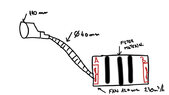
The discussion revolves around the optimal placement of a fan in a fume extractor designed for soldering applications. Participants explore various configurations for maximizing airflow and suction, considering factors such as filter placement, hose diameter, and capture velocity of fumes. The conversation includes technical insights and personal experiences related to fume extraction in electronics work.
Discussion Character
- Exploratory
- Technical explanation
- Debate/contested
- Conceptual clarification
Main Points Raised
- One participant suggests placing the fan after the filter to maintain cleanliness, while another considers both positions (before and after the filter) for airflow efficiency.
- Several participants inquire about the type of fumes being extracted, with one noting that while the fumes are not highly toxic, they are still undesirable.
- A participant shares their experience with powerful fume extractors and emphasizes the importance of positioning the extractor close to the work area for effective performance.
- There is a discussion about the impact of hose diameter on airflow, with one participant arguing that a smaller diameter increases speed but may reduce overall flow and capture efficiency.
- Another participant mentions the significance of capture velocity and suggests researching laminar flow hoods for additional insights.
- One participant proposes using a small fan to direct smoke towards the filter, enhancing the effectiveness of the fume extraction setup.
- Concerns are raised about the rapid drop-off of capture velocity with distance from the hose opening, indicating that positioning is critical for effective fume capture.
Areas of Agreement / Disagreement
Participants express varying opinions on the best fan placement and hose configuration, indicating that multiple competing views remain. The discussion does not reach a consensus on the optimal setup for the fume extractor.
Contextual Notes
Participants highlight limitations related to the design and effectiveness of existing fume extractors, as well as the need for practical solutions that balance performance and cost. There are unresolved questions regarding the specific requirements for different types of fumes and the implications of various design choices.