Binding energy or Kinetic energy?

Join the discussion
Ask a follow-up here, or get your own question answered by working scientists, mathematicians and engineers — people, not an autocomplete.
Real named experts · corrections over time · the nuance an AI answer skips
3 replies · 10K views
A M
Messages
83
Reaction score
16
Summary: I always confuse Binding Energy with Released Energy in such processes. Which one comes from mass defect?
For example in a Deuterium-Tritium fusion two nuclei with lower binding energy converse to He-4 with much higher binding energy (and a neutron). The released energy is 17.6 MeV.
What exactly happens to mass defect?
Is it conversed to the higher binding energy of ∝-particle
or the released kinetic energy of the products?

Anyone could help me with this problem?
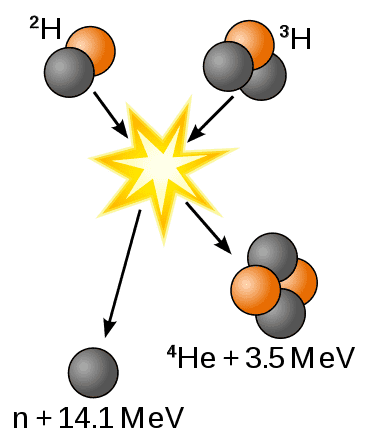
1565138815307.png
Fusion of deuterium with tritium creating helium-4, freeing a neutron, and releasing 17.59 MeV as kinetic energy of the products while a corresponding amount of mass disappears, in agreement with kinetic E = Δmc2, where Δm is the decrease in the total rest mass of particles....This difference in mass arises due to the difference in atomic "binding energy" between the atomic nuclei before and after the reaction.

Isn't it a contrast?!:confused:
https://en.wikipedia.org/wiki/Nuclear_fusion
 
Last edited:
Physics news on Phys.org
Concrete has high chemical binding energy. Uranium has low binding energy, it's actually negative. When an atom bomb explodes above a city, the end result is that the uranium has gained more binding energy while the concrete has lost binding energy. The concrete gained mass, the bomb lost mass.

An asteroid can do the same thing as an atom bomb, because it has lot of kinetic energy.

What can we conclude now? Well, it seems that kinetic energy is negative binding energy. Or those two things are the same thing.

(Maybe I made a little bit too strong claim there, negative binding energy is potential energy, kinetic energy and potential energy are both energy, but different types of energy. )
For uranium: nuclear binding energy + electrostatic binding energy < 0

For concrete: total binding energy < 0 , but chemical binding energy is the only binding energy that changes in this particular scenario.

Questions:

A) What binding energy changes are occurring inside a BWR nuclear power plant? BWR = Boiling Water Reactor.

B) What binding energy changes are occurring inside a dedicated district heating reactor?
 
Last edited:
A M said:
What exactly happens to mass defect?
Is it conversed to the higher binding energy of ∝-particle
or the released kinetic energy of the products?
You're confused because you're double counting. It's not that mass defect is spent on changing the binding energy - it is the difference in binding energy. More tightly bound means less massive. That difference is then emitted as kinetic energy or radiation.

So, let's say we have the reaction shown in the picture:
##m_d, m_t, m_h, m_p, m_n## - rest masses of deuterium, tritium, helium, isolated proton, and isolated neutron respectively.
##E## - released energy
##B## - binding energy

now:
##m_d=m_p+m_n-B_d##
##m_t=m_p+2m_n-B_t##
##m_h=2m_p+2m_n-B_h##

and the fusion reaction is:
##m_d+m_t=m_h+m_n+E##

here we could write:
##m_d+m_t-m_h-m_n=E##
##\Delta m=E## (*using natural units)
and conclude that all the energy comes from the difference in initial and final masses (mass defect),

or write:
##(m_p+m_n-B_d)+(m_p+2m_n-B_t)=(2m_p+2m_n-B_h)+m_n+E##
cancelling out all the rest masses of isolated nucleons we get
##-B_d-B_t=-B_h+E##
##-B_d-B_t+B_h=E##
##\Delta B=E##

So we can see that all the released energy comes from the difference between initial and final binding energies. It's the same thing, just more deeply understood.
 
  • Like
Likes   Reactions: A M
Bandersnatch said:
You're confused because you're double counting. It's not that mass defect is spent on changing the binding energy - it is the difference in binding energy. More tightly bound means less massive. That difference is then emitted as kinetic energy or radiation.

So, let's say we have the reaction shown in the picture:
##m_d, m_t, m_h, m_p, m_n## - rest masses of deuterium, tritium, helium, isolated proton, and isolated neutron respectively.
##E## - released energy
##B## - binding energy

now:
##m_d=m_p+m_n-B_d##
##m_t=m_p+2m_n-B_t##
##m_h=2m_p+2m_n-B_h##

and the fusion reaction is:
##m_d+m_t=m_h+m_n+E##

here we could write:
##m_d+m_t-m_h-m_n=E##
##\Delta m=E## (*using natural units)
and conclude that all the energy comes from the difference in initial and final masses (mass defect),

or write:
##(m_p+m_n-B_d)+(m_p+2m_n-B_t)=(2m_p+2m_n-B_h)+m_n+E##
cancelling out all the rest masses of isolated nucleons we get
##-B_d-B_t=-B_h+E##
##-B_d-B_t+B_h=E##
##\Delta B=E##

So we can see that all the released energy comes from the difference between initial and final binding energies. It's the same thing, just more deeply understood.
Thank you very much!