BJT voltage on the emitter question

  • Thread starter Thread starter ttsky
  • Start date Start date
  • Tags Tags
    Bjt Voltage
Join the discussion
Ask a follow-up here, or get your own question answered by working scientists, mathematicians and engineers — people, not an autocomplete.
Real named experts · corrections over time · the nuance an AI answer skips
3 replies · 3K views
ttsky
Messages
20
Reaction score
0
i got this example from our lecture notes, there is one thing i don't understand,

When calculating Ve, he takes Vb and minus the Voltage drop across transistor, so 2V - 0.7V and gets 1.3 V for Ve,

my confusion is why did he ignore Vc? should it not be (Vc + Vb)-0.7V ,so (10V+2V)-0.7V=11.3V on Ve ?

note,we haven't covered BJT yet, just reading ahead, hence the confusion.

thanks
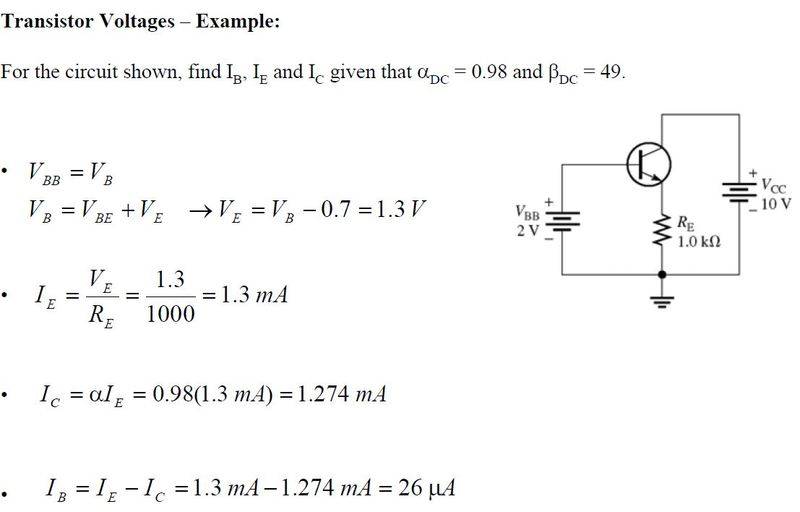
wfs6k.jpg
 
Engineering news on Phys.org
What you have done is fine. There is another voltage Vce which you have not been asked to calculate.
This will be Vcc - Ve = 10 - 1.3 = 8.7V
 
Vcc isn't in series with Vbb in this diagram.

Try to think of it as two loops with the current in the left loop controlling the current in the right loop. The actual value of Vcc doesn't matter much as long as it can supply the necessary current for the right loop.

When the circuit is turned on, base current starts to flow from Vbb. This turns the transistor on and collector current starts to flow in the right loop.

This (and a small contribution from the base current) produces a voltage across the emitter resistor which rises until the sum of this voltage and the base-emitter voltage equals Vbb.

At this point, the base current becomes steady and a predictable collector current is flowing.
 
vk6kro said:
Vcc isn't in series with Vbb in this diagram.

Try to think of it as two loops with the current in the left loop controlling the current in the right loop. The actual value of Vcc doesn't matter much as long as it can supply the necessary current for the right loop.

When the circuit is turned on, base current starts to flow from Vbb. This turns the transistor on and collector current starts to flow in the right loop.

This (and a small contribution from the base current) produces a voltage across the emitter resistor which rises until the sum of this voltage and the base-emitter voltage equals Vbb.

At this point, the base current becomes steady and a predictable collector current is flowing.
aha! that makes a lot of sense, thanks a lot!