Black hole singularity, a time-like surface?

  • Context: Undergrad 
  • Thread starter Thread starter Hill
  • Start date Start date
  • Tags Tags
    Black hole Singularity
Click For Summary

Discussion Overview

The discussion revolves around the characterization of the singularity in a Schwarzschild black hole, specifically whether it is time-like or space-like as represented in a diagram. Participants analyze the implications of hyperbolas in different quadrants of the diagram and reference terminology used in a textbook, debating the accuracy of the descriptions provided.

Discussion Character

  • Debate/contested
  • Technical explanation
  • Conceptual clarification

Main Points Raised

  • Some participants assert that hyperbolas in the right quadrant are time-like and those in the upper quadrant are space-like, questioning the textbook's claim about the singularity being time-like.
  • Others argue that the singularity in a Schwarzschild black hole is spacelike, suggesting that the book contains significant errors in its description.
  • A participant references Wald's work to support their claim about the nature of the singularity, indicating a disagreement with the textbook's interpretation.
  • There is a discussion about the correct interpretation of hypersurfaces, with some stating that a hypersurface is spacelike if the normal vectors are timelike, leading to confusion regarding the terminology used in the textbook.
  • Several participants propose that the errors in the textbook may be due to typos or inconsistent terminology, with some suggesting that the author may be using terms in a non-standard way.
  • Concerns are raised about the pedagogical implications of the author's terminology and whether it aligns with standard conventions in the literature.

Areas of Agreement / Disagreement

Participants do not reach a consensus, as there are multiple competing views regarding the characterization of the singularity and the accuracy of the textbook's terminology. Disagreements persist about whether the issues stem from typos or a misunderstanding of standard terminology.

Contextual Notes

Participants note that the definitions of time-like and space-like can depend on the metric signature convention adopted, which adds complexity to the discussion. The conversation highlights the potential for confusion in the context of general relativity and the interpretation of hypersurfaces.
Hill
Messages
792
Reaction score
614
TL;DR
In "General Relativity: The Theoretical Minimum" (Susskind, Leonard; Cabannes, André), the surface corresponding to the black hole singularity is described as time-like. Why?
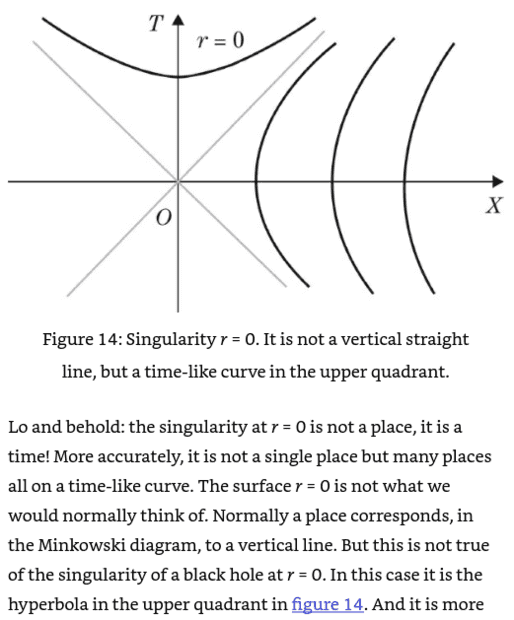
Below is the description from the book. I thought that hyperbolas in the right quadrant are time-like and hyperbolas in the upper quadrant are space-like. If it were so, the surface ##r=0## would be space-like, but the book says otherwise. -- ?
1703127344928.png
 
Physics news on Phys.org
Hill said:
Below is the description from the book. I thought that hyperbolas in the right quadrant are time-like and hyperbolas in the upper quadrant are space-like.
You are correct. The singularity in a Schwarzschild black hole, which is what the diagram is showing, is spacelike. That is a huge error, which I am extremely surprised to see in that book.
 
  • Informative
  • Like
Likes   Reactions: Hill and Demystifier
PeterDonis said:
The singularity in a Schwarzschild black hole, which is what the diagram is showing, is spacelike.
I guess Susskind needs to read Wald, section 6.4, which explicitly states what I state in the quote above.
 
On a Kruskal diagram, like on a Minkowski diagram, null lines slope at 45° and timelike lines are steeper than that.

The body text correctly notes that the singularity is more like a time than a place, though, meaning it is spacelike (any "now" must be a spacelike surface - or line in the case of the Schwarzschild singularity). So the caption is a typo that's got past the authors and editors.
 
  • Like
Likes   Reactions: vanhees71
Ibix said:
the caption is a typo
At least two of them, since "time-like" appears in both the Figure label and the paragraph of text beneath it.
 
  • Like
Likes   Reactions: Ibix
Ibix said:
On a Kruskal diagram, like on a Minkowski diagram, null lines slope at 45° and timelike lines are steeper than that.

The body text correctly notes that the singularity is more like a time than a place, though, meaning it is spacelike (any "now" must be a spacelike surface - or line in the case of the Schwarzschild singularity). So the caption is a typo that's got past the authors and editors.
In other words, the hypersurfaces ##r=\text{const}## with ##r<r_{\text{S}}## are spacelike since the corresponding ##r##-lines are "normal vectors" of this hypersurface are time-like. It's often confusing, but one has to remember that a hypersurface is spacelike if the normalvector is timelike and vice versa. So I'd also say the singularity ##r=0## is a spacelike hypersurface rather than calling it time-like.
 
May be they meant to say that it is like a moment of time. Many places at the same time.
 
  • Like
Likes   Reactions: vanhees71
But that's indeed a spacelike hypersurface ;-)), but I'm not too harsh with textbook authors concerning typos. Tell me a recipy how to produce typo-free textbooks ;-)).
 
I'd call it "misspoken" rather than "typo". It doesn't matter really. I'm just glad that I've spotted it and that my understanding so far is correct.
 
  • #10
martinbn said:
Many places at the same time.
The text sort of says that, but the correct term for such a surface is "spacelike"--it's a surface that can be viewed as "space"--many places--at an instant of time.
 
  • Like
Likes   Reactions: vanhees71
  • #11
Hmm... The book insists: 20 pages later, referring to this figure,
1703188108088.png

it says,
1703188187659.png
 
  • #12
Hill said:
The book insists: 20 pages later, referring to this figure
If by "upper quadrant" they mean the black hole region, this is of course wrong. The constant ##t## lines in the black hole region are timelike, and the constant ##r## hyperbolas are spacelike.

I am skeptical that these were typos. Based on my previous experience reading papers by Susskind, I suspect he is making up his own terminology (where "space-like" means "like a point in space" and "time-like" means "like an instant of time") and either hasn't bothered to check the literature, or doesn't think it matters. Which, given that this book is supposed to be for pedagogy, does not strike me as a sound strategy. I hope I'm wrong.
 
  • Like
Likes   Reactions: vanhees71
  • #13
PeterDonis said:
If by "upper quadrant" they mean the black hole region
They do.
PeterDonis said:
his own terminology
Not in this case: earlier in the book he says,

1703201514714.png
 
  • #14
Some terrible search-and-replace disaster?

##t## is a spacelike coordinate inside the horizon which means that lines of constant ##t## (on this 1+1d diagram) are time-like, and vice-versa outside.
 
  • Like
Likes   Reactions: vanhees71
  • #15
That's an amazing mistake in a (pre-)introductory textbook then. It's anyway confusing with space-like vs. time-like concerning 3D hypersurfaces (already in SR but the more in GR).

The right local criterion is that a hypersurface is called space-like if the normal vectors are time-like.

In the usual Schwarzschild coordinates for ##r<r_{\text{S}}## the ##t##-coordinate is space-like and the ##r##-coordinate is time-like (which adds to the confusion, because it's labelled ##t## for "time" and ##r## for "radial coordiante" due to the fact that ##t## is the time-like coordinate and ##r## a space-like coordinate outside the event horizon, i.e., for ##r>r_{\text{S}}##).

Now for the hypersurfaces defined by ##t=\text{const}## the lines ##(r,\vartheta,\varphi)=\text{const}##, i.e., the ##t##-lines are spacelike for ##r<r_{\text{S}}##, and they are the "hypersurface normal vectors", and thus these hypersurfaces are time-like.
 
  • #16
Ibix said:
Some terrible search-and-replace disaster?
Y'know, the more I think about it the more plausible this hypothesis becomes.
 
  • #17
Hill said:
earlier in the book he says
In itself that quote could be consistent with standard terminology, since the signs of squared intervals depend on what metric signature convention you adopt. In standard terminology, the quote you give is simply describing the standard timelike signature convention.

But if all he's doing is using the standard timelike signature convention, then he's using it wrong in the other quotes you give. So he can't just be using standard terminology.
 
  • Like
Likes   Reactions: Hill
  • #18
PeterDonis said:
In itself that quote could be consistent with standard terminology, since the signs of squared intervals depend on what metric signature convention you adopt. In standard terminology, the quote you give is simply describing the standard timelike signature convention.

But if all he's doing is using the standard timelike signature convention, then he's using it wrong in the other quotes you give. So he can't just be using standard terminology.
He uses the standard terminology everywhere else. Here are some examples:

1703472206063.png


1703472246406.png


1703472288111.png
 
  • #19
Hill said:
He uses the standard terminology everywhere else. Here are some examples
Interesting, so his usage is inconsistent. That would seem to be a point in favor of the "typo" theory.
 
  • #20
Ibix said:
Some terrible search-and-replace disaster?
If it were that one would expect it to show up in the example @Hill gave in post #18, but it doesn't.
 

Similar threads

  • · Replies 22 ·
Replies
22
Views
1K
  • · Replies 5 ·
Replies
5
Views
1K
  • · Replies 12 ·
Replies
12
Views
3K
  • · Replies 57 ·
2
Replies
57
Views
4K
  • · Replies 7 ·
Replies
7
Views
4K
  • · Replies 17 ·
Replies
17
Views
3K
  • · Replies 20 ·
Replies
20
Views
3K
  • · Replies 2 ·
Replies
2
Views
2K
  • · Replies 22 ·
Replies
22
Views
2K
  • · Replies 22 ·
Replies
22
Views
3K