cd19
- 50
- 0
1. Homework Statement
2. Homework Equations
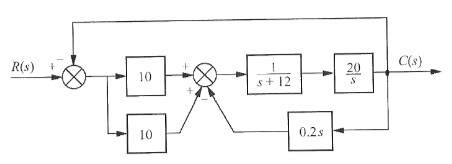
I need to reduce the above block diagram to find the closed loop transfer function
This is my solution to the reduction part of the problem:
i) Add the feed forward paths; (10 + 10)
ii) cascade G(s)2 x G(s)3 , {G(s)2 = 1/1+12, G(s)3= 20/s}
iii) Reduce the minor feedback loop (0.2s) : using, G(s)/1+G(s)H(s) [G(s) being part ii]
iv) then finally cascade blocks in forward path
3. The Attempt at a Solution
This should be my open loop transfer function and from there I can get closed loop BUT I'm getting something wrong in my above reduction which I can't figure out. Anyone see where I'm going wrong?
2. Homework Equations
I need to reduce the above block diagram to find the closed loop transfer function
This is my solution to the reduction part of the problem:
i) Add the feed forward paths; (10 + 10)
ii) cascade G(s)2 x G(s)3 , {G(s)2 = 1/1+12, G(s)3= 20/s}
iii) Reduce the minor feedback loop (0.2s) : using, G(s)/1+G(s)H(s) [G(s) being part ii]
iv) then finally cascade blocks in forward path
3. The Attempt at a Solution
This should be my open loop transfer function and from there I can get closed loop BUT I'm getting something wrong in my above reduction which I can't figure out. Anyone see where I'm going wrong?