Block Diagram Reduction: Steps to Find Closed Loop Transfer Function

Click For Summary

Discussion Overview

The discussion revolves around the process of reducing a block diagram to find the closed loop transfer function, focusing on the steps involved in the reduction and the challenges faced by participants in achieving the correct solution.

Discussion Character

  • Homework-related, Technical explanation, Debate/contested

Main Points Raised

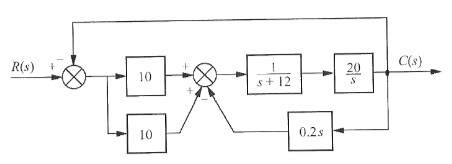
  • One participant outlines a step-by-step approach to reduce the block diagram, including adding feed forward paths and cascading blocks, but expresses uncertainty about an error in their reduction process.
  • Another participant suggests that converting a 3-input summation into two 2-input summations could simplify the problem.
  • A later reply concurs with the suggestion to separate the summing junctions, indicating that this method may lead to an easier solution.
  • There is a request for assistance in confirming the closed loop transfer function, indicating a lack of clarity or consensus on the correct answer.

Areas of Agreement / Disagreement

Participants express differing views on the best approach to simplify the block diagram, with some agreeing on the method of separating summing junctions while others remain uncertain about the overall reduction process.

Contextual Notes

Participants have not resolved the specific error in the original reduction attempt, and there are unresolved steps in the mathematical process of finding the closed loop transfer function.

Who May Find This Useful

Students and practitioners working on control systems, particularly those interested in block diagram analysis and transfer function derivation.

cd19
Messages
50
Reaction score
0
1. Homework Statement
Block2.jpg

2. Homework Equations

I need to reduce the above block diagram to find the closed loop transfer function

This is my solution to the reduction part of the problem:

i) Add the feed forward paths; (10 + 10)

ii) cascade G(s)2 x G(s)3 , {G(s)2 = 1/1+12, G(s)3= 20/s}

iii) Reduce the minor feedback loop (0.2s) : using, G(s)/1+G(s)H(s) [G(s) being part ii]

iv) then finally cascade blocks in forward path


3. The Attempt at a Solution

This should be my open loop transfer function and from there I can get closed loop BUT I'm getting something wrong in my above reduction which I can't figure out. Anyone see where I'm going wrong?
 
Physics news on Phys.org
Can anyone help me out

this is the answer for the closed loop function
closed1.jpg
 
first convert the 3-input summation into two 2-input summation.
and after that i will become very easy to solve
 
This question was asked in May 2011.

Hopefully it was solved by now.

But yes I agree with trapti once you separate the middle summing junction into two it is very simple.
 

Similar threads

Replies
24
Views
5K
  • · Replies 4 ·
Replies
4
Views
2K
  • · Replies 2 ·
Replies
2
Views
8K
Replies
3
Views
3K
Replies
4
Views
2K
  • · Replies 2 ·
Replies
2
Views
2K
  • · Replies 3 ·
Replies
3
Views
2K
  • · Replies 2 ·
Replies
2
Views
2K
  • · Replies 1 ·
Replies
1
Views
2K
  • · Replies 5 ·
Replies
5
Views
2K