Blocks sliding down different lengths of ramp

  • Context: High School 
  • Thread starter Thread starter dibilo
  • Start date Start date
  • Tags Tags
    Blocks Ramp Sliding
Click For Summary

Discussion Overview

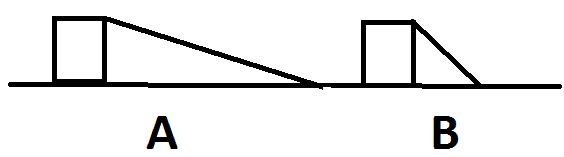
The discussion revolves around the comparison of two ramps (A and B) of different lengths and angles, specifically focusing on the time it takes for a block to slide down each ramp from the same height. Participants explore concepts related to acceleration, the effects of ramp angles, and the implications of the brachistochrone curve.

Discussion Character

  • Exploratory
  • Technical explanation
  • Conceptual clarification
  • Debate/contested

Main Points Raised

  • Some participants propose that the time taken for a block to slide down ramps of different angles is influenced by the component of gravitational acceleration along the ramp, which varies with the angle of incline.
  • Others argue that shallower ramps result in longer distances to travel and lower acceleration, leading to longer times compared to steeper ramps.
  • A participant notes that the assumption of constant acceleration down a slope is incorrect, as the acceleration changes with the slope angle.
  • One participant mentions that the brachistochrone curve represents an ideal path for maximizing acceleration and minimizing travel time, suggesting that the changing slope is a critical factor.
  • There is a suggestion to study forces and their effects further to better understand the relationship between ramp angles and acceleration.

Areas of Agreement / Disagreement

Participants express differing views on the role of acceleration and ramp angles in determining the time taken for a block to slide down. There is no consensus on the implications of friction or the necessity of further study on the topic.

Contextual Notes

Limitations include the assumption that friction is negligible, the dependence on the specific angles of the ramps, and the complexity of calculating the actual brachistochrone curve, which may not be fully addressed in the discussion.

dibilo
Messages
47
Reaction score
0
I have been watching videos on the brachistochrone curve and from my understanding, the curve works as the ball goes through more acceleration at start, therefore causing it to reach the end the fastest. However, I understand that acceleration towards Earth is constant (9.81 m/s^2) and this brings me to another question.
1e2fbjQ.png


From experience, I believe that if I slide a block down both ramps from the same height, a block will reach the ground faster on ramp B than ramp A. Since acceleration towards Earth is constant, what caused the difference in timing? Is it just friction?

Thanks for your help in advance!
 

Attachments

  • 1e2fbjQ.png
    1e2fbjQ.png
    1.2 KB · Views: 1,534
Physics news on Phys.org
dibilo said:
From experience, I believe that if I slide a block down both ramps from the same height, a block will reach the ground faster on ramp B than ramp A
It's not friction. It's the component of the acceleration of gravity in the vertical direction that counts. Think of doing this on a frictionless ramp. When the angle of the incline is zero, the time is infinite, because there is no acceleration in the vertical direction and the block once at rest, stays at rest. When the angle of the ramp is 90o, the time is a minimum because the acceleration is as large as it would get for any angle, namely the acceleration of gravity, and the block is in free fall.

On edit: The component of the acceleration of gravity along the ramp is ax = g sinθ, where θ is the angle with respect to the horizontal.
 
What kuruman said. In addition, shallower angles have longer ramps. The result is that shallower ramps have both lower acceleration and longer distance to travel.
 
The first issue with your assumption is that acceleration is constant when going down a slope. Brachistocrone curves do not have constant slopes and therefore do not have constant acceleration.

Acceleration due to gravity = g sin (theta). The acceleration due to gravity is different due to different slopes. With steep slopes as in Ramp B, theta approaches 90 degrees and the acceleration approaches 9.8 m/s^2. With Ramp A, theta is quite small, and the acceleration due to gravity on the slope is just a fraction of the actual acceleration due to gravity. Ramp B will accelerate an object faster.

A Brachistocrone curve resembles the ideal changing slope for an object to accelerate down. If you wanted to calculate the actual Brachistochrone curve, we could get into some serious calculus.

My suggestion is that you study forces and their effects a little more and then look at Brachistochrone curve videos. The basic reason behind all this is the changing acceleration due to a changing slope (not friction).
 

Similar threads

  • · Replies 2 ·
Replies
2
Views
1K
  • · Replies 9 ·
Replies
9
Views
4K
  • · Replies 8 ·
Replies
8
Views
2K
  • · Replies 3 ·
Replies
3
Views
2K
  • · Replies 9 ·
Replies
9
Views
2K
  • · Replies 2 ·
Replies
2
Views
2K
  • · Replies 4 ·
Replies
4
Views
3K
  • · Replies 5 ·
Replies
5
Views
4K
  • · Replies 4 ·
Replies
4
Views
2K
  • · Replies 4 ·
Replies
4
Views
3K