Bodies connected by a light inextensible string on an inclined plane

Click For Summary
SUMMARY

The discussion focuses on the dynamics of two bodies connected by a light inextensible string on an inclined plane. Participants analyze the assumption of equal acceleration for both blocks, questioning the validity of this assumption when one block may potentially move faster than the other. The conclusion emphasizes that one should calculate the acceleration of each block independently, without assuming they are equal, to avoid incorrect results. The correct approach leads to a more accurate understanding of the system's behavior.

PREREQUISITES
  • Understanding of Newton's laws of motion
  • Basic knowledge of inclined plane mechanics
  • Familiarity with concepts of tension in strings
  • Ability to solve kinematic equations
NEXT STEPS
  • Study the principles of Newton's second law in multi-body systems
  • Learn about the effects of tension in connected objects on inclined planes
  • Explore kinematic equations for objects in motion on inclines
  • Investigate scenarios involving variable acceleration in connected systems
USEFUL FOR

Students of physics, educators teaching mechanics, and anyone interested in understanding the dynamics of connected systems on inclined planes.

Bill Gregoryson
Messages
1
Reaction score
0
Homework Statement
Connected bodies by light inextensible string on an inclined plane
Relevant Equations
F = ma, v^2 = u^2 + 2as, s = ut + 1/2at^2
Here is the question (Qu 9):
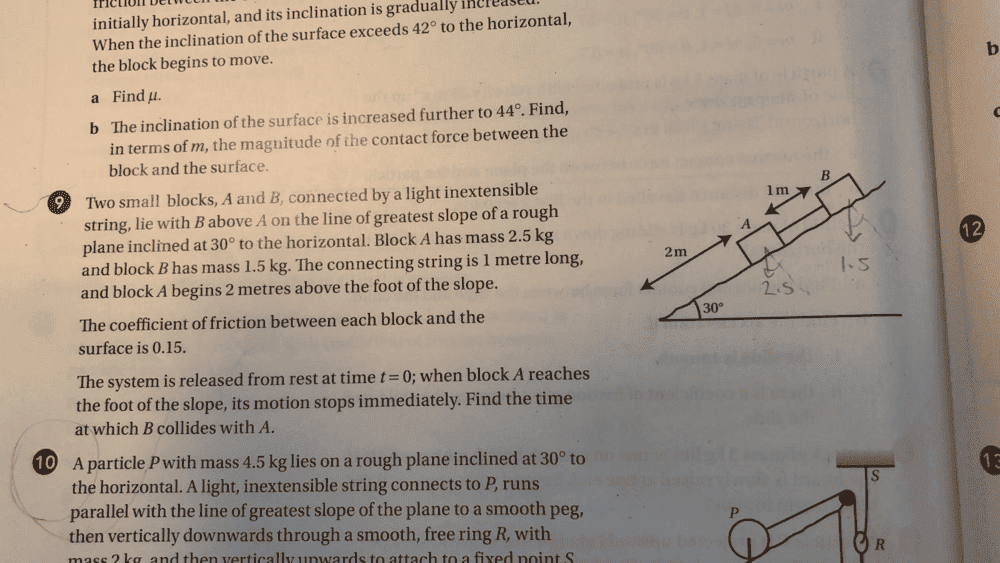
241861

Here is what I have attempted:
assumed that the accelerations are equal, found a value for the acceleration, thus worked out the time taken for A to reach the bottom.
then assumed that the tension becomes 0 once A hits the floor, and then worked out B's new acceleration and hence the time taken for B to hit A.

How am I allowed to assume that the acceleration is equal?
How do we know that B does not at any point move slightly faster such that the string becomes "squashed"?

I get the answer 1.29, which according to the answers is incorrect.
 
Physics news on Phys.org
Bill Gregoryson said:
How am I allowed to assume that the acceleration is equal?
You don't need to assume anything. Just find the acceleration of each block as if the other one were not there. Are the expressions equal or not?
Bill Gregoryson said:
How do we know that B does not at any point move slightly faster such that the string becomes "squashed"?
If the blocks start from rest and their accelerations are equal, can this happen?
 

Similar threads

  • · Replies 2 ·
Replies
2
Views
2K
  • · Replies 18 ·
Replies
18
Views
6K
  • · Replies 37 ·
2
Replies
37
Views
3K
  • · Replies 1 ·
Replies
1
Views
2K
  • · Replies 16 ·
Replies
16
Views
5K
Replies
8
Views
2K
  • · Replies 27 ·
Replies
27
Views
4K
  • · Replies 9 ·
Replies
9
Views
3K
  • · Replies 12 ·
Replies
12
Views
1K
  • · Replies 1 ·
Replies
1
Views
2K