Boiling Food: Is Less Boiling More Efficient?

  • Context: High School 
  • Thread starter Thread starter Maxo
  • Start date Start date
  • Tags Tags
    Boiling Cooking Food
Click For Summary

Discussion Overview

The discussion revolves around the efficiency of boiling food, specifically pasta, and whether less boiling can be more effective. Participants explore various cooking methods, energy consumption, and the implications of temperature on cooking outcomes. The conversation touches on practical cooking tips, scientific principles, and personal experiences related to boiling and cooking techniques.

Discussion Character

  • Exploratory
  • Technical explanation
  • Conceptual clarification
  • Debate/contested
  • Practical application

Main Points Raised

  • Some participants suggest that boiling water slightly may save energy but question whether it results in longer cooking times for pasta.
  • Others argue that a rigorous boil is necessary to prevent pasta from sticking together and ensure even cooking.
  • A participant mentions that adding pasta at room temperature can lower the water temperature, potentially affecting cooking efficiency.
  • There are considerations about the definition of cooking and the role of temperature in breaking down food structures.
  • Some participants share personal observations about the importance of monitoring cooking techniques to avoid messes and undesirable outcomes.
  • One participant highlights the variability of water temperature in a pot and the importance of stirring to achieve uniform cooking.
  • Another participant discusses the use of oil after cooking to prevent sticking, indicating different approaches to pasta preparation.

Areas of Agreement / Disagreement

Participants express differing views on the best boiling method for cooking pasta, with no consensus reached on whether less boiling is more efficient. There are multiple competing perspectives on the importance of water temperature, cooking time, and techniques.

Contextual Notes

Participants mention various assumptions about cooking methods, energy use, and the effects of temperature on food quality, but these remain unresolved within the discussion.

Who May Find This Useful

This discussion may be of interest to home cooks, culinary enthusiasts, and individuals exploring the science of cooking and food preparation techniques.

Maxo
Messages
160
Reaction score
1
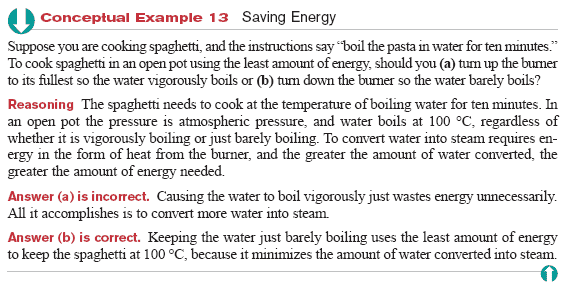
Look at this example.
image.png

I understand the reasoning here, in order to save energy one only needs to boil water slightly. But doesn't it also take longer time to boil it the same amount? I'm pretty sure in a given number of minutes, the spagetti will be more ready (more cooked) if it has been boiled more then if it's only been slightly boiled. What do you think? Is there some other factor that could be taken into consideration here?
 
Science news on Phys.org
Well with answer A you are losing water to steam making the things denser in the pot and will probably wind up with sticky or strung together spaghetti unless you add water which people usually do to contain the bubbles that form.

I think the water in pot contains the same energy content as the excess energy escapes with the steam.
 
Why would faster water loss make the spaghetti "boil more"?

The only way I can see for a faster boil to be better is if you need heat transfer, such as when boiling a potato or egg. A faster boil means more more convection and steam condensing on the surface of what you are cooking.
 
I understand the reasoning here, in order to save energy one only needs to boil water slightly. But doesn't it also take longer time to boil it the same amount?

The instructions say "boil the pasta in water for 10 minutes". That normally means heating the water until it boils and then adding the pasta.

In both a) and b) the pasta would be in boiling water (100C) for 10 mins. So both methods achieve the same end result.
 
Humm. Actually there might be a slight difference in the time...

When you add the pasta (which is at room temperature) the temperature of the water will fall and it may stop boiling. Normally it will quickly start boiling again however method b) might take longer than method a) to raise the temperature back to the boiling point.

That still doesn't mean method b) uses more energy because in both cases the same amount of energy is needed to heat the pasta from room temperature to boiling.
 
Last edited:
This is interesting. I wonder how dependent on temperature this is? For example I've long been a fan of steaming vegetables, shrimp and the like and I've seen that people cook food in liquid nitrogen. It has made me consider what is the exact definition of cooking beyond the breaking down of cell structure.
 
enorbet said:
This is interesting. I wonder how dependent on temperature this is? For example I've long been a fan of steaming vegetables, shrimp and the like and I've seen that people cook food in liquid nitrogen. It has made me consider what is the exact definition of cooking beyond the breaking down of cell structure.

Try Kitchen Chemistry, an old series about cooking and some explanations about the processes. After it appeared many Chefs started using the unorthodox methods presented in it (lots of vacuum applications for french fries :P, and liquid nitrogen etc.). I think it was a starting point for these techniques.
 
  • Like
Likes   Reactions: 1 person
From a practical standpoint, I have observed that when cooking pasta, if you don't monitor the flame setting properly, you can boil the pot over after adding the pasta, which creates an inconvenient mess.

For some reason, the best cooks may not necessarily be the best scientists.
 
Lok said:
Try Kitchen Chemistry, an old series about cooking and some explanations about the processes. After it appeared many Chefs started using the unorthodox methods presented in it (lots of vacuum applications for french fries :P, and liquid nitrogen etc.). I think it was a starting point for these techniques.

Thank you, Lok. You're the 2nd person who has recommended that book and I did see some fascinating excerpts. IIRC the excerpt was about the chemistry of why the first pancake is always awful.

Actually it is part of what fueled my question. I had read that cooking was an extremely important part of human evolution not only because cooked food tends to last longer, even without refrigeration, but that, at least when subjected to higher temperatures, the cell breakdown creates more complex molecules that in many foods, especially meats, are more nutritious.

With so many fad diets always popping up, it's good that people learn the actual chemistry involved to rule out the ridiculous ones. There's always room for just plain fun in cuisine, but misinformation shouldn't ruin good nutrition by becoming "the cake" when it should remain "the frosting" (even though rumor has it, "the cake is a lie! :biggrin:)

PS - to stay precisely On Topic I should mention that I think it may be important to know at what temperature pasta ceases cooking in a manner that humans like and becomes something ghastly, or if temperature is more of a factor than time past a certain point. It may be worthy of note that some foods cook very nicely in microwaves but others are retch worthy.
 
Last edited:
  • #10
CWatters said:
In both a) and b) the pasta would be in boiling water (100C) for 10 mins. So both methods achieve the same end result.
Method b) is a good recipe for creating an inseparable lump of pasta at the bottom of the pot. The bottom of the lump will be partially burnt and will be hard to clean off. The middle of the lump will be undercooked. Yech.

Method a) is the right answer. The water needs to be in a rigorous boil so as to keep the pasta moving around. The right way to cook pasta is to put a generous amount of water in a tall pot, with the top of the water at least three or four inches below the top of the pot. Having a tall pot with several inches of room to spare helps with the boil over problem and allows you to have at least a gallon of water per four servings. Add a bit of salt to the water and bring the water to a rigorous boil. Add the pasta and cover for a bit so as to bring the water back to boiling ASAP. Uncover and stir several times during the first two or three minutes of cooking. Those first few minutes are when the pasta is most likely to form itself into an indigestible glue ball. After that you should only have to stir occasionally if the water is kept in a rigorous boil. The roiling water will stir the pasta. Cook until al dente, or a bit past that if you don't like al dente pasta. The timing instructions are a guideline, not a rule.
 
  • #11
If you want your spaghetti al dente, the most important thing is plenty of water. It's also good to have tall pot, as D H sad. However, you shouldn't really put the heat to the max. It could be rigorous boil initially so that you don't have to manoeuvre the cover quickly, but after you cover the pot (without forgetting salt, of course) you should reduce the temperature a bit. After about half time cooking, during which time you really have to watch and stir regularly cause nothing is worse than glued chunk of pasta, you can relax. I usually don't recover after the final stir, so, ..what was the topic?
Ah yes, the answer should be b) , because you save energy and really get nicely cooked spaghetti, but then again, the problem says "open pot", in which case you definitely need strongest possible boil before putting spaghetti.
 
  • #12
The worst spaghetti I have ever had was in, of all places - ROME!. I was disgusted but too wimpish to complain in the very busy, touristy place so it serves me right. The spaghetti had been put in the pot and not stirred round. One end of the handful had stuck together together in a horrid lump.

What people tend to forget is that the temperature in a pan of 'boiling' water is just not uniform. It may be 100C at the bottom but can be 90C at the top. Stirring, over a high flame, gives the best chance of the water being uniformly hot everywhere. Plenty of water and a big pan (salt of course) all contribute to good pasta cooking.
 
  • #13
My wife does a trick of mixing in some veggie oil (I think?) after the spaghetti dumped into the strainer and then onto the plate.
 

Similar threads

Replies
15
Views
3K
Replies
6
Views
3K
  • · Replies 3 ·
Replies
3
Views
2K
  • · Replies 14 ·
Replies
14
Views
4K
Replies
8
Views
5K
  • · Replies 2 ·
Replies
2
Views
2K
  • · Replies 21 ·
Replies
21
Views
2K
  • · Replies 8 ·
Replies
8
Views
4K
  • · Replies 41 ·
2
Replies
41
Views
7K
Replies
6
Views
35K