Breakdown voltage of humid air in uniform electric field

Click For Summary
SUMMARY

The discussion centers on the breakdown voltage of humid air in a uniform electric field, emphasizing that the intensity of the electric field exceeds the breakdown voltage of humid air. Participants agree that while no spark occurs due to insufficient current, the humid air can become partially ionized, allowing a small current to flow. This current maintains the voltage between dielectric layers at the breakdown voltage of the air flow. Factors such as humidity, air flow speed, and environmental conditions significantly influence the system's behavior.

PREREQUISITES
  • Understanding of breakdown voltage in dielectric materials
  • Knowledge of electric field strength and its effects on air conductivity
  • Familiarity with ionization processes in humid air
  • Basic principles of circuit theory, particularly in high-resistance systems
NEXT STEPS
  • Research the breakdown voltage of various dielectric materials, including humid air
  • Learn about the effects of turbulence on moisture distribution and dielectric properties
  • Explore methods for measuring electric field strength in humid environments
  • Investigate the impact of environmental factors, such as dust and airflow, on dielectric breakdown
USEFUL FOR

Electrical engineers, physicists, and researchers interested in high-voltage systems, dielectric materials, and the behavior of humid air in electric fields will benefit from this discussion.
Ali_A
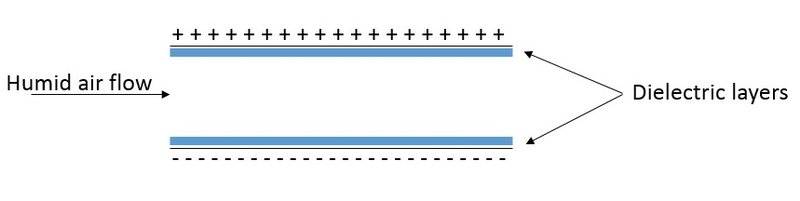
Could anyone please let me know if breakthrough spark can happen, or, in general, what will happen in the below system? Note 1: the dielectric layers have a much higher breakthrough voltage than humid air. Note 2: the intensity of the electric field that develops in the flow of the humid air is higher than the humid air breakthrough voltage.
1.jpg
 
Last edited by a moderator:
Engineering news on Phys.org
Ali_A said:
Could anyone please let me know if breakthrough spark can happen, or, in general, what will happen in the below system? Note 1: the dielectric layers have a much higher breakthrough voltage than humid air. Note 2: the intensity of the electric field that develops in the flow of the humid air is higher than the humid air breakthrough voltage.

initial thoughts

for a start, you will need to find out the breakdown voltage for the dielectric material used taking into account its thickness ( x2)
the distance between the dielectric layers so that you can then find out the breakdown voltage for layer of humid air of that thickness
will the humidity of that air vary ?, of so then so will the breakdown voltage for it
 
Hi Davenn,

Many thanks for your reply.
I do not know if I really understand your point. But let's assume that the breakdown voltage of dielectric layers are high enough to avoid spark through them. And, the humidity is constant.

I would like just to know if how or whether arcing can occur in the humid air flow if the intensity of the electric field that develops in the flow of the humid air is higher than tits breakdown voltage?
 
Ali_A said:
the intensity of the electric field that develops in the flow of the humid air is higher than the humid air breakthrough voltage.
I think that's the point where it's wrong. You take this as if no current would flow at all.

Although no spark will happen (spark requires a minimal current), the humid air will be partially ionized, and will produce a (really small) current enough to keep the voltage between the surfaces of the dielectric layers around the breakdown voltage of the air flow.

At least I think so.
 
Rive said:
I think that's the point where it's wrong. You take this as if no current would flow at all.

Although no spark will happen (spark requires a minimal current), the humid air will be partially ionized, and will produce a (really small) current enough to keep the voltage between the surfaces of the dielectric layers around the breakdown voltage of the air flow.

At least I think so.
Thank you Rive!
Your explanation sounds logical and the point (that a current would flow) is what I am looking for. So, if we would have a current as you said, finally the voltage between the dielectric layers will discharge and the current will be vanished, what do you think? What would the final state of the system be?
 
Ali_A said:
What would the final state of the system be?
I don't know. You should consider this setup as a circuit which is built by resistors at the GOhm scale.
This caliber requires really special knowledge and many thing depends on the exact technology. Even a simple fingerprint can change everything.

For example, in a typical real-world application such setups tends to gather dust//dust bunnies, which greatly changes the parameters.
Or if the air flow is fast enough then it'll blow out slightly ionized air. I don't know how should that be calculated.
 
Rive said:
I don't know. You should consider this setup as a circuit which is built by resistors at the GOhm scale.
This caliber requires really special knowledge and many thing depends on the exact technology. Even a simple fingerprint can change everything.

For example, in a typical real-world application such setups tends to gather dust//dust bunnies, which greatly changes the parameters.
Or if the air flow is fast enough then it'll blow out slightly ionized air. I don't know how should that be calculated.
Thank you!

Hopefully I can get the funding to build the setup and let you know the result in future. In the meanwhile I have to study a lot as this field is competently new to me.
 
I am confused by your comment " I would like just to know if how or whether arcing can occur in the humid air flow if the intensity of the electric field that develops in the flow of the humid air is higher than it's breakdown voltage?"

How do you define "breakdown voltage"?

I.e. "Although air is normally an excellent insulator, when stressed by a sufficiently high voltage (an electric field strength of about 3 x 10⁶ V/m or 3 kV/mm), air can begin to break down, becoming partially conductive."

Basically you are asking if the breakdown voltage (Voltage where arcing occurs) is it's breakdown voltage?

----

In your diagram, you have 2 dielectric materials, the Air counts as one. The breakdown voltage is the where the energy stored in the material, proportional to its dielectric constant, exceeded it dielectric strength. Even though no conventional current flows, this is essentially a voltage divider.

For a static system most of this can be calculated easily. The trick here, IMO, will be the affects of the FLOW. As turbulence has peculiar impacts on moisture distribution, heat, and pressure -- all of which will affect both Dielectric constant and strength. AND lastly - turbulence is chaotic - so not predictable.
 
  • Like
Likes   Reactions: Asymptotic
A somewhat related demonstration that I saw at a trade show many years ago was an arc in free air with no apparent voltage source. The arc was created with a high powered LASER focused to a small region. The electric field of the light was high enough to actually break down the air and show up as an arc!

I wouldn't have believed it if I hadn't seen it. That must have been a LOT of power. The LASER itself was about 4 to 6 feet long and its enclosure parhaps 16 inches square... sitting on a substantial steel stand.
 

Similar threads

  • · Replies 3 ·
Replies
3
Views
2K
  • · Replies 2 ·
Replies
2
Views
2K
  • · Replies 9 ·
Replies
9
Views
3K
  • · Replies 4 ·
Replies
4
Views
2K
  • · Replies 4 ·
Replies
4
Views
4K
  • · Replies 10 ·
Replies
10
Views
3K
  • · Replies 11 ·
Replies
11
Views
3K
  • · Replies 1 ·
Replies
1
Views
2K
  • · Replies 5 ·
Replies
5
Views
3K
  • · Replies 6 ·
Replies
6
Views
3K