Bridge Rectifiers: How Do They Work?

Click For Summary
SUMMARY

This discussion focuses on the operation of full-wave bridge rectifiers, specifically addressing the confusion surrounding diode biasing in the circuit. The participants clarify that during the positive cycle, diodes D2 and D3 conduct, while D1 and D4 conduct during the negative cycle. A critical error in the referenced book, "Electronics for Dummies" by Doug Lowe, is identified regarding the labeling of diodes, which should be corrected for accurate understanding. The importance of having a load, such as a resistor, is emphasized to complete the circuit and allow current flow.

PREREQUISITES
  • Understanding of full-wave bridge rectifier circuits
  • Knowledge of diode operation and biasing (forward and reverse)
  • Familiarity with basic electrical concepts such as voltage and current
  • Experience with breadboarding and circuit assembly
NEXT STEPS
  • Study the operation of full-wave bridge rectifiers in detail
  • Learn about diode characteristics and their role in rectification
  • Explore circuit simulation tools to visualize diode behavior
  • Read "Electronics for Dummies" by Doug Lowe for foundational knowledge
USEFUL FOR

Electronics enthusiasts, students learning about rectification, and hobbyists building circuits on breadboards will benefit from this discussion.

Alex Hughes
Messages
54
Reaction score
13
Ok so I've been reading a book on electronics and I got to a section that talks about full-wave bridge rectifiers. This is the diagram the author gives:
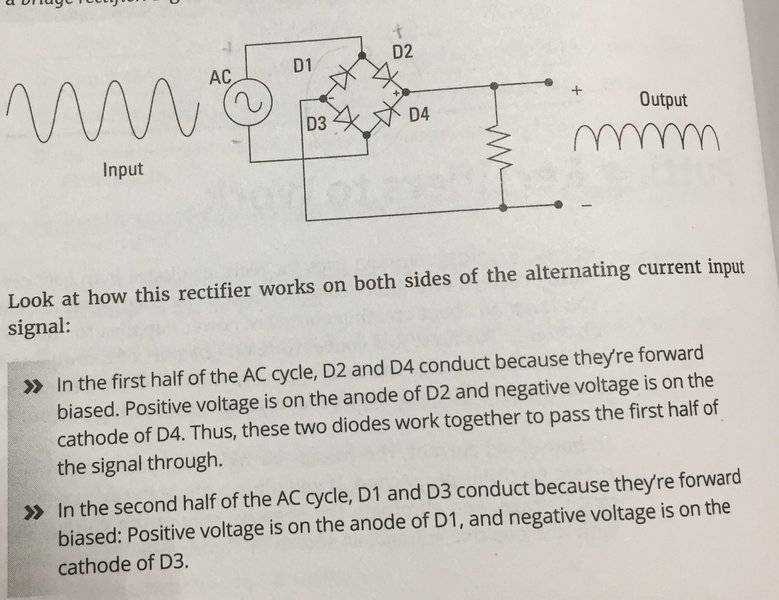
IMG_0119 (2).jpg

In this diagram he says the D2 and D4 diode are forward biased. But, doesn't the current flow through D2, goes through the resistor, and then flows through D3 meaning that D2 and D3 are the ones that are foward bias in the up cycle and D1 and D4 are forward bias in the down cycle? Is this a typo or am I just misinterpreting the diagram.

My next question was for when I actually built the bridge rectifier on a breadboard. I used a 9v AC power adapter and it works. I used my multimeter and got an accurate DC reading so I'm confident I hooked the circuit up correctly. I'm just confused on how it works. Here is the circuit:
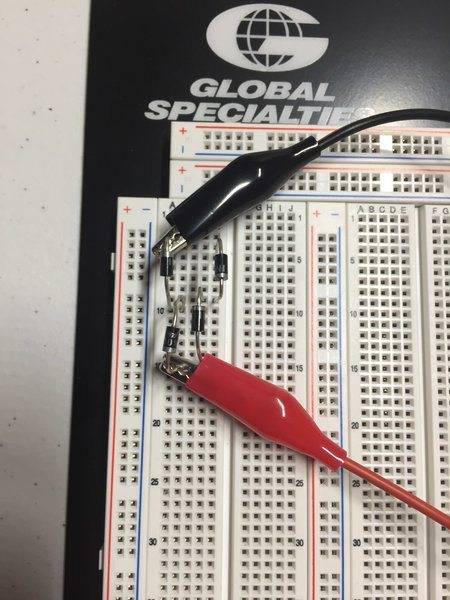
Breadboard_diagram.jpg

The circuit uses 4 diodes. The two alligator clips you see are attached to the leads of my 9v AC power adapter. To me it seems that when the positive current goes through the red alligator clip, it can't go through the diode which has its cathode (silver stripe) connected to B15 since it's reverse bias, instead it can only travel through the diode next to it, the one with its anode at D15. However, once it travels through it I see no place for the current to go. The diode whose cathode is connected to E9 is reverse bias, and the diode next to it is on a different row (cathode connected to A10 not A9). How does this bridge rectifier work? Can somebody please explain it to me I'm very confused. Thanks.
 

Attachments

  • IMG_0119 (2).jpg
    IMG_0119 (2).jpg
    57 KB · Views: 1,067
  • Breadboard_diagram.jpg
    Breadboard_diagram.jpg
    49.7 KB · Views: 1,257
Last edited:
Engineering news on Phys.org
You are right.
Row 9 is the Positive, or +, output of the bridge.
Row 10 is the Negative, or -, output of the bridge.

The load (the resistor in the book) would connect from Row 9 to Row 10.

The book got it rather confused. The person writing the text and the person drawing the diagram didn't talk to each other and the editor didn't catch it.
In the drawing, you need to swap the D3 and D4 labels, then it all works out.
(The writer probably labeled the diodes going clockwise around the circuit, while the draftsman automatically considered the labelling as text and started a new line for the lower diodes.)

By the way, what book and what author is that. We like to be aware of such things so we can pay close attention to those publications in future questions. (when we remember!)

Cheers,
Tom
 
  • Like
Likes jim hardy, Averagesupernova, anorlunda and 1 other person
Tom.G said:
You are right.
Row 9 is the Positive, or +, output of the bridge.
Row 10 is the Negative, or -, output of the bridge.

The load (the resistor in the book) would connect from Row 9 to Row 10.

The book got it rather confused. The person writing the text and the person drawing the diagram didn't talk to each other and the editor didn't catch it.
In the drawing, you need to swap the D3 and D4 labels, then it all works out.
(The writer probably labeled the diodes going clockwise around the circuit, while the draftsman automatically considered the labelling as text and started a new line for the lower diodes.)

By the way, what book and what author is that. We like to be aware of such things so we can pay close attention to those publications in future questions. (when we remember!)

Cheers,
Tom
Thanks a bunch Tom, that helped a lot. But, if the circuit doesn't have a load (such as a resistor connecting row 9 to row 10, then how does the current get back to the AC source. Doesn't current have to get back to the source in order to complete the circuit? In the diagram the book gave, if you removed the resistor that connected the positive and negative end of the bridge, it would be an incomplete circuit would it not? How does this differ than the circuit I created on my breadboard.
 
Also, the book I'm reading is Electronics for Dummies by Doug Lowe
 
Alex Hughes said:
if the circuit doesn't have a load (such as a resistor connecting row 9 to row 10, then how does the current get back to the AC source.
Without a load there is no current leaving the circuit, so there is none to get back to the circuit.

Here is a not-very-good description, but it often helps when first trying to get your brain wrapped around the initial concepts. If you turn off a water faucet no water comes out so there is no water to go down the drain to be recycled. There is still pressure in the pipe though (similar to voltage in the circuit). As you get deeper into Electronics and Physics you will get much more detailed, and sometimes confusing, approaches to "what is really happenning."

Enjoy the journey!
Tom
 
  • Like
Likes jim hardy and Alex Hughes
Alex Hughes said:
In the diagram the book gave, if you removed the resistor that connected the positive and negative end of the bridge, it would be an incomplete circuit would it not?
Yes it would be an incomplete, aka "open" , circuit.

Alex Hughes said:
How does this differ than the circuit I created on my breadboard.
It doesn't. You appear to have grasped the concepts .

Keep up the good work !
 
  • Like
Likes Alex Hughes

Similar threads

  • · Replies 10 ·
Replies
10
Views
4K
  • · Replies 7 ·
Replies
7
Views
2K
  • · Replies 8 ·
Replies
8
Views
2K
  • · Replies 15 ·
Replies
15
Views
2K
  • · Replies 37 ·
2
Replies
37
Views
7K
  • · Replies 21 ·
Replies
21
Views
7K
Replies
12
Views
2K
Replies
11
Views
2K
  • · Replies 15 ·
Replies
15
Views
3K
  • · Replies 9 ·
Replies
9
Views
5K