Build a Square Wave Oscillator: A Beginners' Guide to DIY Circuit Building

  • Thread starter Thread starter omonoid
  • Start date Start date
  • Tags Tags
    Circuit
Click For Summary

Discussion Overview

The discussion revolves around building a square wave oscillator circuit, focusing on component selection, schematic interpretation, and troubleshooting issues encountered during the assembly process. Participants share their experiences and seek advice on various aspects of circuit building, including resistor values, potentiometer connections, capacitor orientation, and general soldering techniques.

Discussion Character

  • Exploratory
  • Technical explanation
  • Homework-related
  • Debate/contested

Main Points Raised

  • One participant questions the discrepancy between the parts list and the schematic regarding resistor values, suggesting that using 1kΩ resistors may increase current draw.
  • Another participant advises that the 500kΩ potentiometer is necessary for frequency variation, while a 10kΩ pot could be used in a different position.
  • There is a discussion about the orientation of capacitors, with some participants stating that the 1000 pF capacitor can be placed in either direction, while the 100μF capacitor is deemed unsuitable for its intended position.
  • Participants express confusion about the connections on the potentiometer and clarify that it is acceptable to use a two-lead pot as long as the middle lead is not missing.
  • One participant suggests using a wall-wart power supply instead of batteries to reduce costs over time.
  • There is a proposal to modify the circuit design to include a +4.5V supply and clarification on the number of 33kΩ resistors needed.
  • A participant reports that their circuit did not work as expected, attributing the issue to a potential mistake in using a 47Ω resistor instead of a 47kΩ resistor and seeks advice on reconfiguring the circuit.
  • Another participant notes that the 47kΩ resistor should not prevent the circuit from functioning and suggests checking the connections and the op-amp used.

Areas of Agreement / Disagreement

Participants express differing opinions on component choices and circuit configurations, with no consensus reached on the best approach to resolve the issues encountered. The discussion remains unresolved regarding the optimal component values and configurations for the oscillator circuit.

Contextual Notes

Participants highlight potential issues with the circuit design and component selection, including the need for specific resistor values and the implications of using incorrect components. There is also mention of the importance of verifying connections and the correct orientation of components.

Who May Find This Useful

This discussion may be useful for beginners in electronics, particularly those interested in building waveform generators or oscillators, as well as individuals seeking troubleshooting advice for DIY circuit projects.

omonoid
Messages
18
Reaction score
0
OK i have to build a waveform generator with adgujtable amp and freq. I have lots of soldering expericne, but no schematic reading experience.

I found this helpful guide to achieve what i want
http://www.instructables.com/id/Build-a-Square-Wave-Oscillator-Part-1-of-DIY-Mod/"
Here is the shematics (hard to read kinda)
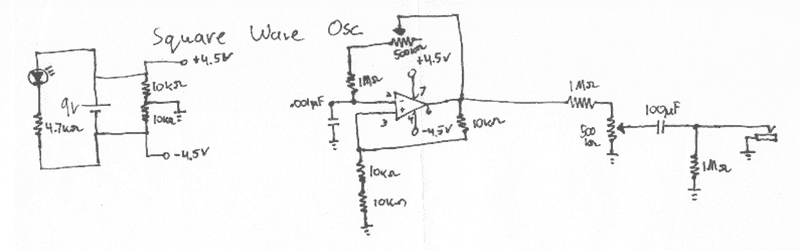
FG9MG8CGFRWMNFA.png


My basic questions so far are...

First, in the parts list it calls for 5x 1kΩ Resistors and no 10k ones, but the schematics show 10k ohm ones instead...I bought 5x 1kΩ ones so hopefully i can use them.

Second, I have plenty of 4.7k and 10k pots. It calls for 500k ones. I have 2 of these http://www.radioshack.com/product/index.jsp?productId=3012598, but they onoly have 2 pins instead of the standard 3 pins. Am i out of luck, or can i use a combonation of what i have?

Third can the capacitors go in any direction? How can you tell based on these schematics

Fourth DO the ground points all connect together basically

Last, how would you recommend soldering it all? I have a perfboard but none of the holes are connected. Should i use solder to make the leads between two things?

Thanks a ton in advance

Any suggestions help!
 
Last edited by a moderator:
Engineering news on Phys.org
It looks like the circuit would still work with 1 K resistors, however the circuit may draw nearly 10 times as much current from your battery.

We are very lucky to have access to very cheap electronic components, so I would suggest that you go back to the store and get the correct components.

Then next time you need a 1 K resistor, you will know where to find one.

The upper 500 K pot is used to vary the frequency. A smaller one will give you less variation.
So, you need one of those, too.

The pot on the output doesn't have to be 500 k so you could use your 10 K pot there, but put one of your 1 K resistors in series with it instead of the 1 Meg resistor.

Yes, the Earth points do have to be joined together.
So do all the other connections in the circuit, so if your perfboard doesn't connect them, you will have to do it with bits of wire, not just sloder. The cut ends of resistors make good wire bits for connecting things.


The 1000 pF capacitor can go in either way. The 100 uF capacitor is not suitable for that position. It is too big and it will not have a DC voltage on it, so I would get a 0.1 uF capacitor.
 
ok its kinda irritating that it said get 5 1k when you need 10k...but oh well one more trip to radio shack won't hurt

Im glad i won't have to buy more pots. So the 500k one i have have two leads, a middle one and a right side one. Does the wire coming from pin 2 of the op amp go into the right lead and the other in the center or vice versa?
[PLAIN]http://rsk.imageg.net/graphics/product_images/pRS1C-4471472w345.jpg\

The 1000 pF capacitor can go in either way. The 100 uF capacitor is not suitable for that position. It is too big and it will not have a DC voltage on it, so I would get a 0.1 uF capacitor.

Im confused. Are you saying the 100uF cap should not be used as directed in the schematics?

Is there any other things you would do different if you built this?

Thanks a ton vk6kro
 
Last edited by a moderator:
It doesn't matter that one of the leads of the pot is missing as long as it isn't the middle one.
So, yes, just connect to the two connecttions it does have.

That 100 uF is a bad choice for that position. If it got a voltage on it from something you connected it to, it could take several minutes to discharge.

After you get it going, you could make the capacitor switchable to get other frequencies.
Like this:
[PLAIN]http://dl.dropbox.com/u/4222062/switched%20capacitors.PNG

You could also consider getting a wall-wart power supply for it because the batteries will get expensive if you keep using them.
 
Last edited by a moderator:
Ok that all makes sense. In the future i may try to make it switch waveforms, maybe some sort of toggle between square, wave and sine, but for now ill keep it simple.

For the power supply i was planning on using a Dc 9v jack and just plug it into the wall

Thanks
 
Don't get any resistors yet. There are some problems with the circuit.

[PLAIN]http://dl.dropbox.com/u/4222062/Square%20wave%20Osc.PNG

The circuit above is looking more promising.
 
Last edited by a moderator:
So it looks like the only difference is some resistors and that added +4.5 volts. What is the Purpose of that?

Also i only need a total of 2 33k resistors right? The drawing shows 2 chanes with 2 on each chain, but you only wrote 1 33k on each chains. So I am assuming i only need 2 total
 
omonoid said:
So it looks like the only difference is some resistors and that added +4.5 volts. What is the Purpose of that?

Also i only need a total of 2 33k resistors right? The drawing shows 2 chanes with 2 on each chain, but you only wrote 1 33k on each chains. So I am assuming i only need 2 total

The 4.5 volts is the same one that goes to pin 7. It was just difficult to draw it like that.

Just two 33 K and a 47 K and a 0.1 uF capacitor.

The waveform is a square wave except above 5 KHz when it becomes triangular.

Seems like you could make a useful instrument out of it if you can borrow a frequency counter to calibrate it.
 
5Khz is a pretty high pitch right? What makes it change?

So for clarification, there will be a 33k resistor before the +4.5v gets to pin 7
 
  • #10
The new 33K resistor just connects to pin 7 as well as the +4.5 volts.

5 KHz is a pretty high pitch. Like a mosquito, I guess.
 
  • #11
ugh. I finished it all, tested...didn't work. The amplitude pot worked fine, but only noise came out

I looked for my error and found i used a 47 ohm resistor instead of 47k. careless mistake, but radio shack is closed and it would be great to finish tonight. Is there a way of reconfiguring things to replace the 47k ohm resistor with one i have?

I'm currently searching through old tvs and vcrs for the golden 47k resister
 
  • #12
The 47K should not stop it working. It is only there to stop the coverage being too great when the pot resistance is reduced towards zero.

If you set the pot resistance to maximum, the frequency should be about 1000 Hz, according to my simulator.

If you have the inverting and non inverting inputs of the IC wrongly connected, this would stop it working.

Which opamp are you using, and how are you checking the output?

Check that all the wires go where they are supposed to go.
 
  • #13
Im using the radio shack 741 op amp. I haven't checked the output. All i did was give it power, and p[lug it into a headphone jack. The headphones just buzzed, but the 10k vol pot changed the vol of the buzz.

Im about to go to bed, so i can't recheck now.

sine I am using the same perfboard, I've been using these pictures as a guideline for my own. I matched most of it up to this. One thing that confused me was replacing the 2 10ks with one, because some stuff would be skiped over using one resister vs 2. (see picture for what i mean)

http://www.instructables.com/files/orig/FBJ/5FKP/GFRWMOU7/FBJ5FKPGFRWMOU7.jpg
http://www.instructables.com/files/orig/FLK/SKKY/GFRWMOU6/FLKSKKYGFRWMOU6.jpg
 

Similar threads

Replies
16
Views
3K
  • · Replies 1 ·
Replies
1
Views
3K
  • · Replies 8 ·
Replies
8
Views
18K
  • · Replies 31 ·
2
Replies
31
Views
20K
Replies
12
Views
8K
  • · Replies 14 ·
Replies
14
Views
11K
  • · Replies 3 ·
Replies
3
Views
2K