By using Gauss' law, can the electric field be p/(pi*ε*r^2)

Click For Summary

Homework Help Overview

The discussion revolves around applying Gauss' law to determine the electric field, specifically questioning the validity of a proposed expression involving charge density and geometric considerations. The subject area is electromagnetism, focusing on electric fields and flux calculations.

Discussion Character

  • Exploratory, Assumption checking, Conceptual clarification

Approaches and Questions Raised

  • Participants explore different methods for calculating electric flux, questioning whether to use the area or circumference of a circle. There are discussions about the dimensional accuracy of the proposed methods and the implications of radial fields on flux through closed surfaces.

Discussion Status

Participants are actively engaging with the problem, offering various perspectives on the methods to apply and the assumptions involved. Some guidance is provided regarding the need to consider total flux through all surfaces, while others highlight potential ambiguities in the methods discussed.

Contextual Notes

There are indications of confusion regarding the surface area calculations for a cylinder and the implications of radial symmetry on the flux through end caps. The discussion reflects a mix of established principles and uncertainties in application.

adamaero
Messages
109
Reaction score
1
Homework Statement
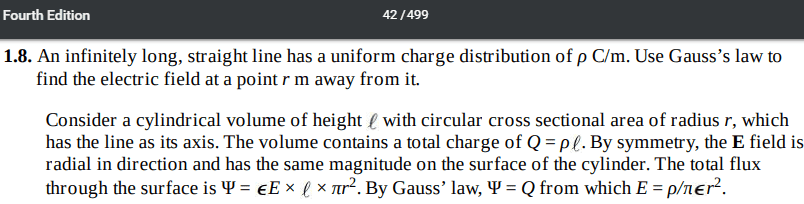
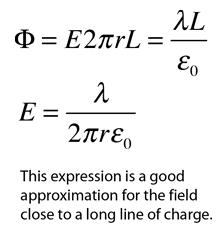
By using Gauss' law, can the electric field be p/(pi*ε*r^2) instead of p/(2*pi*ε*r) where "p" is the charge distribution?
Relevant Equations
Q = p*l
Which is better to use? The equation for the area or the circumference of a circle?
1564439256948.png

Schaum's Electromagnetics (4 ed) by Edminister
vs
1564439431674.png

http://hyperphysics.phy-astr.gsu.edu/hbase/electric/elecyl.html
 
Physics news on Phys.org
You should be able to figure out the answer to your question on your own. Do you know how to calculate flux?
 
You could also check dimensions, which every physics student should. Of course, that is not what is asked for here but you should nevertheless always do it.
 
Note that you must add both the flux through the end caps as well as that through the lateral area to get the total flux through a closed surface. However, the field is radial and therefore the flux theough the end caps is zero.
 
vela said:
You should be able to figure out the answer to your question on your own. Do you know how to calculate flux?
The flux in the second way is easy, the first method, however, is somewhat ambiguous. It is suggesting that ##\rho=r/2##.
 
The first method seems simply wrong; it assumes the surface area of a cylinder is πr2L, rather than 2πrL. The answer is dimensionally wrong.
 
  • Like
  • Sad
Likes   Reactions: vela, archaic and adamaero

Similar threads

  • · Replies 26 ·
Replies
26
Views
3K
Replies
3
Views
2K
Replies
9
Views
1K
Replies
6
Views
2K
  • · Replies 1 ·
Replies
1
Views
2K
Replies
12
Views
3K
Replies
11
Views
2K
Replies
2
Views
1K
  • · Replies 6 ·
Replies
6
Views
2K
Replies
10
Views
4K