Gauss' Law: Understand How to Calculate Flux

Click For Summary
SUMMARY

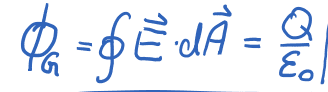
Gauss' Law is essential for calculating electric flux in electrostatics. There are two primary formulas: the integral form, flux = ∫E·ds, and the differential form, flux = Q/ε0. The integral form is used when the electric field (E) is known, while the differential form is applicable when the charge (Q) enclosed by the surface is known. Understanding when to apply each formula is crucial for accurate calculations in physics.

PREREQUISITES
  • Understanding of electric fields and their properties
  • Familiarity with the concept of electric charge
  • Basic knowledge of calculus for integration
  • Knowledge of ε0 (epsilon naught), the permittivity of free space
NEXT STEPS
  • Study the derivation of Gauss' Law and its applications in electrostatics
  • Learn about the concept of electric flux and its significance in physics
  • Explore examples of applying Gauss' Law to different symmetrical charge distributions
  • Investigate the relationship between electric fields and potential energy in electrostatics
USEFUL FOR

Students of physics, educators teaching electromagnetism, and anyone looking to deepen their understanding of electric fields and Gauss' Law.

sayuri2009
Messages
13
Reaction score
2
Homework Statement
Gauss Law for flux
Relevant Equations
flux = Integration E ds = Q / e0
Hello everybody

To calculate the flux for the electric field I need the gauss law. There are two formula one with the integration over some area and the other is Q/e0. When do I have to use which one?
1609694547736.png
 
Physics news on Phys.org
sayuri2009 said:
Homework Statement:: Gauss Law for flux
Relevant Equations:: flux = Integration E ds = Q / e0

Hello everybody

To calculate the flux for the electric field I need the gauss law. There are two formula one with the integration over some area and the other is Q/e0. When do I have to use which one?
View attachment 275550
I depends on what is given to you. If you know the electric field, you do the integral to find the flux. If you know the charge enclosed by the surface, you divide that charge by ε0 and you have the flux through the surface.
 
  • Like
Likes   Reactions: sayuri2009

Similar threads

  • · Replies 22 ·
Replies
22
Views
3K
  • · Replies 12 ·
Replies
12
Views
1K
  • · Replies 5 ·
Replies
5
Views
2K
  • · Replies 2 ·
Replies
2
Views
2K
Replies
3
Views
1K
  • · Replies 8 ·
Replies
8
Views
3K
Replies
10
Views
4K
  • · Replies 26 ·
Replies
26
Views
3K
Replies
9
Views
825