Calculate angular momentum? I almost got the right answer but it's wrong Help

Click For Summary
The discussion focuses on calculating angular momentum for a system involving a particle and a stick, where the participant initially applied the wrong formula for moment of inertia. They provided values for mass and angular velocity but miscalculated angular momentum by not using the correct formula for a distributed mass, specifically for the slender rod. Other participants pointed out that conservation of angular momentum does not apply in this scenario and emphasized the need to calculate the moment of inertia accurately. They suggested using calculus or reference tables to find the appropriate moment of inertia for the stick. Accurate calculations are essential for determining the correct angular momentum in such problems.
riseofphoenix
Messages
294
Reaction score
2
Calculate angular momentum? I almost got the right answer but it's wrong! Help!
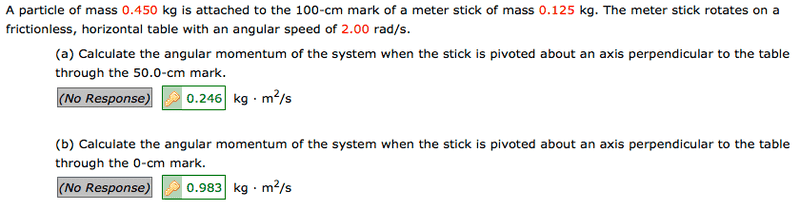
Number22.png


This is what I did for part a...

1. What is given

Particle
mp = 0.450 kg
ω = 2.00 rad/s
r = 1 m

Stick
ms = 0.125 kg
ω = 2.00 rad/s
r = 0.5 m

2. Angular momentum is conserved (Linitial = Lfinal) due to a lack of friction

0 = Lfinal

L = Iω
L = (mr2
L = (0.450 + 0.125)(0.52)(2)
L = (0.575)(0.25)(2)
L = 0.2875

Help!
 
Physics news on Phys.org
The formula you use for I is only good for a point mass. For a distributed mass (the meter stick) you must use a different formula, see,

http://www.physics.uoguelph.ca/tutorials/torque/Q.torque.inertia.html

and use the appropriate formulas for the slender rod.

So I_total = I_meter stick + I_mass


2. Angular momentum is conserved (Linitial = Lfinal) due to a lack of friction

0 = Lfinal
?? This problem does not involve conservation of angular momentum.

L = Iω
L = (mr2

You need to find the moment of inertia of the stick either by calculation using calculus or by consulting a table.
 
The book claims the answer is that all the magnitudes are the same because "the gravitational force on the penguin is the same". I'm having trouble understanding this. I thought the buoyant force was equal to the weight of the fluid displaced. Weight depends on mass which depends on density. Therefore, due to the differing densities the buoyant force will be different in each case? Is this incorrect?

Similar threads

  • · Replies 6 ·
Replies
6
Views
3K
  • · Replies 5 ·
Replies
5
Views
2K
  • · Replies 5 ·
Replies
5
Views
3K
  • · Replies 6 ·
Replies
6
Views
2K
  • · Replies 3 ·
Replies
3
Views
2K
  • · Replies 5 ·
Replies
5
Views
6K
Replies
2
Views
2K
Replies
1
Views
2K
  • · Replies 4 ·
Replies
4
Views
2K
  • · Replies 7 ·
Replies
7
Views
2K