Calculate double integral of the intersection of the ellipse and circle

Click For Summary
SUMMARY

The discussion focuses on calculating the double integral of the function f(x,y) = a0 + a1y + a2x + a3xy over the intersected area of an ellipse and a circle. The participants suggest using polar coordinates, specifically x = r cos(θ) and y = r sin(θ), to transform the equations for integration. The equation of the circle is defined as (x - x0)² + (y - y0)² = r², and the integration limits are determined by the intersection points of the two shapes. The inner integral should use the ellipse's equation as the lower limit and the circle's equation as the upper limit for y.

PREREQUISITES
  • Understanding of double integrals in calculus
  • Familiarity with polar coordinates and transformations
  • Knowledge of the equations of ellipses and circles
  • Ability to determine intersection points of geometric shapes
NEXT STEPS
  • Study the method for calculating double integrals over irregular regions
  • Learn how to derive the equations of ellipses and circles in polar coordinates
  • Research techniques for finding intersection points of curves
  • Explore the use of numerical methods for evaluating double integrals
USEFUL FOR

Mathematicians, physics students, and engineers involved in calculus, particularly those working on problems related to integration over complex geometric shapes.

zs96742
Messages
4
Reaction score
0
how to calculate the double integral of f(x,y) within the intersected area?

f(x,y)=a0+a1y+a2x+a3xy

The area is the intersection of an ellipse and a circle.
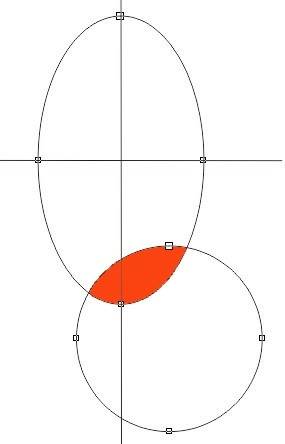
attachment.php?attachmentid=54378&stc=1&d=1357046899.jpg


Any help will be appreciated, I don't know how to do this.

can I use x=racosθ,y=rbsinθ to transformer the ellipse and circle?
If I can, what's the equation for the circle?
what's the range for r while calculating.
 

Attachments

  • 1.jpg
    1.jpg
    7.6 KB · Views: 1,154
Last edited:
Physics news on Phys.org
Well, it's your circle! I don't see how anyone else can tell you what its equation is. The equation of a circle with center at (x_0, y_0) and radius r is, of course, (x- x_0)^2+ (y- y_0)^2= r^2. How to integrate depends on exactly how the two figures overlap. x= r cos(\theta), y= r sin(\theta) assumes that r is measured from (0, 0). That might be useful if you were to "translate" your system so that the center of the circle is at the origin.
 
HallsofIvy said:
Well, it's your circle! I don't see how anyone else can tell you what its equation is. The equation of a circle with center at (x_0, y_0) and radius r is, of course, (x- x_0)^2+ (y- y_0)^2= r^2. How to integrate depends on exactly how the two figures overlap. x= r cos(\theta), y= r sin(\theta) assumes that r is measured from (0, 0). That might be useful if you were to "translate" your system so that the center of the circle is at the origin.

Yes, I forgot this, the center of the circle and the ellipse, the radius, the a and b are all known. That means I can calculate the intersection points.

If you chose the circle center as the origin, what's the equation for the ellipse?
 
From the picture and your previous remark, I suggest the following.

Get the x values of the intersection points - outer integral in x.

Use the y = for the ellipse as the lower and the y = for the circle as the upper limit - inner integral in y.
Since y is defined as a square root for both figures, make sure you pick the correct sign.
 
Last edited:
mathman said:
From the picture and your previous remark, I suggest the following.

Get the x values of the intersection points - outer integral in x.

Use the y = for the ellipse as the lower and the y = for the circle as the upper limit - inner integral in y.
Since y is defined as a square root for both figures, make sure you pick the correct sign.

In this case, I have to separate the area, any chance I can use polar coordinate?
 
zs96742 said:
In this case, I have to separate the area, any chance I can use polar coordinate?

What is the need to separate? It seems to me polar coordinates make it more complicated.

I also realized later, the y integral is trivial, since the integrand is 1. All you need to do is write the x integrand as the difference between the equation for y of the circle piece minus the equation for the ellipse piece.
 

Similar threads

  • · Replies 4 ·
Replies
4
Views
2K
  • · Replies 11 ·
Replies
11
Views
3K
  • · Replies 2 ·
Replies
2
Views
3K
  • · Replies 24 ·
Replies
24
Views
4K
  • · Replies 1 ·
Replies
1
Views
2K
  • · Replies 5 ·
Replies
5
Views
3K
  • · Replies 2 ·
Replies
2
Views
2K
  • · Replies 29 ·
Replies
29
Views
5K
  • · Replies 10 ·
Replies
10
Views
3K
  • · Replies 3 ·
Replies
3
Views
2K