Calculate Meeting Time for Equilateral Triangle Turtles | Classic Problem Solved

  • Context: Undergrad 
  • Thread starter Thread starter jpas
  • Start date Start date
Click For Summary
SUMMARY

The problem of calculating the meeting time for turtles positioned at the vertices of an equilateral triangle of side length L, each moving with velocity V towards the next turtle, has been solved with definitive results. The correct time for the turtles to meet is established as t = 2L / 3V, which is 1.5 times longer than the initial incorrect calculation of L / 3V. The solution involves understanding the geometry of the triangle and the relative motion of the turtles, specifically using radial coordinates and the relationship between their velocities and distances.

PREREQUISITES
  • Understanding of equilateral triangle geometry
  • Familiarity with relative motion concepts
  • Knowledge of radial coordinates in motion analysis
  • Basic principles of calculus for deriving motion equations
NEXT STEPS
  • Study the application of radial coordinates in motion problems
  • Learn about relative velocity in multi-body systems
  • Explore geometric interpretations of motion in physics
  • Investigate the use of calculus in solving dynamic systems
USEFUL FOR

Mathematicians, physicists, and students interested in motion dynamics, particularly those exploring geometric problems and relative motion in multi-agent systems.

jpas
Messages
45
Reaction score
0
This is supost to be a classic. I solved it but my answer isn´t right and I can´t find out why. Hope you guys can help.

Imagine an equilateral triangle with one turtle on each side of lenth L. All turtles move with velocity V. Turtle 1 always directs its motion to turtle 2, turtle 2 to turtle 3, and turtle 3 to turtle 1, again. Calculate the time the turtles take to meet.


The movement will be something like this.
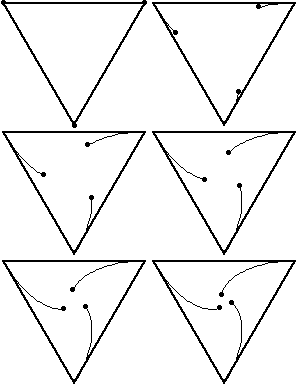
mice3.gif


Relative to turtle 2, turtle 1 will be in uniform rectilinear motion and its velocity will be:

\vec V_{12}=\vec v_1 - \vec v_2

\vec v_1 and \vec -v_2 make an angle of 60º degrees. So,

V_{12}= \frac{V}{\sqrt{3}}

Relative to turtle 2, turtle 1 will only travel the distance that separates it from the center of the triangle, which is \frac{L}{3}

So, t= \frac{v_{12}}{d} = \frac{L}{3V}

P.S.: I guess some of you might have already solved this problem. If not, I recommend it, though I got it wrong.
 
Last edited by a moderator:
Physics news on Phys.org
You have an equilateral triangle with side length L. The velocity of each turtle is v. The triangle defined by the 3 points (turtles) is always at any time t an equilateral triangle. Because the distance d between the turtles (the side of the equilateral triangle) at time t is

d=L-vt,

the turtles meet when

L-vt = 0

Bob S
 
Thanks for the answer.

Because the distance d between the turtles (the side of the equilateral triangle) at time t is

d=L-vt,

This isn´t true. How did you arrive to this equation?

The real time the turtles take is \frac{2L}{3V} , 1.5 times what you got.

Does anyone have other sugestions? I advise you, if you´ve got nothing to do, this is a fun problem!
 
You are correct. The easiest way to get the solution is to use radial coordinates. The direct distance from the apex to the center is (from plane geometry)

R = L/√3

For a radial step dr, the turtle must always travel a distance 2·v·dt/√3

So to travel a radial distance R=L/√3,

v·t = (L/√3)(2/√3) = 2L/3

t=2L/3v

Bob S
 
Hi Bob, thanks for the reply.

R = L/√3

Right. On my orginal post I had a typo. I meant this.


For a radial step dr, the turtle must always travel a distance 2·v·dt/√3

Can you explain this step? What is dr and how did you calculate it?
 
For a radial step dr, the turtle must always travel a distance 2·v·dt/√3.
jpas said:
Can you explain this step? What is dr and how did you calculate it?
A turtle step dx = v·dt is always at a 30-degree angle to the radial direction dr from the apex of the equilateral triangle (between the 3 turtles) to the center, because the radial direction always bisects the 60-degree angle of the equilateral triangle (even as the turtles move and the equilateral triangle rotates), and the instantaneous direction of v·dt is always parallel to one of the sides of the equilateral triangle. Using plane geometry, the longer side of a 30-60-90 degree triangle is equal to √3/2 times the hypotenuse. The turtle step v·dt is along the hypotenuse and the radial step projection dr is along the longer side.

So a radial step dr = (√3)·v·dt/2

Bob S
 

Similar threads

  • · Replies 2 ·
Replies
2
Views
2K
  • · Replies 7 ·
Replies
7
Views
2K
  • · Replies 2 ·
Replies
2
Views
684
  • · Replies 11 ·
Replies
11
Views
2K
  • · Replies 30 ·
2
Replies
30
Views
2K
  • · Replies 4 ·
Replies
4
Views
1K
  • · Replies 3 ·
Replies
3
Views
2K
  • · Replies 11 ·
Replies
11
Views
3K
Replies
4
Views
2K
  • · Replies 3 ·
Replies
3
Views
2K