Time Reversal Symmetry in Classical Physics

Click For Summary

Discussion Overview

The discussion revolves around the concept of time-reversal symmetry in classical physics, specifically in the context of free fall. Participants explore the implications of time reversal on the equations of motion and the initial conditions of a falling particle.

Discussion Character

  • Exploratory
  • Technical explanation
  • Debate/contested

Main Points Raised

  • One participant presents a mathematical formulation of free fall and questions the application of time-reversal symmetry, noting discrepancies when substituting negative time values.
  • Another participant clarifies that time reversal requires not only changing the time variable but also adjusting the initial conditions accordingly, asserting that accelerations remain unchanged.
  • Some participants argue that time-reversal does not yield new solutions to the equations of motion but rather modifies the initial conditions, leading to the same physical behavior.
  • There is a discussion about the implications of time-reversal symmetry in relation to the thermodynamic arrow of time and its apparent violation in certain physical interactions, particularly in weak interactions.
  • Participants discuss the arbitrary nature of the choice of the origin of time, suggesting that it is a matter of convention in Newtonian mechanics.
  • One participant expresses uncertainty about the implications of time-reversal on the evolution of the system, seeking clarification on the direction of time evolution in a time-reversed state.

Areas of Agreement / Disagreement

Participants generally agree that time-reversal symmetry modifies initial conditions rather than providing new solutions. However, there is ongoing debate regarding the implications of this symmetry in physical contexts, particularly concerning the thermodynamic arrow of time and its assumptions.

Contextual Notes

Some participants note that the discussion involves unresolved assumptions about the nature of time and the implications of time-reversal symmetry, particularly in relation to thermodynamics and causal arrows of time.

Who May Find This Useful

This discussion may be of interest to those studying classical mechanics, time-reversal symmetry, and the philosophical implications of time in physics.

hokhani
Messages
601
Reaction score
22
TL;DR
I don't understand how does time-reversal applies to the free-fall problem.
I try to justify time-reversal symmetry in a very simple classical problem; Free Fall. The position, ##x##, and the velocity, ##v## are obtained versus time from the equation ##-g=\ddot x##. So, if we consider the primary conditions as ##t_0,x_0,v_0## it is clear that, ##x(t)=\frac{1}{2}(-g)(t-t_0)^2+v_0(t-t_0)+x_0## and ##v(t)=-g(t-t_0)+v_0## give the position and velocity at any time. Plesase see the attached figure. AT the point (1) we have$$x(t_1)=x_1=\frac{1}{2}(-g)(t_1-t_0)^2+v_0(t_1-t_0)+x_0$$ and $$v(t_1)=v_1=-g(t_1-t_0)+v_0.$$ We expect by applying time reversal to obtain ##x(-t_1)=x(t_1)## and ##v(-t_1)=-v(t_1)##. However, inserting ##-t_1## instead of ##t_1## doesn't neccesarily fulfill this requirement:
$$x(-t_1)=\frac{1}{2}(-g)(-t_1-t_0)^2+v_0(-t_1-t_0)+x_0$$ and $$v(-t_1)=-g(-t_1-t_0)+v_0.$$ I would like to know what is my mistake? FFP.png
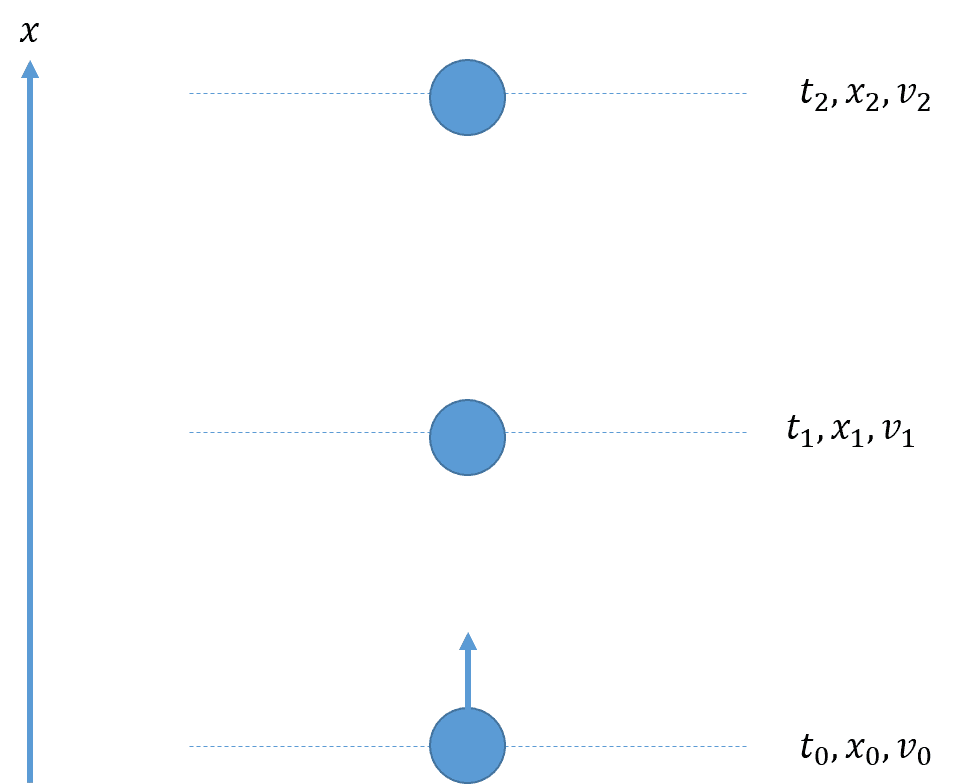
FFP.png
 
Physics news on Phys.org
It's a bit a subtle point you stumbled on. Time reversal doesn't simply mean that you make ##t \rightarrow t'=-t##, but you also have to start with the time-reversed initial condition, i.e., ##x_0'=x_0## and ##v_0'=-v_0##. Also accelerations don't change under time-reversal, i.e., ##g'=g##. Now take your solutions (for convenience I set ##t_0=0##)
$$x(t)=-\frac{g}{2} t^2 + v_0 t +x_0.$$
Now let's look at the time-reversed process. Just make the above transformations of both the time variable and the initial conditions. Then you get
$$x'(t')=x(t)=x(-t')=-\frac{g'}{2} t^{\prime 2} -v_0 t' + x_0'=-\frac{g}{2} t^{\prime 2} + v_0' t' + x_0',$$
which is the same as the original solution. This reflects time-reversal invariance of your mechanical system.
 
  • Like
  • Informative
Likes   Reactions: haushofer, hokhani and (deleted member)
vanhees71 said:
It's a bit a subtle point you stumbled on. Time reversal doesn't simply mean that you make ##t \rightarrow t'=-t##, but you also have to start with the time-reversed initial condition, i.e., ##x_0'=x_0## and ##v_0'=-v_0##. Also accelerations don't change under time-reversal, i.e., ##g'=g##. Now take your solutions (for convenience I set ##t_0=0##)
$$x(t)=-\frac{g}{2} t^2 + v_0 t +x_0.$$
Now let's look at the time-reversed process. Just make the above transformations of both the time variable and the initial conditions. Then you get
$$x'(t')=x(t)=x(-t')=-\frac{g'}{2} t^{\prime 2} -v_0 t' + x_0'=-\frac{g}{2} t^{\prime 2} + v_0' t' + x_0',$$
which is the same as the original solution. This reflects time-reversal invariance of your mechanical system.
Many thanks for your reply.
However, I still don't know the time evolution of the system in the time-reversal state. Better to say, consider the following figure. The left panel shows the motion in the direct time and the right panel, in the time-reversal states. What is the time evolution of the system in the right panel? The particle must fall from the point with ##-t## to the point ##-t_0## or vice versa?
In other words, as shown in the schematic clock at the rightmost figure, which direction is the time evolution in the time-reversal state (between the two times ##-t## and ##-t_0##) ?

1587739939482.png
 
Time evolution is always forward i.e. from smaller to larger values of ##t##, i.e., your time-reversed situation describes free fall of a particle starting at time ##t##.
 
  • Like
Likes   Reactions: etotheipi
vanhees71 said:
Time evolution is always forward i.e. from smaller to larger values of ##t##, i.e., your time-reversed situation describes free fall of a particle starting at time ##t##.
So, it seems that time-reversal doesn't give a new solution to equation ##x\ddot =-g ##, and only changes the initial conditions. We could set the initial conditions at the top with a downward velocity, and then exactly the same motion would occur. In other words, Time reversal doesn't present a new motion!
 
  • Like
Likes   Reactions: vanhees71
That's the point! It leads again to a solution of the equations of motion, which means that Newton's law for the given force law is invariant under time reversal.
 
  • Like
Likes   Reactions: PeroK and hokhani
Time reversal symmetry means exactly the following trivial fact: if ##x(t)## is a solution to the equation ##\ddot x=f(x),\quad x\in\mathbb{R}^m## then ##x(\hat t-t)## is also a solution to the same equation. Sure ##x(t)## must be defined on an interval consistent with the constant ##\hat t## and bla-bla other evident math details
 
  • Like
Likes   Reactions: etotheipi and vanhees71
Well, it's mathematically trivial, but physicswise it's not. First of all, how do you explain that in everyday life there's an obvious breaking of this symmetry. It's not as trivial as it sounds since the "thermodynamic arrow of time" from Boltzmann's H Theorem is not an explanation but an assumption, because you assume the directedness of time in deriving the Boltzmann equation via making the assumption of "molecular chaos". I.e., all you prove is that the "thermodynamic arrow of time" is identical with the assumed "causal arrow of time".

In electromagnetism you also have to make the assumption of directedness of time and then choose the retarded solution over all other possible solutions of Maxwell's equations. The argument is pretty similar to the argument in deriving the H theorem, i.e., this defines a "radiation arrow of time", but it's again only using the assumption of the "causal arrow of time".

The only known violation of time-reversal invariance is due to the weak interaction, implying together with the CPT theorem of local QFTs that CP is violated in the standard model too. The only trouble is, it's not enough to explain our very existence (though there was some hope from the recent neutrino result by T2K):

https://www.nature.com/articles/s41586-020-2177-0
https://www.quantamagazine.org/neutrino-asymmetry-passes-critical-threshold-20200415/
 
vanhees71 said:
That's the point! It leads again to a solution of the equations of motion, which means that Newton's law for the given force law is invariant under time reversal.
How about the origin of the time, ##t=0##. Is it arbitrarily chosen?
 
  • #10
hokhani said:
So, it seems that time-reversal doesn't give a new solution to equation x¨=−gx\ddot =-g , and only changes the initial conditions
different initial conditions provide different solutions (existence and uniqueness theorem)
 
  • #11
hokhani said:
How about the origin of the time, ##t=0##. Is it arbitrarily chosen?
Sure, what you count as ##t=0## is just an arbitrary setting of your clock. In Newtonian mechanics time is translation invariant (which leads to energy conservation due to Noether's theorems).
 
  • Like
Likes   Reactions: hokhani
  • #12
vanhees71 said:
Sure, what you count as ##t=0## is just an arbitrary setting of your clock. In Newtonian mechanics time is translation invariant (which leads to energy conservation due to Noether's theorems).
So, I conclude that:
If we start at the initial time ##t=0##, then, follow the time direct (time reversal) motion, we would go toward later times by time evolution. However, the time-reversal motion would take the system behavior towards the last times.
Is this conclusion correct?
 
Last edited:

Similar threads

  • · Replies 4 ·
Replies
4
Views
2K
  • · Replies 12 ·
Replies
12
Views
2K
  • · Replies 3 ·
Replies
3
Views
2K
Replies
12
Views
1K
  • · Replies 23 ·
Replies
23
Views
3K
  • · Replies 5 ·
Replies
5
Views
3K
  • · Replies 49 ·
2
Replies
49
Views
4K
  • · Replies 6 ·
Replies
6
Views
2K
  • · Replies 25 ·
Replies
25
Views
2K
Replies
5
Views
3K